

Maintenance Checklist

Florian Bartholomäus, osapiens Expert | 9. February 2026 | Lesezeit 16 min.
Recurring equipment failures, rising maintenance costs, and overlooked compliance gaps are usually the result of blind spots in maintenance processes that go unchecked for too long. A structured maintenance audit form helps organizations uncover these issues early, before they escalate into downtime, safety incidents, or budget overruns.
Start with maintenance management









TRUSTED BY LEADING COMPANIES




ENTERPRISE-READY
 SAP Certification
 ISO 27001
 EU Hosting
 Entra ID & Okta
 Multi-Entity
Table of Contents
- Key Facts
- What is a Maintenance Audit?
- Why Maintenance Audits Matter for Compliance and Operational Resilience
- How to Prepare Your Maintenance Audit: Equipment and Asset Management Essentials
- Maintenance Audit Checklist: Reduce Equipment Downtime and Ensure Compliance
- Maintenance Audit Areas
- Who Should Be Involved in a Maintenance Audit?
- How osapiens HUB Supports Maintenance Management
- Conclusion: How Maintenance Audits Drive Compliance with Industry Regulations
- FAQ
This guide provides a practical maintenance audit framework. You’ll learn what a maintenance audit covers, why it matters for compliance and operational resilience, how to prepare effectively, and how to evaluate every critical area of your maintenance operations. The maintenance audit checklist in this guide is designed to be actionable, scalable, and suitable for both internal improvement initiatives and formal compliance audits. Digital tools such as osapiens HUB can further streamline audits by centralizing data, automating documentation, and making performance insights immediately accessible.
Key Facts
-
Systematic audits reduce downtime: Structured maintenance audits uncover inefficiencies in planning, execution, and asset management that contribute to unplanned outages and impact equipment uptime.
-
Significant cost savings: Regular audits can reduce maintenance costs by eliminating unnecessary preventive maintenance tasks and streamlining spare parts inventory through cost effective strategies.
-
Measurable performance improvement: Tracking KPIs like MTTR, MTBF, and unplanned downtime through systematic audits identifies improvement opportunities that keep operations running smoothly.
-
Platforms like osapiens HUB make audits faster, more accurate, and audit-ready through centralized data and real-time analytics.
What is a Maintenance Audit?
A maintenance audit is a comprehensive, systematic evaluation of an organization’s maintenance processes and maintenance performance. Audits examine how effectively your organization plans, executes, documents, and improves maintenance activities, helping keep operations running smoothly across all assets and facilities.
Maintenance audits go beyond basic compliance checks. They verify adherence to safety regulations, industry standards, and internal maintenance policies, helping organizations reduce regulatory risk, avoid fines, and prevent operational disruptions. By systematically reviewing maintenance practices, audits uncover gaps that often contribute to unplanned downtime and safety incidents.
Why Maintenance Audits Matter for Compliance and Operational Resilience
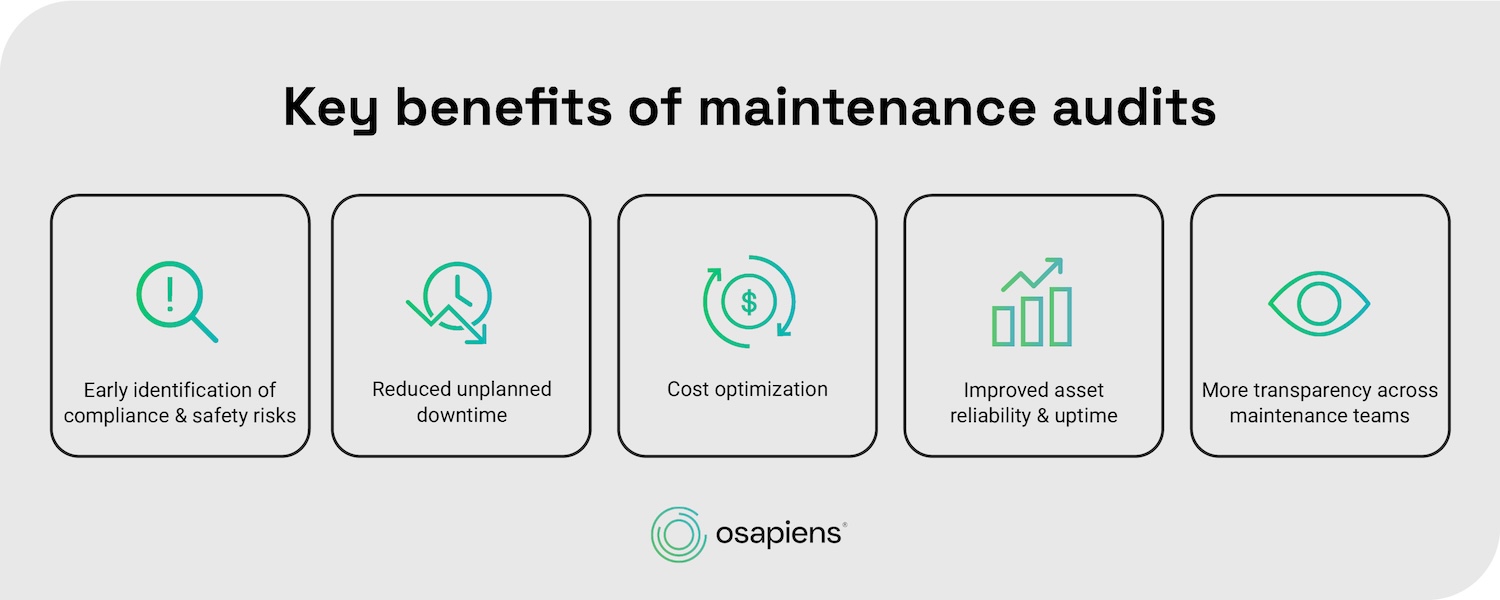
Maintenance audits transform reactive compliance into proactive risk management. By systematically reviewing maintenance policies, work execution, asset condition, and documentation quality, audits identify the gaps that lead to regulatory violations, equipment failures, and unplanned downtime.
Organizations that audit regularly reduce maintenance costs by eliminating wasteful practices, improve asset life through better preventive maintenance schedule adherence, and gain the transparency needed to make informed decisions. Effective audits also improve reporting maintenance issues, ensuring problems are documented and addressed through systematic corrective actions.
osapiens HUB for Maintenance centralizes all maintenance data, compliance records, and performance metrics in one platform, making your next audit faster, more structured, and less stressful for your team.
Stop Digging Through Spreadsheets During Audits
Scattered documentation, manual data collection, and incomplete records make every audit stressful and time-consuming. osapiens HUB centralizes all maintenance history, work orders, compliance records, and performance metrics in one platform.
Start with maintenance management
How to Prepare Your Maintenance Audit: Equipment and Asset Management Essentials
Effective preparation determines the quality and efficiency of your maintenance audit.
-
Start by defining clear audit objectives: Are you conducting a compliance check, pursuing process improvement, or focusing on cost reduction? Your objectives shape the entire audit approach.
-
Next, determine the audit scope by identifying which assets, locations, and timeframes you’ll examine. Prioritize critical assets that have the highest impact on operations, safety, or maintenance costs.
-
Gather all necessary documentation before the audit begins. This includes details such as work order management records, preventive maintenance schedule histories, equipment specifications, compliance records, and maintenance manual references for your most important assets.
-
Schedule the audit to minimize operational disruption, and communicate the audit purpose clearly to your maintenance team.
-
Create a preliminary timeline with specific milestones and assign clear responsibilities for who will conduct different audit components, provide information, and review findings.
Digital maintenance management systems like osapiens HUB for Maintenance simplify preparation by centralizing records, ensuring data accuracy, and providing quick access to historical information.
Stop Digging Through Spreadsheets During Audits
Scattered documentation, manual data collection, and incomplete records make every audit stressful and time-consuming. osapiens HUB centralizes all maintenance history, work orders, compliance records, and performance metrics in one platform. Start with maintenance management.
Maintenance Audit Checklist: Reduce Equipment Downtime and Ensure Compliance
This maintenance audit template serves as your roadmap to identify areas where current practices fall short, minimize downtime through better processes, and reduce costs by eliminating waste and inefficiency.
Maintenance Audit Checklist:
| Audit Area | Key Review Points |
|---|---|
| Maintenance Policies and Procedures | ☐ Maintenance policies are clearly documented and centrally accessible ☐ Policies align with industry standards and internal requirements ☐ Policies are reviewed and updated regularly ☐ Maintenance procedures reflect current equipment and regulations ☐ Repair logs, service reports, and downtime data support policy effectiveness ☐ Documented procedures match actual maintenance practices |
| Maintenance Planning and Preventive Strategy | ☐ Maintenance planning processes are standardized ☐ Preventive maintenance aligns with business and operational goals ☐ PM schedules are based on asset criticality and manufacturer guidance ☐ Usage patterns and historical failure data are considered ☐ Maintenance tasks are clearly defined (roles, parts, timing) ☐ Preventive maintenance reduces failures and downtime ☐ Fixed schedules are reviewed against usage-based alternatives |
| Work Order Management | ☐ Work orders include complete and accurate information ☐ Tasks are clearly described and assigned to qualified personnel ☐ Required parts, time estimates, and asset references are included ☐ Work orders are created promptly after issues are reported ☐ Prioritization reflects asset criticality and operational impact ☐ Backlogs are monitored and controlled ☐ Planned and unplanned work orders are analyzed separately ☐ Maintenance approach is predominantly proactive |
| Assets & Equipment | ☐ Asset register is complete and up to date ☐ Critical assets are clearly identified and prioritized ☐ Physical inspections identify wear, damage, or performance issues ☐ Asset performance aligns with expected specifications ☐ Safety features (e.g. emergency stops, guards) function correctly ☐ Maintenance history and lifecycle data reflect actual asset condition |
| Spare Parts & Inventory | ☐ Spare parts are clearly cataloged with standardized naming ☐ Inventory records match physical stock levels ☐ Critical spare parts are available when needed ☐ Stock levels avoid both excess inventory and shortages ☐ Procurement lead times are monitored and optimized ☐ Parts usage patterns are regularly reviewed ☐ Supplier performance (cost, quality, delivery) is evaluated ☐ Spare parts usage is traceable to assets and work orders |
| Digital Maintenance Systems and Technology Valuation | ☐ CMMS / EAM system is actively used across maintenance operations ☐ Key system features are fully utilized ☐ System integrates with ERP, procurement, or monitoring tools ☐ Digital tools are used in the field (mobile access) ☐ Manual or paper-based processes are minimized ☐ System supports work orders, PM scheduling, and reporting ☐ System improves KPIs such as MTTR, downtime, and maintenance cost ☐ Data quality is complete, accurate, and consistent |
| Maintenance Team Qualifications and Training | ☐ Required certifications and licenses are valid and up to date ☐ Training records are complete and regularly reviewed ☐ Training aligns with job roles and equipment requirements ☐ Safety and technical training is conducted regularly ☐ Skill gaps are identified and addressed ☐ Competency is verified through observation or performance reviews |
| Compliance & Safety | ☐ Maintenance activities comply with applicable regulations and standards ☐ Safety features on equipment are functional and maintained ☐ PPE is available and consistently used ☐ Hazardous materials are handled and documented correctly ☐ Inspections and certifications are current ☐ Compliance documentation is complete and audit-ready ☐ QM documentation meets ISO 9001 requirements (if certified) |
| Budget Allocation and Cost Analysis | ☐ Maintenance KPIs are clearly defined and standardized ☐ MTTR is tracked and benchmarked ☐ MTBF is tracked for critical assets ☐ Planned vs. unplanned maintenance ratio is monitored ☐ PM compliance rate meets target levels (>90%) ☐ Unplanned downtime is measured and analyzed ☐ KPIs are used for decision-making, not only reporting |
| Emergency Readiness | ☐ Emergency procedures are documented and accessible ☐ Staff are trained on emergency response protocols ☐ Emergency equipment is available and regularly tested ☐ Business continuity plans exist for critical assets ☐ Backup equipment is maintained and ready for use ☐ Past incidents and drills are reviewed for improvement actions |
Maintenance Audit Areas
The checklist above provides the specific evaluation points for your audit. This section explains the context behind each audit area.
Maintenance Policies and Procedures
This area examines whether your maintenance policies are clearly documented, accessible to your team, and regularly updated. The audit verifies that documented procedures match actual maintenance practices and align with current industry standards.
Maintenance Planning and Preventive Strategy
This section reviews how effectively maintenance activities are planned and whether preventive maintenance delivers real value. Assess whether planning processes are standardized, aligned with business goals, and supported by suitable tools.
Preventive maintenance schedules should be based on asset criticality, manufacturer guidance, usage patterns, and historical failure data. Tasks must be clearly defined and consistently executed. The goal is to confirm that preventive maintenance reduces failures and downtime rather than creating unnecessary cost, for example by relying on fixed schedules where usage-based maintenance would be more effective.
Work Order Management
This area reviews how efficiently work orders move from creation to completion. Auditors assess whether work orders contain complete information, are properly prioritized, and provide reliable documentation for compliance and analysis.
Effective work order management provides full visibility into maintenance activities and ensures reliable documentation for future analysis.
Stop digging through spreadsheets during audits
With osapiens HUB, your entire work order history is documented, traceable, and instantly accessible.
Asset Condition and Management
This section examines the physical condition of assets and the accuracy of asset records. Auditors verify that critical assets are properly identified, safety features function correctly, and maintenance history reflects actual equipment condition.
Spare Parts Inventory and Supply Control
This section evaluates how effectively spare parts are managed and whether inventory practices support reliable maintenance. The audit checks inventory accuracy, stock optimization, and supplier performance to ensure parts management is dependable.
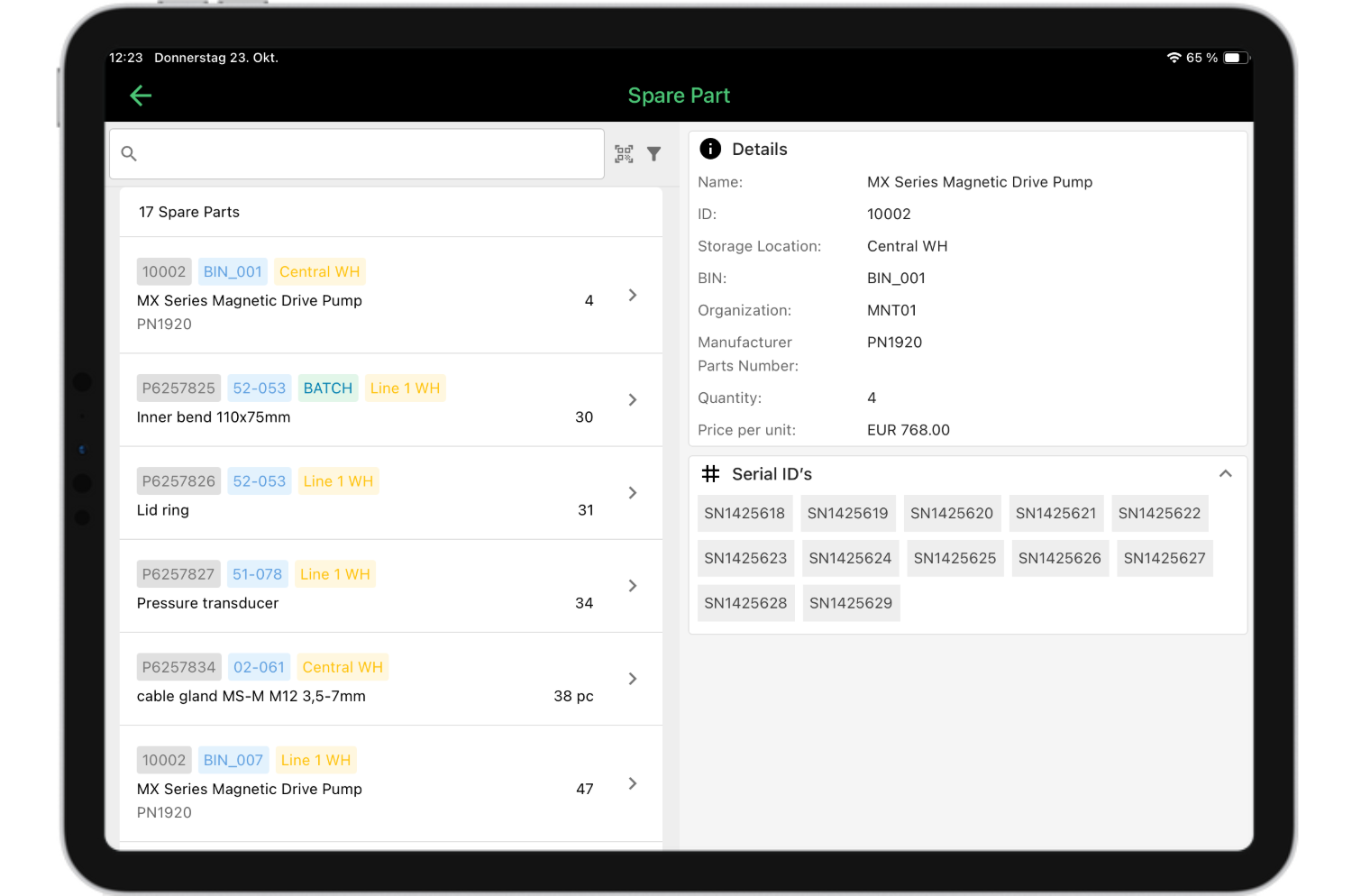
Effective spare parts management reduces downtime, improves cost control, and supports auditability through clear traceability. osapiens HUB provides real-time spare parts visibility, ensuring your team always knows what’s in stock and where it’s needed.
Digital Maintenance Systems and Technology Valuation
This section reviews whether digital maintenance systems effectively support daily operations and deliver measurable value.
Check if the system improves key performance metrics such as downtime, MTTR, and maintenance costs, and whether technicians consistently use digital and mobile tools instead of manual processes. Effective systems automate routine tasks, provide actionable insights, and rely on high-quality data to support better maintenance decisions.
Ready for Audit-Ready Maintenance Management?
Centralized maintenance records, automated compliance documentation, real-time KPI dashboards, and complete work order traceability, all in one platform with SAP integration and mobile access for technicians in the field.Start with maintenance management
Maintenance Team Qualifications and Training
This area verifies that maintenance personnel have current certifications, proper training, and the skills required for their roles. Proper training ensures that maintenance work is performed safely, efficiently, and in compliance with established standards.
Compliance, Safety Verification and ISO 9001
This section confirms that maintenance activities comply with safety regulations and industry standards. Auditors verify that safety features are functional, PPE is used consistently, and compliance documentation is audit-ready.
Beyond regulatory compliance, many organizations also maintain quality management certifications like ISO 9001, which place additional requirements on maintenance documentation and process control. ISO 9001 is the internationally recognized standard for quality management systems (QMS). It provides a framework for organizations to consistently deliver products and services that meet customer and regulatory requirements while continuously improving their processes. The standard is currently being revised: ISO 9001:2026 is scheduled to replace the 2015 edition, with a multi-year transition period so currently certified organizations can adopt the changes without losing their certification. (ISO).
For maintenance operations, ISO 9001 certification demonstrates that your organization follows documented procedures, maintains complete records, and systematically tracks and resolves quality issues. The standard’s emphasis on documentation and process control reduces errors, improves consistency across maintenance teams, and ensures that critical maintenance activities are never overlooked. ISO 9001 compliance also strengthens customer confidence and opens doors to new business opportunities, as many industries require suppliers and service providers to maintain certified quality management systems.
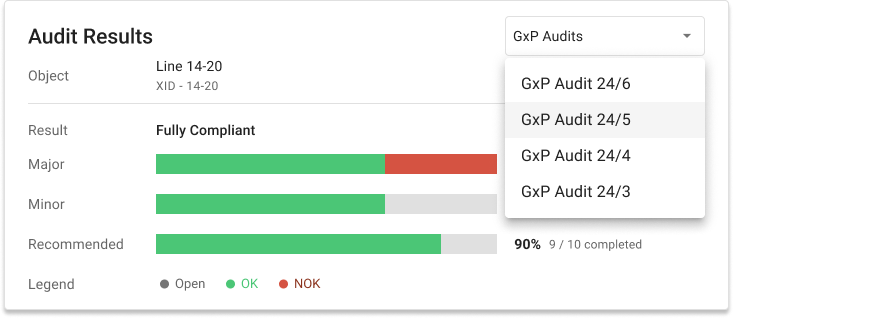
Meeting regulatory and quality management requirements demands comprehensive documentation and rapid access to compliance evidence during audits. osapiens HUB simplifies this by centralizing all relevant maintenance records in one platform, automatically documenting every work order, asset inspection, and maintenance activity.
Benchmark Performance Using KPIs and Metrics
This area focuses on maintenance performance measurement through KPIs like MTTR, MTBF, and PM compliance. The audit evaluates whether metrics are tracked consistently and used for decision-making rather than just reporting.
| Metric | Definition | Industry Benchmark |
|---|---|---|
| MTTR | Average time to complete repairs | Under 5 hours |
| MTBF | Average time between equipment failures | Varies by equipment type |
| PM Compliance | Percentage of scheduled maintenance completed on time | Above 90% |
| Unplanned Downtime | Hours of unexpected equipment unavailability | Below 5% of operating time |
These figures vary by industry and asset criticality, so treat them as reference points rather than fixed targets: independent research puts world-class PM compliance above 90 percent, while the broader manufacturing average sits closer to 85 percent (KPI Depot).
Budget Allocation and Cost Analysis
This section evaluates whether maintenance budgets are spent effectively and aligned with performance outcomes. Auditors examine how budgets are distributed across different maintenance types and identify opportunities to spend more efficiently without compromising reliability. The goal is to shift budgets away from low-value activities and toward maintenance efforts that deliver measurable improvements without compromising safety or reliability.
Emergency Response and Business Continuity Readiness
This area assesses how well the organization is prepared for maintenance-related emergencies and unexpected equipment failures. The audit verifies that emergency procedures are documented, practiced regularly, and that response equipment is functional and accessible. Past incidents and drills should be reviewed to identify response delays and improvement opportunities, ensuring the organization can react quickly and minimize operational impact during emergencies.
Who Should Be Involved in a Maintenance Audit?
Effective maintenance audits require cross-functional input from multiple stakeholders, each bringing unique perspectives and expertise. Key participants should include:
-
Maintenance managers for process oversight and historical context
-
Technicians and maintenance staff for hands-on operational insight
-
Operations managers to assess production impact and priorities
-
Procurement or inventory teams for spare parts and supplier data
-
Safety and compliance officers to verify regulatory adherence
-
External auditors or quality specialists for independent, objective assessments
For mandatory compliance audits, external consultants or brand compliance leaders may lead the process, while internal audits can be managed by your maintenance department with support from other departments.
How osapiens HUB Supports Maintenance Management
osapiens HUB for Maintenance addresses the key challenges identified in maintenance audits by centralizing all maintenance data in a single, accessible platform. This unified approach improves transparency across maintenance activities and makes audits faster, more structured, and more actionable.
The platform combines enterprise-grade functionality with flexible scalability, making it suitable for both large organizations and growing maintenance teams. osapiens HUB supports preventive maintenance planning to reduce downtime and enables systematic root cause analysis to address recurring failures and inefficiencies.
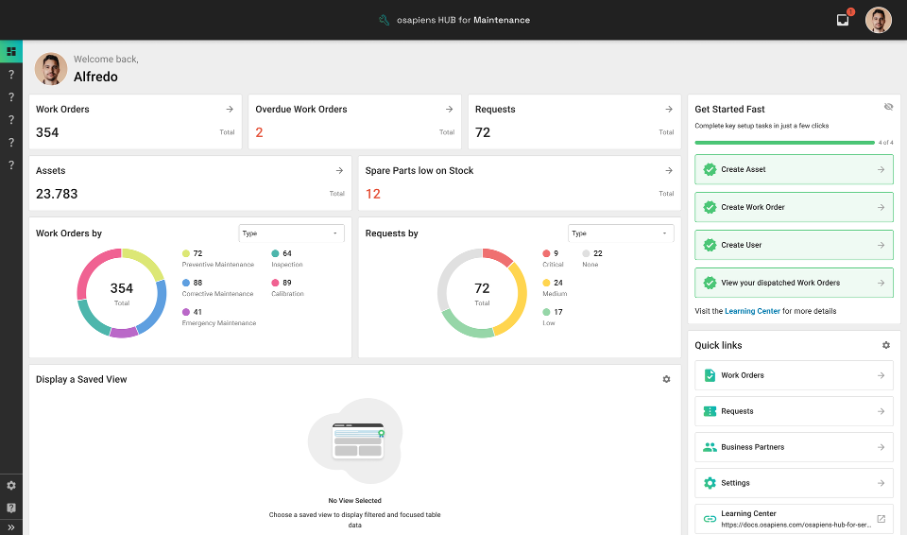
Key features that directly support maintenance audits include:
-
Centralized maintenance history and asset records for reliable asset management
-
Real-time work order tracking from request to completion
-
Automated preventive maintenance scheduling with compliance monitoring
-
Spare parts inventory visibility and usage analysis
-
Integrated compliance documentation and safety standards tracking
-
Performance dashboards providing insight into maintenance efficiency and trends
Beyond core audit support, osapiens HUB strengthens daily maintenance operations through:
-
Mobile-first workflows that allow technicians to document work directly in the field, ensuring accurate, up-to-date records and eliminating paper-based processes
-
Full SAP PM integration, enabling seamless data exchange with existing enterprise systems while avoiding data silos and manual transfers
-
Automated work order management that reduces administrative effort and frees maintenance teams to focus on value-adding tasks
-
Advanced reporting and analytics that simplify KPI tracking and support data-driven decisions
Together, these capabilities help organizations move from reactive maintenance to a transparent, efficient, and audit-ready maintenance management approach.

Pradeep Dalal, Product Director – Planning & Execution
★ ★ ★ ★ ★CONA Services
“Working with osapiens has been a positive experience for our company. Their innovative solutions and exceptional support have not only met but exceeded our expectations, paving the way for a successful partnership.”
With a freemium model available, osapiens HUB is accessible to organizations of all sizes: from small maintenance teams managing a few hundred assets to enterprise customers like Coca-Cola North America operating across 35 plants with 1,500 users.
Conclusion: How Maintenance Audits Drive Compliance with Industry Regulations
Systematic maintenance audits using a comprehensive maintenance audit template transform maintenance from reactive firefighting into strategic asset management that drives operational excellence. Regular audits identify hidden inefficiencies that drain budgets, ensure compliance with industry regulations and safety standards, reduce costs by eliminating wasteful practices, and improve operational resilience through better preventive maintenance and asset health management.
Proper preparation combined with software like osapiens HUB for Maintenance makes audits manageable rather than overwhelming, turning what seems like a daunting task into a structured process that delivers clear value. Start your next maintenance audit with confidence.
Ready for Audit-Ready Maintenance Management?
Centralized maintenance records, automated compliance documentation, real-time KPI dashboards, and complete work order traceability—all in one platform with SAP integration and mobile access for technicians in the field.
Start with maintenance management
FAQ
How Do You Conduct a Maintenance Audit?
Start by defining clear objectives and scope, then gather documentation including work order history and maintenance records. Conduct physical inspections of critical assets and interview maintenance personnel to understand actual practices. Evaluate processes against your audit checklist to verify compliance with standards, document findings with specific examples, and prioritize recommendations based on impact. Create an action plan with clear timelines and responsibilities. Digital CMMS platforms streamline data collection and analysis, making the process more efficient.
How Often Should You Perform a Preventive Maintenance Audit?
Conduct comprehensive maintenance audits at least annually to evaluate your entire maintenance management system. For critical systems with high safety risks or operational impact, perform focused audits quarterly or semi-annually. Audit frequency should reflect your operational complexity, regulatory requirements, and asset criticality. Organizations preparing for external compliance audits benefit from more frequent internal audits to identify areas needing improvement and ensure readiness when regulators arrive.
What Should a Preventive Maintenance Audit Cover?
A comprehensive preventive maintenance programs review should cover maintenance policies and documentation, preventive maintenance schedule adherence and execution quality, work order management effectiveness, asset condition and criticality assessment, spare parts inventory control, maintenance team qualifications and training, compliance with safety regulations and industry standards, performance metrics and KPIs tracking, budget allocation and cost effectiveness, and emergency procedures and preparedness. Effective audits examine both processes and outcomes to identify areas for continuous improvement.
What Documentation Is Required for a Maintenance Audit?
Essential documentation includes maintenance policies and documented procedures, complete work order history covering both planned and unplanned maintenance, preventive maintenance schedules with completion records, asset registers containing maintenance history and equipment records, spare parts inventory records with usage tracking, training and certification records for maintenance personnel, safety inspection reports and compliance documentation, performance metrics and KPI reports, and maintenance budget records with cost analysis. Digital CMMS platforms centralize this documentation, providing easier audit access and up to date information.
Which Types of Organizations Benefit Most from Maintenance Audits?
Any organization with significant physical assets benefits from systematic maintenance audits, but they deliver exceptional value for manufacturing facilities with complex equipment, energy and utilities providers managing critical infrastructure, healthcare facilities operating life-safety equipment, transportation and logistics companies maintaining vehicle fleets, and facilities management organizations responsible for multiple properties, therefore in need of a multi site maintenance management software. Asset-intensive industries where equipment downtime directly impacts revenue or safety gain the most value from regular, thorough maintenance audit processes.
Start using osapiens for free
Improve your uptime, extend the life of your equipment, and simplify work order management.
Book a demo
ENTERPRISE CAPABILITIES
- SAP ECC & S/4HANA Certified
- Infor & MS Dynamics
- Microsoft Entra ID / Okta
- ISO 27001 & 9001
- EU Cloud · Data Sovereignty
- Development, Test, and Production Environments
- Multi-Entity & Multi-Site
- Power BI Integration
- Audit Trail & Compliance
Related content
January 1, 2026
Lyophilizer Maintenance Checklist – Tasks, Tips & Template
January 1, 2026
Industrial Preventive Maintenance Checklist – Tasks, Documentation & Digital Execution
January 1, 2026
Automatic Sliding Door Preventive Maintenance Checklist – Tasks, Tips & Best Practices
January 1, 2026
Backhoe Maintenance Checklist – Tasks, Tips & Best Practices
January 1, 2026
Power Cable Maintenance Checklist – Tasks, Tips & Template

August 17, 2026
Best Fleet Maintenance Software for Enterprise: Top 5 in 2026

December 16, 2025
Top MaintainX Alternatives: Find the Best CMMS for Your Maintenance Teams in 2026
January 1, 2026
Lorry Maintenance Checklist – Tasks, Tips & Template
January 1, 2026
Electrical Substation Maintenance Checklist – Tasks, Safety & Digital Execution
January 1, 2026
Shot Blasting Machine Maintenance Checklist – Tasks, Tips & Digital Execution

April 7, 2026
CMMS Enterprise Rollout: How to Scale Maintenance Operations Across Multiple Sites
January 1, 2026