

Maintenance Checklist

Florian Bartholomäus, osapiens Expert | 1. January 2026 | Lesezeit 11 min.
Many press machine failures start with overlooked daily checks. Hydraulic fluid contamination, loose fasteners, and pressure fluctuations often show warning signs weeks before breakdowns—but only if technicians follow structured checklists consistently instead of relying on memory.
Create your checklist for free












TRUSTED BY LEADING COMPANIES




ENTERPRISE-READY
 SAP Certification
 ISO 27001
 EU Hosting
 Entra ID & Okta
 Multi-Entity
Table of Contents
- Press Machine Maintenance: Key Facts
- Why You Need a Press Machine Maintenance Checklist
- What to Include in Your Press Machine Maintenance Checklist
- Common Press Machine Problems Your Maintenance Checklist Prevents
- From Paper Checklist to Digital: How the osapiens HUB Automates Your Press Machine Maintenance Checklist
- FAQ
Press machines—whether hydraulic, mechanical, or pneumatic—deliver the force and precision that manufacturing depends on. But without structured maintenance, small issues like hydraulic leaks, misaligned rams, or contaminated fluid escalate into costly breakdowns and safety hazards.
A Press Machine maintenance checklist provides the systematic approach maintenance teams need to catch problems early, maintain consistent performance, and ensure audit-ready documentation. This guide explains what to inspect, when to perform maintenance tasks, and how digital tools like the osapiens HUB for Maintenance transform paper-based checklists into mobile, automated workflows that reduce downtime and extend equipment life.
Press Machine Maintenance: Key Facts
- Structured checklists reduce failures: Organizations implementing preventive maintenance on press equipment report significant reductions in unplanned downtime compared to reactive-only approaches, according to research on maintenance strategies.
- Hydraulic contamination is a leading cause of failure: Contaminated hydraulic fluid damages seals, valves, and cylinders—making fluid analysis and filter management critical preventive tasks.
- Safety compliance is mandatory: OSHA and ANSI B11 standards require documented inspection schedules for press machines, including weekly or monthly checks of safety systems and mechanical components.
- Digital execution improves consistency: Mobile CMMS platforms enable technicians to execute checklists at the point of work, capture photos, and automatically document completion—eliminating the gaps that occur with paper-based processes.
Why You Need a Press Machine Maintenance Checklist
Press machines operate under extreme mechanical and hydraulic stress. Without a structured maintenance approach, critical inspection points get overlooked, leading to failures that could have been prevented.
- Consistency across shifts and technicians: Checklists ensure that every technician performs the same critical inspections, regardless of experience level. Without documented procedures, maintenance quality depends on individual memory and judgment—creating gaps when experienced personnel are unavailable.
- Risk reduction through early detection: Hydraulic leaks, pressure fluctuations, and unusual vibrations signal developing problems. Structured checklists prompt technicians to check for these warning signs before they cause catastrophic failures or production-stopping breakdowns.
- Documentation for compliance and audit readiness: OSHA regulations and ANSI B11 standards require documented maintenance records. Checklists create the audit trails necessary to demonstrate compliance during inspections and support liability protection if incidents occur.
- Technician guidance and training support: Detailed checklists guide less experienced technicians through complex procedures, ensuring they don’t miss critical steps. This is especially important for hydraulic system maintenance, where improper technique can introduce contamination or create safety hazards.
- Standardization across multiple assets: Organizations operating multiple press machines benefit from standardized checklists that ensure consistent maintenance quality across all equipment, regardless of location or shift.
- Improved handover quality: When maintenance work spans multiple shifts, documented checklists ensure the next technician understands what has been completed and what requires follow-up—preventing duplicated effort or missed tasks.
What to Include in Your Press Machine Maintenance Checklist
Effective Press Machine maintenance checklists organize tasks by component or system rather than by frequency alone. This structure ensures technicians address all critical areas systematically.
The checklist below organizes maintenance tasks by the physical systems of the press machine. Actual inspection intervals depend on usage intensity, operating environment, and manufacturer recommendations—not arbitrary time-based schedules.
| Component / System | Inspection & Maintenance Tasks | Purpose |
|---|---|---|
| Hydraulic Fluid System | Check fluid level using sight gauge or dipstick; top up if below minimum mark; inspect for discoloration or contamination; verify oil specification matches manufacturer requirement; take samples for lab testing (viscosity, water content, particulate matter); replace oil if contaminated or after recommended operating hours | Prevent pump damage, maintain system pressure, avoid contamination-related failures |
| Hydraulic Pump & Motor | Listen for unusual noise (whining, knocking) during operation; inspect pump casing and connections for oil seepage or leaks; check for vibration at mounting points; ensure pump delivers specified pressure at rated RPM | Early detection of bearing wear, seal degradation, or pump failure |
| Filters & Cooling System | Change or clean hydraulic filters according to OEM guidelines; inspect filter differential pressure indicators; check fluid coolers for proper functioning; clean radiator vanes to maintain airflow; verify thermostat operation | Prevent filter bypass, maintain oil cleanliness, control operating temperature |
| Hoses, Seals & Connections | Inspect all hoses, seals, and fittings for minor leaks or wear; check for damp spots, bulging sections, or cracked fittings; tighten loose connections; replace degraded components before catastrophic failure | Maintain system pressure, prevent contamination, ensure workplace safety |
| Cylinders, Rams & Alignment | Evaluate cylinder rods for pitting or scratch marks; check for uneven ram movement or die contact; test press bed and ram alignment using precision measurement tools; verify load distribution; inspect for frame distortion | Maintain forming accuracy, prevent uneven wear, ensure product quality |
| Pressure Relief & Control Valves | Test relief valves with calibrated gauge to confirm they open at specified limit; inspect proportional valves and directional control valves for proper function; check for pressure fluctuations indicating valve drift | Prevent over-pressure conditions, maintain consistent force, protect system components |
| Pneumatic System (if applicable) | Verify air pressure remains within specification; drain air supply storage tanks of accumulated condensation and moisture; inspect inline filters, lubricators, and pressure regulators; check for air leaks in connections; verify air-pressure switch operation | Prevent moisture damage to clutch and brake systems, maintain consistent operation |
| Mechanical Components | Inspect bearings for wear; check fastener tightness on cylinder attachments, bolster-plate fasteners, and tie-rod nuts; apply lubrication to guide rails, pivot points, and sliding blocks per manufacturer specifications; verify spring condition in mechanical presses | Prevent mechanical failures, reduce friction, extend component life |
| Electrical & Control Systems | Assess electrical components including wiring, fuses, and programmable logic controllers for overheating or damage; check for frayed cables and loose connections; verify sensors and limit switches remain accurate; keep PLC software updated | Prevent electrical faults, maintain control system reliability, ensure sensor accuracy |
| Safety Systems | Test e-stop button and all safety interlocks to confirm they operate correctly; verify operation of light curtains, safety mats, and interlocking gates; inspect guards and sensors; ensure safety devices respond properly to triggering conditions | Operator safety, regulatory compliance, prevent inadvertent startup |
Important: This checklist represents common maintenance tasks. Your specific press machine may require additional inspections based on manufacturer recommendations, operating conditions, and regulatory requirements. Always consult OEM documentation and adjust inspection intervals based on actual equipment usage and performance data.
Turn Your Press Machine Maintenance Checklist into Digital Work Orders
Create structured checklists for every component—from hydraulic systems to safety interlocks. Execute them on mobile, sync with SAP PM, and keep full audit trails automatically.Start with Your Press Machine Maintenance Checklist
Common Press Machine Problems Your Maintenance Checklist Prevents
A structured maintenance checklist helps prevent the most common press machine failures that cause downtime and safety incidents:
- Hydraulic fluid contamination and degradation: Without regular fluid analysis and filter changes, contaminated oil damages seals, valves, and cylinders. Checklists prompt technicians to inspect fluid color, check filter differential pressure, and schedule oil sampling—catching contamination before it causes pump failure or pressure loss.
- Pressure fluctuations and inconsistent force: Undetected leaks, worn seals, or valve drift cause irregular pressure that affects product quality and can damage tooling. Regular inspection of hoses, connections, and pressure relief valves identifies these issues early.
- Ram misalignment and uneven wear: Mechanical drift in press platens or misaligned rams creates uneven loading that accelerates wear and produces defective parts. Periodic alignment checks using precision measurement tools prevent this progressive deterioration.
- Fastener loosening under repeated stress: The enormous forces press machines exert cause bolts, nuts, and fasteners to loosen over time. Monthly torque verification of cylinder attachments, bolster-plate fasteners, and tie-rod nuts prevents structural failures.
- Safety system failures: Emergency stops, light curtains, and safety interlocks can fail due to electrical issues, sensor drift, or mechanical wear. Daily functional testing ensures these critical systems remain operational—preventing injuries and regulatory violations.
- Pneumatic system moisture accumulation: For air-over-oil and pneumatic presses, moisture in compressed air damages clutch and brake systems. Weekly draining of air supply tanks and inspection of inline filters prevents this common failure mode.
- Electrical component degradation: Overheating, frayed cables, and loose connections cause control system failures that halt production. Quarterly electrical inspections identify these issues before they cause unexpected shutdowns.
From Paper Checklist to Digital: How the osapiens HUB Automates Your Press Machine Maintenance Checklist
Paper checklists and Excel spreadsheets create friction that undermines even well-designed maintenance programs. Technicians working with paper face manual transcription, lost documentation, and no real-time visibility into maintenance status.
The osapiens HUB for Maintenance transforms press machine maintenance through mobile-first execution that delivers checklists directly to technicians at the point of work:
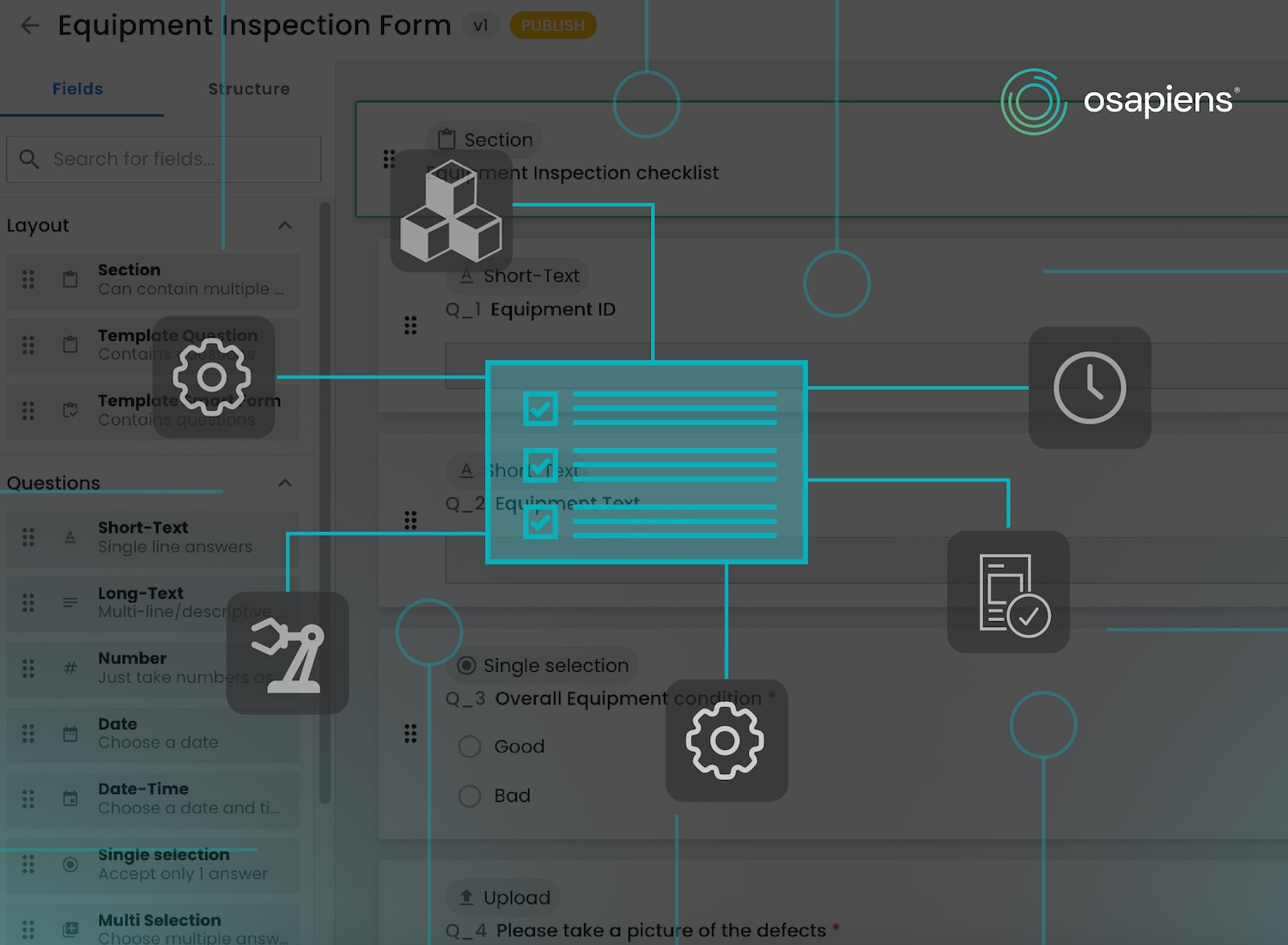
- Mobile checklist execution: Technicians access step-by-step procedures on smartphones or tablets, complete with photos demonstrating proper technique. They record observations, measurements, and completion status directly in the system—eliminating manual data entry.
- Automated work order generation: When inspections reveal defects or measurements fall outside acceptable ranges, the system automatically creates corrective work orders with appropriate priority and assignment—ensuring problems receive immediate attention.
- Photo documentation and timestamps: Technicians attach photos of defects, completed work, or equipment condition directly to work orders. Automatic timestamps create verifiable records of when maintenance was performed.
- SAP PM integration: For organizations using SAP, the osapiens HUB provides SAP-certified integration that synchronizes maintenance data bidirectionally—eliminating duplicate entry while maintaining enterprise system consistency.
- Offline capability: Technicians download checklists before entering areas with poor connectivity. Work continues uninterrupted, with data synchronizing automatically when connection returns.
- Complete audit trails: Every completed checklist, recorded measurement, and attached photo becomes part of the permanent equipment record—providing the documentation necessary for regulatory compliance and liability protection.
This digital approach saves an average of 17 minutes per work order while reducing downtime by 8% through faster response to detected issues and elimination of administrative overhead.
| Aspect | Paper or Excel Checklist | Digital Checklist with osapiens HUB |
|---|---|---|
| Accessibility | Technicians must return to office to retrieve or submit checklists | Mobile access at the point of work, online and offline |
| Documentation Quality | Manual transcription introduces errors; photos require separate handling | Direct data entry with integrated photo capture and timestamps |
| Visibility | No real-time status; supervisors must physically locate technicians | Real-time progress tracking and completion notifications |
| Follow-up Actions | Defects noted on paper may not generate work orders promptly | Automatic work order creation when issues detected |
| Historical Data | Paper archives difficult to search; trend analysis requires manual compilation | Complete digital history enables trend analysis and predictive insights |
| Compliance | Manual record-keeping creates gaps; audit preparation is time-consuming | Automatic audit trails; instant access to compliance documentation |
Stop Losing Uptime to Missed Press Inspections
Digitize your maintenance checklists, automate work order creation, and give every technician a mobile tool that works—even offline. SAP PM integration included.Try osapiens HUB for Free
FAQ
What should be included in a Press Machine maintenance checklist?
A comprehensive checklist should cover hydraulic fluid system inspection (level, contamination, temperature), pump and motor condition (noise, vibration, leaks), filter and cooling system maintenance, hoses and seal inspection, cylinder and ram alignment verification, pressure relief valve testing, pneumatic system checks (if applicable), mechanical component lubrication, electrical system inspection, and safety system functional testing. Organize tasks by component or system rather than frequency alone, and customize based on your specific press type and manufacturer recommendations.
How often should I complete my Press Machine maintenance checklist?
Inspection frequency depends on usage intensity, operating environment, and equipment criticality. Common practice includes daily visual checks for leaks and safety system tests, weekly lubrication and basic inspections, monthly filter changes and fastener torque verification, quarterly hydraulic fluid analysis and electrical system checks, and annual comprehensive overhauls. High-utilization presses or those in demanding environments may require more frequent inspections. Base your schedule on manufacturer guidance, historical failure data, and condition monitoring insights rather than arbitrary intervals.
Can I customize this Press Machine maintenance checklist template?
Yes—customization is essential for effective maintenance. Your checklist should reflect your specific press type (hydraulic, mechanical, pneumatic), manufacturer recommendations, operating conditions, regulatory requirements, and historical failure patterns. Digital platforms like osapiens HUB for Maintenance enable you to create equipment-specific checklists with customized inspection points, acceptance criteria, required tools, and estimated completion times—ensuring procedures match your actual operational needs.
How does a digital CMMS improve maintenance checklist management?
A digital CMMS transforms checklist execution through mobile access at the point of work, automatic work order generation when defects are detected, integrated photo documentation and timestamps, real-time visibility into maintenance status, complete audit trails for compliance, and trend analysis revealing failure patterns. The osapiens HUB for Maintenance provides these capabilities with SAP PM integration, ensuring maintenance data flows seamlessly across enterprise systems while technicians work through intuitive mobile interfaces.
Start using osapiens for free
Improve your uptime, extend the life of your equipment, and simplify work order management.
Book a demo
ENTERPRISE CAPABILITIES
- SAP ECC & S/4HANA Certified
- Infor & MS Dynamics
- Microsoft Entra ID / Okta
- ISO 27001 & 9001
- EU Cloud · Data Sovereignty
- Development, Test, and Production Environments
- Multi-Entity & Multi-Site
- Power BI Integration
- Audit Trail & Compliance
Related content
January 1, 2026
Plastic Injection Mold Maintenance Checklist – Tasks, Tips & Best Practices

January 15, 2026
IBM Maximo Alternatives: The Best EAM & CMMS Platforms Compared

July 4, 2025
Making pharma maintenance efficient and compliant with a modern CMMS

July 21, 2025
Maintenance Bilbao 2025: Key Insights on Maintenance Management
January 1, 2026
Turret Punch Press Maintenance Checklist – Tasks, Tips & Template
January 1, 2026
Tablet Press Maintenance Checklist – Tasks, Tips & Template
January 1, 2026
Shot Blasting Machine Maintenance Checklist – Tasks, Tips & Digital Execution
January 1, 2026
3D Printer Maintenance Checklist – Essential Tasks, Tips & Digital Execution
January 1, 2026
Plasma Cutting Machine Maintenance Checklist – Tasks, Safety & Digital Execution
January 1, 2026
Dust Collector Maintenance Checklist – Tasks, Safety & Digital Execution

November 24, 2025
Benefits of Predictive Maintenance in Manufacturing
January 1, 2026