

Maintenance Checklist

Florian Bartholomäus, osapiens Expert | 1. January 2026 | Lesezeit 10 min.
Most assembly line failures start with small, detectable changes—slight pressure drops in pneumatic systems, gradual belt tracking drift, or subtle vibration increases in motors. A structured checklist helps technicians catch these early warning signs before they escalate into production-stopping failures.
Create your checklist for free










TRUSTED BY LEADING COMPANIES




ENTERPRISE-READY
 SAP Certification
 ISO 27001
 EU Hosting
 Entra ID & Okta
 Multi-Entity
Table of Contents
- Assembly Line Equipment Maintenance: Key Facts
- Why You Need an Assembly Line Equipment Maintenance Checklist
- What to Include in Your Assembly Line Equipment Maintenance Checklist
- Common Assembly Line Equipment Problems Your Maintenance Checklist Prevents
- From Paper Checklist to Digital: How the osapiens HUB Automates Your Assembly Line Equipment Maintenance Checklist
- FAQ
Assembly line equipment keeps production moving, but without structured preventive maintenance, even minor issues can cascade into costly downtime. A well-designed assembly line equipment maintenance checklist helps maintenance teams systematically inspect conveyors, pneumatic systems, motors, and automation equipment—catching problems before they halt operations.
Assembly Line Equipment Maintenance: Key Facts
- Downtime costs escalate rapidly: According to industry research, large manufacturing plants lose approximately $253 million annually to unplanned downtime, with automotive plants experiencing costs reaching $2.3 million per hour for critical line stoppages.
- Structured checklists reduce failures: Organizations implementing comprehensive preventive maintenance checklists achieve 25–35% increases in mean time between failures (MTBF) and reduce reactive maintenance work to below 10% of total maintenance hours.
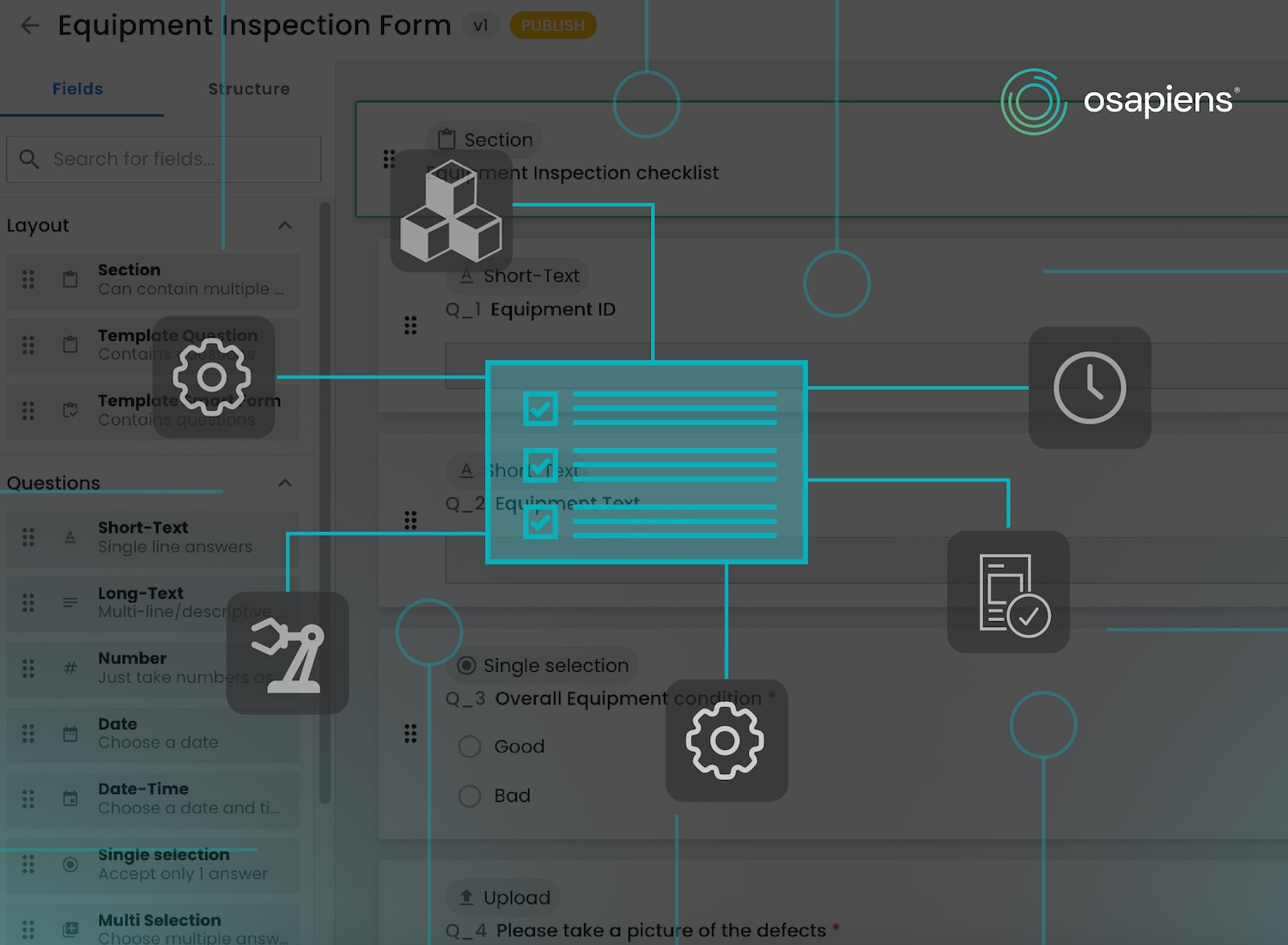
- Digital execution improves compliance: Mobile CMMS platforms like osapiens HUB for Maintenance enable technicians to execute checklists in the field, capture photos, and automatically create audit-ready documentation.
- Component-specific inspection prevents cascading failures: Assembly line equipment failures often trigger chain reactions—a single conveyor bearing failure can halt multiple production cells, making systematic inspection of critical components essential for operational continuity.
Why You Need an Assembly Line Equipment Maintenance Checklist
Assembly line equipment operates in complex, interdependent systems where a single component failure can disrupt entire production sequences. Without a structured checklist, maintenance becomes inconsistent, critical tasks get overlooked, and institutional knowledge walks out the door when experienced technicians leave.
- Consistency across shifts and sites: Checklists ensure every technician—regardless of experience level—performs the same critical inspections on conveyors, pneumatic actuators, motors, and control systems. This standardization eliminates the variability that leads to missed warning signs and unexpected failures.
- Risk reduction through early detection: Seal failures, belt tracking drift, bearing degradation, and hydraulic contamination all provide detectable warning signs days or weeks before catastrophic failure. A structured checklist ensures technicians systematically check these indicators rather than relying on chance observation.
- Documentation and traceability: Regulatory standards including OSHA 29 CFR 1910 and ISO 9001 require documented proof that maintenance was performed according to established procedures. Digital checklists within a CMMS platform automatically create timestamped, audit-ready records.
- Technician guidance and knowledge transfer: Detailed checklists with specific inspection criteria (e.g., “belt should track within ±0.5 inches of center” or “bearing temperature should not exceed 65°C”) provide clear guidance that helps less experienced technicians perform work to the same standard as veterans.
- Standardization for continuous improvement: When maintenance tasks are documented consistently, patterns emerge. Recurring issues become visible, enabling data-driven improvements to maintenance intervals, procedures, and equipment specifications.
- Handover quality during shift transitions: Structured documentation ensures the next shift understands exactly what was inspected, what was found, and what requires follow-up—eliminating communication gaps that lead to repeated failures.
What to Include in Your Assembly Line Equipment Maintenance Checklist
An effective assembly line equipment maintenance checklist organizes tasks by physical component or system rather than by arbitrary time intervals. This component-based structure ensures technicians systematically address each critical subsystem.
The checklist should include visual inspection tasks (checking for wear, damage, leaks, and misalignment), functional checks (verifying equipment operates within specifications), safety verification (confirming guards, e-stops, and interlocks function properly), basic servicing (lubrication, filter checks, seal inspection), and documentation steps (recording findings, capturing photos, noting abnormal conditions).
Actual maintenance intervals depend on equipment usage patterns, operating environment, and risk assessment. The checklist below provides a framework—adapt task frequency based on your specific operational context and manufacturer recommendations. For guidance on structuring maintenance programs, see preventive maintenance best practices.
| Component / System | Inspection & Maintenance Tasks | Purpose |
|---|---|---|
| Conveyor Belts & Drives | Check belt tracking and alignment, inspect for tears or edge wear, verify roller rotation, listen for unusual bearing noise, monitor motor temperature | Prevent belt failure, reduce friction losses, catch bearing degradation early |
| Pneumatic Systems | Inspect seals and fittings for leaks, verify pressure levels, check air filter condition, test actuator response time, drain moisture from air lines | Maintain system pressure, prevent contamination, ensure actuator reliability |
| Hydraulic Systems | Check fluid levels and quality, inspect hoses for wear or leaks, verify pressure relief valve function, test filter differential pressure, monitor system temperature | Prevent contamination, maintain clamping force, avoid seal blowout |
| Motors & Electrical Drives | Monitor vibration levels, check bearing temperatures, inspect electrical connections, verify cooling fan operation, test variable frequency drive (VFD) parameters | Detect bearing wear, prevent overheating, avoid electrical failures |
| Control Systems & Sensors | Verify sensor calibration, test emergency stop functionality, check PLC communication, inspect cable routing and connections, validate safety interlock operation | Ensure process control accuracy, maintain safety systems, prevent control failures |
| Lubrication Points | Apply lubricant to specified bearing points, verify automatic lubrication system function, check grease quality and quantity, inspect for over-lubrication or contamination | Reduce friction and wear, extend bearing life, prevent premature component failure |
| Safety Guards & Devices | Inspect physical guards for damage, test light curtains and safety mats, verify lockout/tagout points are accessible, check warning labels and signage | Protect operators, ensure regulatory compliance, prevent safety incidents |
| Fasteners & Structural Components | Check mounting bolts for tightness, inspect welds and structural supports, verify equipment leveling and alignment, look for cracks or metal fatigue | Prevent equipment misalignment, avoid structural failure, maintain precision |
Turn Your Assembly Line Maintenance Checklist into Mobile Work Orders
Create structured checklists for every component—from conveyors to pneumatic systems. Execute them on mobile, sync with SAP PM, and keep full audit trails automatically.Start with Your Assembly Line Equipment Maintenance Checklist
Common Assembly Line Equipment Problems Your Maintenance Checklist Prevents
A structured maintenance checklist addresses the failure modes that cause the majority of unplanned downtime in assembly line operations. Understanding these failure patterns helps maintenance teams focus inspection efforts where they deliver greatest impact.
- Conveyor belt tracking drift and edge wear: Belt misalignment begins subtly but accelerates as edges contact mounting brackets. Without systematic tracking checks, belts wear through and rupture suddenly. Checklists ensure technicians verify tracking alignment during every inspection, catching drift before edge damage occurs.
- Pneumatic seal failures and air leaks: A single failed O-ring can halt production lines worth thousands of dollars per hour. Seal failures often provide warning signs—slight pressure drops, increased noise, or minor visible leaks. Systematic seal inspection catches these early indicators before catastrophic failure.
- Hydraulic fluid contamination: Contamination creates a progressive failure cycle where microscopic particles cause component wear, generating more debris that accelerates degradation. Regular fluid sampling and filter inspection break this cycle before contamination reaches critical levels.
- Motor and bearing degradation: Bearing failures often escalate rapidly from subtle vibration to catastrophic seizure within hours or days. Systematic vibration monitoring and thermal checks detect developing problems 2–8 weeks before failure, enabling planned intervention during scheduled downtime.
- Safety system failures and compliance gaps: Emergency stops, safety interlocks, and guards must function reliably to protect operators. Regular functional testing ensures these systems work when needed while creating the documentation required for OSHA compliance and audit readiness.
- Documentation gaps that delay root cause analysis: When failures occur without documented maintenance history, root cause analysis becomes guesswork. Systematic checklist execution creates the historical data needed to identify recurring patterns and implement permanent solutions. Learn more about maintenance documentation best practices.
From Paper Checklist to Digital: How the osapiens HUB Automates Your Assembly Line Equipment Maintenance Checklist
Paper checklists, handwritten notes, and Excel spreadsheets create significant operational friction in assembly line maintenance. Technicians must carry printed forms, document work in challenging field conditions, and manually transcribe information—introducing delays and errors that undermine maintenance effectiveness.
Manual documentation prevents real-time visibility into maintenance status. Maintenance managers cannot see whether scheduled work is actually being completed, cannot identify recurring issues across similar equipment, and cannot demonstrate audit readiness because data remains scattered across paper records and individual spreadsheets.
The osapiens HUB for Maintenance eliminates these barriers through mobile-first execution that enables technicians to receive work orders, access complete asset history, and document findings directly from smartphones or tablets—even offline in areas with poor connectivity. The platform provides structured digital checklists with step-by-step instructions, required inspection points, and automatic photo capture for visual documentation.
SAP PM integration ensures maintenance data flows seamlessly between field execution and enterprise planning systems without manual re-entry, while automatic audit trails create timestamped, traceable records of every inspection, finding, and corrective action. For organizations managing assembly line equipment across multiple sites, see how manufacturing CMMS solutions support enterprise-scale operations.
| Aspect | Paper or Excel Checklist | Digital Checklist with osapiens HUB |
|---|---|---|
| Execution Location | Requires printed forms, clipboard, manual writing in field conditions | Mobile app provides full checklist access on smartphone/tablet, works offline |
| Data Entry | Handwritten notes, later transcribed to computer, multiple opportunities for errors | Direct digital entry, photo capture, automatic timestamps, no transcription needed |
| Real-Time Visibility | Managers see status only after paperwork returns to office, often hours or days delayed | Instant visibility into work completion, findings, and required follow-up actions |
| Asset History | Scattered across filing cabinets, spreadsheets, individual technician notes | Complete maintenance history linked to each asset, accessible instantly via QR code scan |
| Audit Readiness | Manual compilation of records, difficult to prove compliance, gaps common | Automatic audit trails with timestamps, signatures, photos—instantly exportable for audits |
| Recurring Issue Detection | Patterns invisible unless someone manually reviews months of paper records | Analytics automatically identify recurring failures, enabling data-driven improvements |
| Technician Guidance | Generic instructions, relies on technician memory and experience | Equipment-specific procedures with photos, videos, and measurement criteria |
The platform’s work order management capabilities automatically generate preventive maintenance tasks based on time intervals, meter readings, or condition thresholds—ensuring critical assembly line equipment receives timely servicing without manual scheduling burden. Integration with spare parts inventory ensures technicians know exactly which components are available and where to find them, eliminating maintenance delays caused by missing materials.
Stop Losing Production Time to Missed Assembly Line Inspections
Digitize your maintenance checklists, automate work order creation, and give every technician a mobile tool that works—even offline. SAP PM integration included.Try osapiens HUB for Free
FAQ
What should be included in an assembly line equipment maintenance checklist?
A comprehensive checklist should cover conveyor systems (belt tracking, roller condition, drive alignment), pneumatic and hydraulic systems (seal inspection, pressure verification, contamination checks), motors and drives (vibration monitoring, temperature checks, electrical connections), control systems (sensor calibration, safety interlock testing), and lubrication points (bearing servicing, automatic system verification). Organize tasks by component or system rather than arbitrary time intervals, and include specific, measurable inspection criteria rather than vague instructions. Adapt the checklist based on your specific equipment, usage patterns, and risk assessment.
How often should I complete my assembly line equipment maintenance checklist?
Maintenance frequency depends on equipment usage intensity, operating environment, and criticality to production. High-utilization equipment operating 24/7 requires more frequent inspection than equipment running single shifts. Harsh environments with dust, moisture, or temperature extremes accelerate wear and demand shorter intervals. Many organizations perform daily visual checks for obvious issues, weekly functional tests on critical systems, and monthly detailed inspections requiring equipment shutdown. Usage-based triggers (operating hours, production cycles) often provide more precise maintenance timing than fixed calendar schedules. Learn more about preventive maintenance strategies.
Can I customize this assembly line equipment maintenance checklist template?
Yes—customization is essential for effective maintenance. Generic checklists miss equipment-specific failure modes and create unnecessary work on low-risk components. Adapt the checklist based on manufacturer recommendations for your specific equipment models, historical failure patterns observed in your facility, operating conditions unique to your environment, and regulatory requirements applicable to your industry. Digital CMMS platforms like osapiens HUB enable easy checklist customization while maintaining standardization across similar equipment types. Start with the framework provided, then refine based on actual operational experience.
How does a digital CMMS improve maintenance checklist management?
A CMMS platform transforms checklist execution from paper-based documentation into streamlined digital workflows. Technicians receive mobile access to equipment-specific checklists with step-by-step instructions, capture findings through photos and structured data entry, and automatically create audit-ready records with timestamps and traceability. The system provides real-time visibility into maintenance status, enabling managers to see completion rates, identify overdue tasks, and spot recurring issues across similar equipment. SAP PM integration ensures maintenance data flows seamlessly into enterprise planning systems without manual re-entry. Organizations using platforms like osapiens HUB report significant reductions in administrative burden and improvements in maintenance consistency.
Start using osapiens for free
Improve your uptime, extend the life of your equipment, and simplify work order management.
Book a demo
ENTERPRISE CAPABILITIES
- SAP ECC & S/4HANA Certified
- Infor & MS Dynamics
- Microsoft Entra ID / Okta
- ISO 27001 & 9001
- EU Cloud · Data Sovereignty
- Development, Test, and Production Environments
- Multi-Entity & Multi-Site
- Power BI Integration
- Audit Trail & Compliance
Related content

December 4, 2025
Best UpKeep Alternatives for Enterprise CMMS in 2026
January 1, 2026
Vehicle Maintenance Checklist – Essential Tasks, Compliance Tips & Digital Template
January 1, 2026
Backflow Preventer Maintenance Checklist – Tasks, Compliance & Digital Execution

July 29, 2026
CMMS for Wind Energy: Reducing Turbine Downtime and Managing Assets Across Multiple Sites
January 1, 2026
Fire Suppression System Maintenance Checklist – Tasks, Compliance & Digital Execution
January 1, 2026
Excavator Maintenance Checklist: What to Inspect, When & How
January 1, 2026
Uninterruptible Power Supply Maintenance Checklist – Tasks, Safety & Digital Execution
January 1, 2026
Furnace Maintenance Checklist – Tasks, Tips & Template
January 1, 2026
Construction Equipment Maintenance Checklist – Tasks, Tips & Template
January 1, 2026
Concrete Mixer Truck Maintenance Checklist – Tasks, Safety & Digital Execution

May 23, 2025
Whitepaper: How to Build a Strong Business Case for a CMMS
January 1, 2026