

Maintenance Checklist

Florian Bartholomäus, osapiens Expert | 1. January 2026 | Lesezeit 13 min.
Many separator failures stem from inconsistent inspection intervals and incomplete documentation of internal component condition. Structured checklists ensure technicians systematically inspect bearings, seals, coalescing plates, and separation chambers—capturing condition data that reveals degradation patterns before catastrophic failure occurs.
Create your checklist for free











TRUSTED BY LEADING COMPANIES




ENTERPRISE-READY
 SAP Certification
 ISO 27001
 EU Hosting
 Entra ID & Okta
 Multi-Entity
Table of Contents
- Separator Equipment Maintenance: Key Facts
- Why You Need a Separator Equipment Maintenance Checklist
- What to Include in Your Separator Equipment Maintenance Checklist
- Common Separator Equipment Problems Your Maintenance Checklist Prevents
- From Paper Checklist to Digital: How the osapiens HUB Automates Your Separator Equipment Maintenance Checklist
- FAQ
Separator equipment operates as critical process equipment across manufacturing, energy, maritime, and facility management sectors—removing contaminants, separating fluid phases, and protecting downstream equipment from damage. When separator maintenance relies on memory-based procedures or inconsistent inspection practices, bearing failures, seal leaks, and internal component degradation go undetected until equipment fails unexpectedly. A structured separator equipment maintenance checklist transforms reactive firefighting into systematic preventive maintenance, ensuring technicians inspect every critical component, document equipment condition, and identify developing problems before they escalate into production-stopping failures.
Separator Equipment Maintenance: Key Facts
- Structured checklists reduce unplanned downtime: Organizations implementing systematic separator maintenance programs experience measurably lower rates of unexpected failures compared to facilities relying on reactive, run-to-failure approaches.
- Documentation supports compliance: Comprehensive maintenance records demonstrate regulatory compliance during audits, particularly for oil-water separators subject to environmental regulations and magnetic separators in food and pharmaceutical applications requiring HACCP and GMP documentation.
- Condition-based triggers optimize intervals: Combining time-based preventive schedules with condition-based maintenance monitoring through vibration analysis, oil analysis, and pressure differential measurement enables targeted maintenance execution when equipment condition indicates actual need.
- Digital execution eliminates gaps: Mobile CMMS platforms like osapiens HUB for Maintenance enable technicians to execute checklists in the field, capture photos and measurements directly, and build comprehensive equipment history without paper-based transcription delays.
Why You Need a Separator Equipment Maintenance Checklist
Separator equipment failures create cascading operational consequences extending far beyond equipment repair costs. Understanding why structured checklists matter provides essential context for maintenance program design.
- Consistency across technicians: When maintenance execution relies on individual technician experience rather than documented procedures, inspection quality varies significantly based on who performs the work. Structured checklists ensure every technician—regardless of experience level—inspects the same critical components using identical criteria, creating consistent maintenance quality across all equipment and maintenance events.
- Early problem detection: Bearing wear, seal degradation, and internal component erosion develop gradually through stages detectable during systematic inspection before catastrophic failure occurs. Checklists direct technician attention to specific failure indicators—abnormal bearing temperature, visible seal leakage, excessive vibration, or pressure differential changes—enabling maintenance teams to identify developing issues while components remain serviceable and plan corrective actions during optimal production windows.
- Documentation and traceability: Regulatory frameworks in food processing, pharmaceutical manufacturing, marine operations, and environmental compliance require comprehensive maintenance documentation demonstrating that equipment receives appropriate servicing. Structured checklists create systematic records of inspection findings, component replacements, and maintenance actions performed, providing audit-ready evidence of regulatory compliance and supporting product traceability investigations if equipment-related quality issues emerge.
- Knowledge capture and training: Detailed checklists serve as training tools for less-experienced technicians, providing step-by-step guidance through complex maintenance procedures and ensuring critical inspection points aren’t overlooked. As technicians execute checklist-guided maintenance, they build familiarity with equipment-specific failure patterns and develop troubleshooting capabilities that reduce organizational dependence on individual expert technicians.
- Standardization across sites: Organizations operating multiple facilities benefit from standardized maintenance procedures that ensure consistent equipment reliability regardless of location. Checklists enable corporate maintenance managers to define maintenance standards centrally while accommodating site-specific equipment configurations and operational conditions, creating repeatability that supports continuous improvement and cross-site performance benchmarking.
- Compliance with safety requirements: Separator equipment operating under pressure, handling hazardous fluids, or incorporating high-speed rotating components presents significant safety risks if maintenance procedures bypass critical safety checks. Checklists systematically verify lockout/tagout procedures, pressure relief verification, and guard functionality, creating documented evidence of safety procedure compliance that protects both personnel and organizations from liability.
What to Include in Your Separator Equipment Maintenance Checklist
Effective separator maintenance checklists combine technical specificity appropriate to equipment characteristics with sufficient clarity that technicians can execute procedures consistently. The checklist structure should organize tasks by physical component or subsystem rather than by frequency, enabling technicians to systematically work through equipment from inlet to outlet.
Actual maintenance intervals depend on equipment usage intensity, incoming material characteristics, operational environment, and manufacturer recommendations—there are no universally applicable fixed schedules. Organizations should establish baseline intervals based on OEM guidance, then adjust based on observed equipment behavior and failure patterns accumulated through systematic documentation.
| Component / System | Inspection & Maintenance Tasks | Purpose |
|---|---|---|
| Bearing Assemblies | Check bearing temperature using infrared thermometry or hand-feel; listen for abnormal noise indicating degradation; inspect lubrication condition and verify absence of contamination; measure vibration using portable analyzer; verify proper lubrication intervals and lubricant type | Bearing failures represent the most common separator failure mode—early detection through temperature and vibration monitoring prevents catastrophic bearing collapse and secondary damage |
| Seals and Gaskets | Visual inspection for leakage at seal locations; verify seal integrity and absence of visible wear; check for fluid contamination indicating seal compromise; confirm proper installation and alignment; replace seals approaching end of service life | Seal failures allow bearing lubricants to contaminate product streams or permit process fluids to leak, compromising product quality, equipment performance, and creating environmental hazards |
| Internal Separator Components | Inspect bowl condition in centrifugal separators when accessible; verify disc integrity and absence of internal deposits; measure component geometric wear; assess coalescing plate condition in oil-water separators; check for biological growth or scale deposits; verify internal passage clearances | Internal component degradation progressively reduces separation efficiency, allowing carry-over of target contaminants before dramatic external failure symptoms become apparent |
| Filter Elements and Media | Measure pressure differential across filter elements; visual inspection for structural damage or bypass conditions; verify absence of excessive contamination accumulation; replace elements at manufacturer-specified intervals or when differential pressure exceeds thresholds | Clogged filters increase pressure differential, creating structural stress and potentially permitting bypass of unfiltered fluid—timely replacement prevents secondary equipment damage |
| Motor and Drive System | Verify electrical connector integrity and absence of corrosion; assess motor bearing lubrication condition; check alignment between drive components; measure motor current and compare to baseline; inspect coupling condition and verify proper installation | Motor and drive system problems create vibration, reduce efficiency, and can lead to complete equipment shutdown—systematic inspection identifies electrical and mechanical issues before failure |
| Separation Chamber and Vessel | Inspect vessel integrity for corrosion or structural damage; verify pressure vessel certification remains current; check internal baffles and flow distribution components; assess accumulated sludge levels; measure separation performance through effluent testing | Vessel integrity failures present safety risks and environmental contamination potential—regular inspection ensures structural soundness and verifies separation performance remains within specifications |
| Valves and Controls | Test pressure relief valves and verify proper operation; inspect control valves for proper operation and absence of leakage; verify emergency shutdown valve functionality; check pressure and temperature controls against design specifications; test alarm systems and verify proper response | Control system failures can prevent proper separator operation or create safety hazards—systematic testing ensures protective devices operate on demand and process controls maintain equipment within design parameters |
| Lubrication System | Verify adequate lubricant quantity and condition; perform oil analysis to detect wear particles and lubrication degradation; check lubrication system pumps and distribution lines; ensure proper lubricant type per manufacturer specifications; verify lubrication intervals are maintained | Inadequate or degraded lubrication accelerates bearing wear and reduces equipment life—systematic lubrication maintenance prevents premature bearing failure and extends service intervals |
Turn Your Separator Equipment Maintenance Checklist into Digital Work Orders
Create structured checklists for every component—from bearings to coalescing plates. Execute them on mobile, sync with SAP PM, and keep full audit trails automatically.Start with Your Separator Equipment Maintenance Checklist
Common Separator Equipment Problems Your Maintenance Checklist Prevents
Understanding typical failure patterns helps maintenance teams focus inspection efforts on highest-risk components and recognize early warning signs before problems escalate.
- Catastrophic bearing failure: Bearing degradation typically progresses through detectable stages—initial spalling creates shock impulses measurable through vibration analysis, elevated bearing temperature indicates inadequate lubrication or excessive load, and abnormal noise signals advanced deterioration. Structured checklists systematically capture these warning signs, enabling bearing replacement during planned maintenance rather than emergency response after catastrophic collapse contaminates equipment and damages bearing bores.
- Seal and gasket leakage: Seal failures allow process fluids to escape equipment or bearing lubricants to contaminate product streams, creating product quality issues, environmental compliance violations, and safety hazards. Regular visual inspection identifies early-stage seal weeping before leakage becomes severe, while systematic seal replacement at manufacturer-recommended intervals prevents age-related seal degradation that leads to sudden failure.
- Internal component erosion: In centrifugal separators, bowl wear and disc deterioration develop gradually as abrasive particles contact internal surfaces, progressively degrading separation efficiency. Oil-water separator coalescing plates accumulate biological growth and chemical scale deposits that restrict flow and reduce separation effectiveness. Periodic internal inspection during scheduled maintenance identifies component degradation requiring cleaning or replacement before separation performance falls below acceptable thresholds.
- Filter element clogging: Accumulated contaminants progressively restrict flow through filter elements, increasing pressure differential and creating structural stress on mounting hardware. Systematic pressure differential monitoring triggers filter replacement before excessive pressure creates bypass conditions or structural failures, while documentation of filter service life informs optimization of replacement intervals based on actual contamination rates rather than arbitrary schedules.
- Magnetic separator strength loss: Rare-earth magnets in magnetic separators gradually lose strength over extended operational periods, particularly in elevated-temperature environments, resulting in progressively reduced ability to capture ferrous contaminants. Without systematic validation testing, magnet strength degradation goes undetected until contaminated product reaches consumers, triggering recalls and regulatory sanctions. Structured maintenance programs incorporate periodic magnet strength testing, documenting separation effectiveness and triggering magnet replacement when strength falls below critical thresholds.
- Inadequate documentation for audits: Regulatory audits in food processing, pharmaceutical manufacturing, and environmental compliance applications require comprehensive maintenance records demonstrating equipment receives appropriate servicing. Paper-based maintenance logs create gaps where handwritten entries prove illegible, observations aren’t systematically captured, and historical trend analysis remains impossible. Digital work order management through CMMS platforms ensures complete documentation with timestamps, personnel identification, and photographic evidence, creating audit-ready records accessible during regulatory inspections.
From Paper Checklist to Digital: How the osapiens HUB Automates Your Separator Equipment Maintenance Checklist
Traditional paper-based separator maintenance creates friction that undermines program effectiveness. Technicians must access centralized filing systems to retrieve prior maintenance records, handwritten notes prove difficult to decipher weeks later, photographs taken for documentation become separated from maintenance records, and administrative staff spend hours transcribing handwritten forms into electronic systems—introducing transcription errors and creating delays between maintenance execution and data availability for decision-making.
The osapiens HUB for Maintenance addresses these pain points through mobile-first design that enables technicians to execute maintenance checklists directly in the field using smartphones or tablets. Equipment-specific checklists guide systematic inspection with conditional logic directing technicians to additional steps based on findings—if bearing temperature exceeds defined thresholds, the system automatically prompts vibration measurement or bearing examination. Required fields prevent incomplete submissions, ensuring critical observations are consistently captured without relying on technician memory or discipline.
Key capabilities supporting separator maintenance include:
- Mobile checklist execution: Technicians access asset-specific maintenance procedures, historical records, and equipment manuals from field locations without office visits, executing checklists with real-time data capture that eliminates transcription delays and errors.
- Photo and measurement documentation: Integrated photo capture associates visual evidence directly with maintenance records, while measurement fields capture bearing temperatures, vibration levels, pressure differentials, and other condition indicators with timestamps and personnel identification, creating comprehensive equipment condition history.
- Automated work order generation: When inspection findings exceed defined thresholds—bearing vibration elevated beyond baseline, pressure differential indicating filter replacement needed, or seal leakage observed—the system automatically generates corrective work orders with appropriate priority, ensuring identified problems trigger immediate response without manual intervention or administrative delays.
- SAP PM integration: For organizations operating SAP environments, osapiens HUB provides SAP-certified integration enabling bidirectional data synchronization between mobile maintenance execution and enterprise asset management systems, eliminating duplicate data entry while maintaining SAP PM as the system of record for asset master data and maintenance history.
- Audit-ready documentation: Complete maintenance records with timestamps, personnel identification, photographic evidence, and measurement data provide comprehensive audit trails demonstrating regulatory compliance, supporting warranty claims, and enabling historical analysis of equipment performance trends and failure patterns.
| Aspect | Paper or Excel Checklist | Digital Checklist with osapiens HUB |
|---|---|---|
| Accessibility | Centralized filing systems require office visits; prior maintenance records unavailable during field work | Complete equipment history, procedures, and manuals accessible on mobile devices at point of work |
| Data Capture | Handwritten notes transcribed hours or days later; measurements recorded from memory; photos stored separately | Real-time data entry with integrated photo capture, measurement fields, and automatic timestamp/personnel documentation |
| Consistency | Inspection quality varies by technician experience; critical steps overlooked; incomplete documentation common | Required fields and conditional logic ensure systematic inspection; incomplete submissions prevented |
| Analysis Capability | Historical trend analysis impossible; pattern recognition relies on memory; cross-equipment comparison impractical | Automated trending of condition indicators; pattern recognition across equipment populations; performance benchmarking |
| Audit Readiness | Manual file retrieval; illegible handwriting; missing records; incomplete documentation | Instant record retrieval; complete audit trails; photographic evidence; regulatory compliance reporting |
| Response Time | Identified problems documented on paper; administrative entry delays; follow-up work orders created manually days later | Automatic work order generation when thresholds exceeded; immediate notification to maintenance planning; real-time status visibility |
Stop Losing Uptime to Missed Separator Inspections
Digitize your maintenance checklists, automate work order creation, and give every technician a mobile tool that works—even offline. SAP PM integration included.Try osapiens HUB for Free
FAQ
What should be included in a separator equipment maintenance checklist?
A comprehensive separator maintenance checklist should include bearing inspection and lubrication verification, seal and gasket condition assessment, internal component examination when accessible, filter element pressure differential monitoring, motor and drive system checks, separation performance testing, and safety system verification. The specific tasks vary based on separator type—centrifugal separators require bowl and disc inspection, oil-water separators need coalescing plate cleaning and sludge level measurement, and magnetic separators require periodic strength validation testing. Checklists should be customized to specific equipment configurations, manufacturer recommendations, and operational conditions rather than relying on generic templates.
How often should I complete my separator equipment maintenance checklist?
Maintenance frequency depends on equipment usage intensity, incoming material contamination levels, operational environment, and manufacturer recommendations rather than fixed universal intervals. Common practice includes daily visual checks for obvious problems like abnormal noise or visible leakage, weekly lubrication and basic cleaning, monthly comprehensive inspections with vibration measurement and detailed component assessment, and annual or longer-interval specialized procedures requiring equipment disassembly for internal inspection. Organizations should establish baseline intervals based on OEM guidance, then adjust based on observed equipment behavior—condition-based maintenance monitoring through vibration analysis, oil analysis, and pressure differential measurement enables targeted maintenance execution when equipment condition indicates actual need rather than arbitrary calendar schedules.
Can I customize this separator equipment maintenance checklist template?
Customization is essential rather than optional—effective maintenance checklists must reflect specific equipment configurations, operational conditions, and organizational requirements. Separator equipment varies dramatically in design, operating principles, and maintenance needs based on application, manufacturer, and process requirements. Organizations should use manufacturer OEM manuals as the foundation, incorporate lessons learned from historical failure patterns, adapt procedures to site-specific operational conditions, and continuously refine checklists based on accumulated maintenance experience. Digital CMMS platforms like osapiens HUB enable flexible checklist customization while maintaining standardization across similar equipment, supporting both corporate consistency and site-specific adaptation.
How does a digital CMMS improve maintenance checklist management?
Digital CMMS platforms transform maintenance execution by enabling mobile checklist access at the point of work, eliminating office visits to retrieve procedures or prior maintenance records. Real-time data capture with integrated photo documentation, measurement fields, and automatic timestamps ensures complete, accurate records without transcription delays or errors. Required fields and conditional logic prevent incomplete submissions and guide technicians through equipment-specific procedures regardless of experience level. Automatic work order generation when inspection findings exceed thresholds ensures identified problems trigger immediate response, while comprehensive historical records enable trend analysis, pattern recognition, and continuous improvement of maintenance intervals and procedures. For organizations operating SAP PM environments, certified integration maintains enterprise system consistency while providing mobile usability that drives technician adoption and data quality.
Start using osapiens for free
Improve your uptime, extend the life of your equipment, and simplify work order management.
Book a demo
ENTERPRISE CAPABILITIES
- SAP ECC & S/4HANA Certified
- Infor & MS Dynamics
- Microsoft Entra ID / Okta
- ISO 27001 & 9001
- EU Cloud · Data Sovereignty
- Development, Test, and Production Environments
- Multi-Entity & Multi-Site
- Power BI Integration
- Audit Trail & Compliance
Related content

February 9, 2026
Maintenance Audit Checklist: How to Systematically Review Your Maintenance Operations
January 1, 2026
Sterilization Equipment Maintenance Checklist – Tasks, Safety & Compliance
January 1, 2026
Industrial Mixer Maintenance Checklist – Tasks, Tips & Template
November 26, 2025
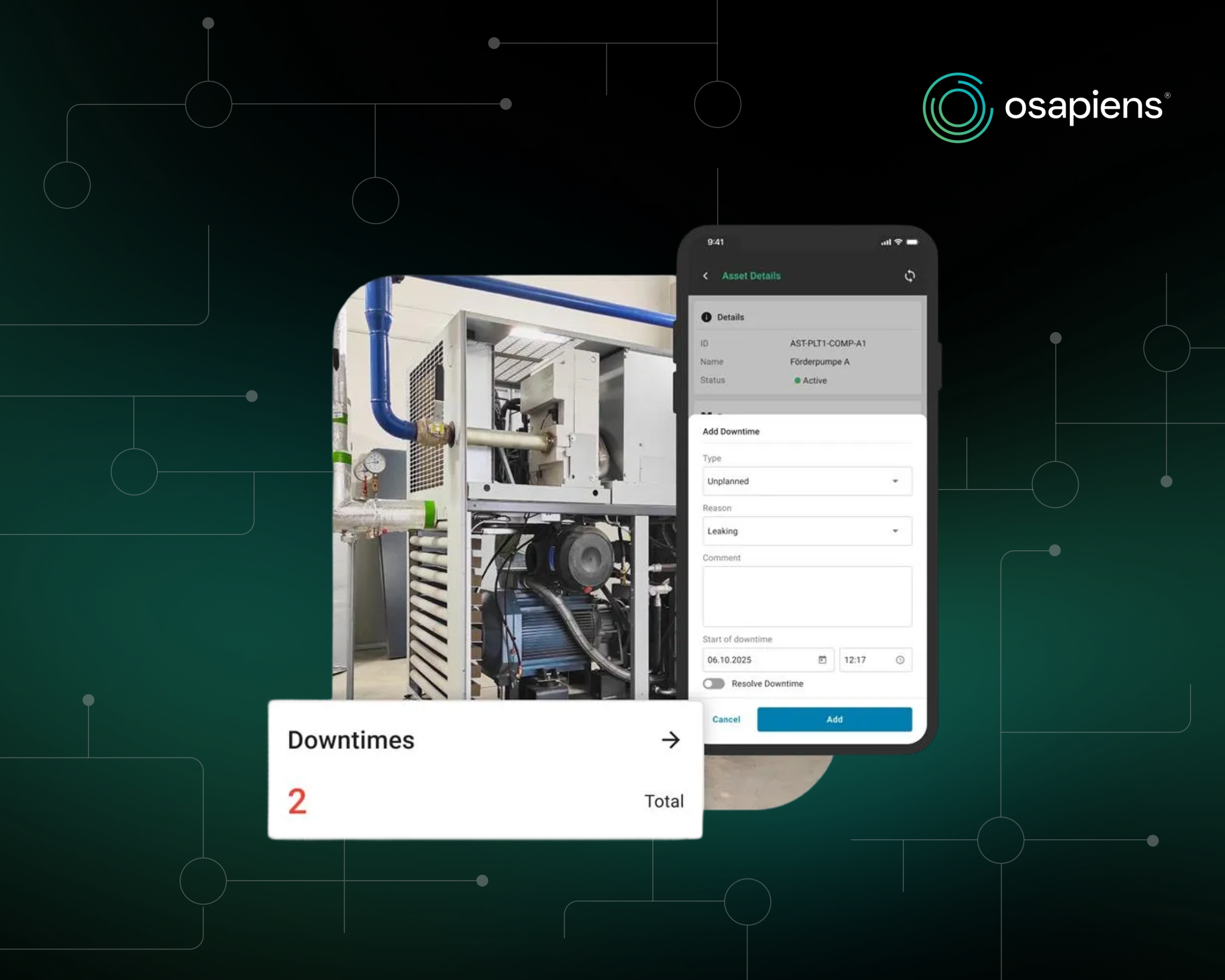
New version 3.18 – Asset upload, new asset owner persona, and downtime tracking

May 26, 2026
SAP Service and Asset Manager Alternatives 2026: The Best Solutions for Mobile Maintenance Compared
January 1, 2026
Milling Machine Maintenance Checklist – Tasks, Best Practices & Digital Execution

March 9, 2026
Field Service Management: How to optimize your resource planning
January 1, 2026
Pallet Jack Maintenance Checklist – Essential Tasks, Safety Checks & Digital Execution
January 1, 2026
Packaging Machine Maintenance Checklist – Tasks, Tips & Digital Execution
January 1, 2026
Property Maintenance Checklist – Tasks, Tips & Template

July 7, 2026
IFS Field Service Management Alternatives: 5 Options Worth Considering in 2026
January 1, 2026