

CMMS
 Tobias Schlereth,
osapiens Expert | 4. February 2026 | Lesezeit 16 min.
Tobias Schlereth,
osapiens Expert | 4. February 2026 | Lesezeit 16 min.
Meter reading software digitizes field workflows through mobile apps, enabling technicians to capture readings, validate data on-site, and sync directly with ERP systems, eliminating paperwork while maintaining cost-effective manual processes.
Book a demo
More than 2200 companies trust osapiens






Table of Contents
- Key Facts
- What Is Meter Reading Software?
- Why Utility Companies Need Meter Reading Software
- Challenges with Manual Meter Readings
- Manual Meter Reading vs. Automated Meter Reading
- Core Features of Effective Meter Reading Software for Utilities
- Choosing the Best Meter Reading Software for Utilities
- The Best Meter Reading Software Solutions
- Conclusion: Transform Your Meter Reading Process with osapiens
- FAQ
Your field technicians are driving across town with clipboards, manually recording meter readings at hundreds of locations. By the time they return to the office, half the handwritten numbers are illegible, several readings are missing, and you’re already behind schedule. Meanwhile, billing errors are piling up, customers are complaining, and your team is drowning in paperwork. Modern meter reading software transforms paper-based processes into efficient digital workflows through mobile apps that technicians use on-site.
This guide explores how meter reading software works, the core features that matter most, and how leading solutions like osapiens HUB for Maintenance help utility companies manage over 100,000 meters without investing in expensive AMR/AMI infrastructure.
Key Facts
- Digital capture replaces paper chaos: Meter reading software digitizes electricity, gas, and water meter data through mobile apps, eliminating handwritten notes and manual transcription that cause billing errors.
- On-site validation stops errors at the source: Plausibility checks validate readings against historical patterns instantly, preventing billing disputes before technicians leave customer locations.
- One planning board for all field operations: Manage technicians for both meter reading and maintenance in a single platform, maximizing productivity without juggling separate systems.
- SAP IS-U & Schleupen integration meets intuitive mobile UX: Robust backend connectivity with user-friendly apps that technicians actually adopt – no more fighting with complex SAP interfaces in the field.
What Is Meter Reading Software?
Meter reading software is a digital solution that streamlines the collection, validation, and management of consumption data from utility meters (electricity, gas, water) through mobile applications used by field technicians. It replaces manual, paper-based processes with smart digital workflows that capture meter readings on-site through intuitive mobile apps, eliminating clipboards, handwritten notes, and manual data entry.
It bridges the gap between physical meters in the field and backend billing systems, ensuring accurate data flows seamlessly from collection to invoice generation.
Primary users include:
- Utility companies and energy service providers managing water, gas, and electricity distribution and interval data
- Property management firms tracking consumption across multiple buildings
- Municipalities responsible for public utility infrastructure
Why Utility Companies Need Meter Reading Software
As utility networks grow and meter counts rise into the tens of thousands, paper-based manual processes create operational bottlenecks. Field technicians spend hours managing handwritten notes, billing teams struggle with illegible readings, and transcription errors generate customer disputes that consume valuable resources. At the same time, labor shortages make efficient technician deployment critical: every route must be optimized, and every reading must be captured correctly the first time.
The best meter reading software for utilities addresses these challenges by digitizing manual workflows while maintaining the flexibility of on-site reading operations. Here’s how modern solutions like osapiens HUB create real value:
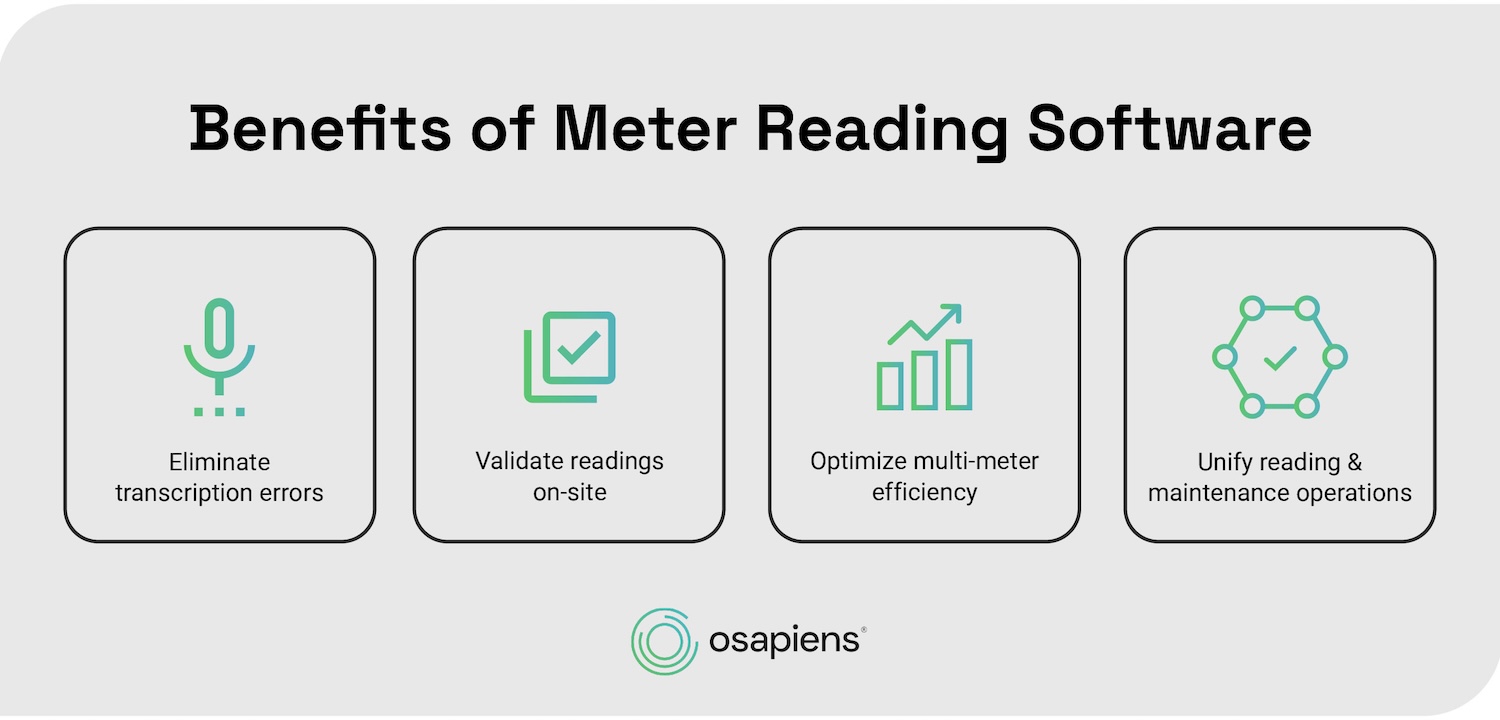
- Eliminate transcription errors: Technicians enter readings directly into mobile apps with built-in validation, removing handwritten notes and manual data entry that cause billing disputes.
- Validate readings on-site: Plausibility checks compare current readings against historical data instantly, flagging anomalies before technicians leave the customer location, preventing billing errors at the source.
- Optimize multi-meter efficiency: Streamlined mobile interfaces enable rapid reading of multiple electricity, gas, and water meters in multi-unit buildings and commercial facilities, significantly reducing time per location.
- Unify reading and maintenance operations: Integrated workforce management coordinates meter reading routes with equipment maintenance tasks in one planning board, maximizing technician productivity across all field activities. Automatic synchronization with SAP IS-U and Schleupen eliminates manual data transfers, accelerating billing cycles and improving cash flow.
As meter counts scale, workforce management becomes critical. Modern workforce management solutions like osapiens HUB help utility companies coordinate meter reading alongside maintenance tasks, optimizing technician schedules and ensuring efficient field operations across all utility processes.
Challenges with Manual Meter Readings
Manual meter reading processes create a cascade of operational headaches that extend far beyond simple data collection. Field technicians face daily obstacles that compromise accuracy and efficiency, while back-office teams struggle with the downstream consequences of flawed data.
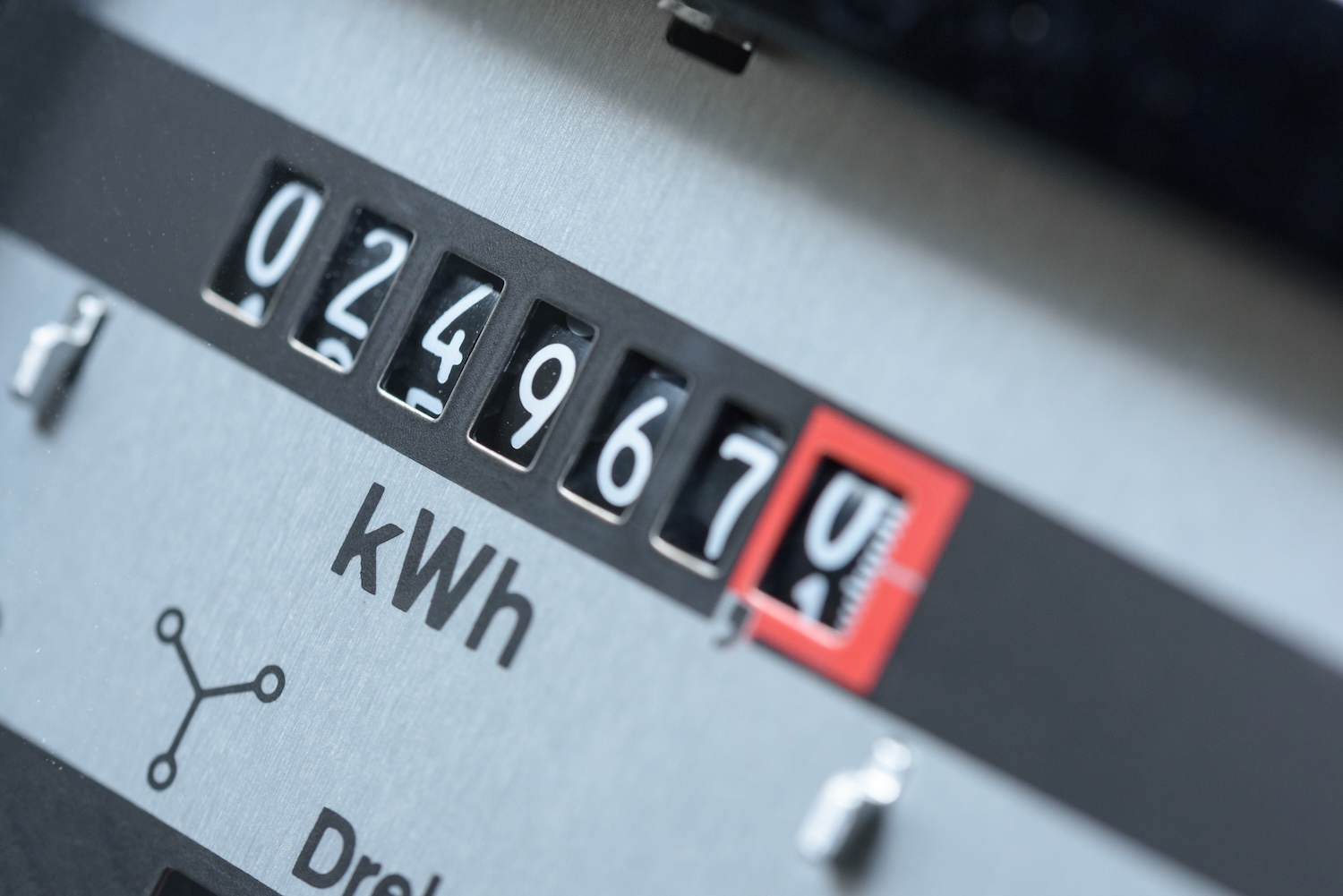
Here are the most common issues with manual meter reading:
- Human error and data quality: Handwritten notes lead to frequent data entry mistakes, which generate thousands of billing disputes annually.
- Field access problems: Locked gates, pets, and absent property owners force technicians to skip readings. When readings can’t be captured, utility companies must issue estimated bills that frustrate customers and delay accurate invoicing.
- Weather and safety risks: Extreme temperatures, storms, and hazardous conditions slow field operations and put technicians at risk during manual meter routes.
- Time consumption and high labor costs: Manual meter reading requires significant workforce investment, with technicians spending hours driving routes and recording data on paper that must later be transcribed into billing systems.
- Billing delays and cash flow impact: Missed readings force estimated bills, delaying accurate invoicing. This creates revenue recognition delays and impacts cash flow, particularly problematic for utilities managing thousands of meters across large service areas.
Manual Meter Reading vs. Automated Meter Reading
Understanding the fundamental differences between paper-based manual reading, digitally supported manual reading, and fully automated approaches helps utility companies choose the right strategy for their operations and budget.
| Aspect | Manual Meter Reading | Automated Meter Reading |
|---|---|---|
| Data Collection Method | Technician visits each meter physically | Remote data transmission via AMR/AMI |
| Accuracy Rate | 95–98 % (human errors occur) | 99.5 %+ |
| Time Required | Hours to days per route | Real-time or scheduled intervals |
| Labor Costs | High (technicians, vehicles, fuel) | Low (minimal field visits) |
| Data Availability | Delayed until manual entry complete | Immediate access to meter data |
| Error Correction Effort | Significant (requires field revisits) | Minimal (automated validation) |
| Scalability | Limited by workforce capacity | Handles 100,000+ meters efficiently |
| Weather Dependency | High (delays during extreme conditions) | None (operates continuously) |
| Infrastructure Investment | Minimal | High |
While AMR/AMI systems deliver operational advantages, the infrastructure investment can reach millions of euros for large-scale deployments. Smart meter hardware, installation labor, network infrastructure, and backend systems create substantial upfront costs that many utilities cannot justify, particularly when existing meter portfolios have years of remaining service life.
Many utilities adopt hybrid approaches that combine both methods. Mobile work order software supports manual collection with digital tools: technicians use apps to scan barcodes, capture photos, and validate readings instantly. This eliminates paperwork while maintaining flexibility for meters that require physical acces, delivering immediate efficiency improvements without hardware infrastructure investments.
Ready to Modernize Your Meter Reading Operations? See how the osapiens HUB handles meter readings in one unified platform. Reduce errors, accelerate billing, and scale effortlessly.
Core Features of Effective Meter Reading Software for Utilities
Not all meter reading software delivers the same value. While basic solutions may digitize data collection, comprehensive platforms transform entire field operations by connecting meter reading with workforce management, billing systems, and real-time analytics. Understanding which features matter most helps utility companies avoid investing in solutions that create new silos instead of solving fragmented system challenges.
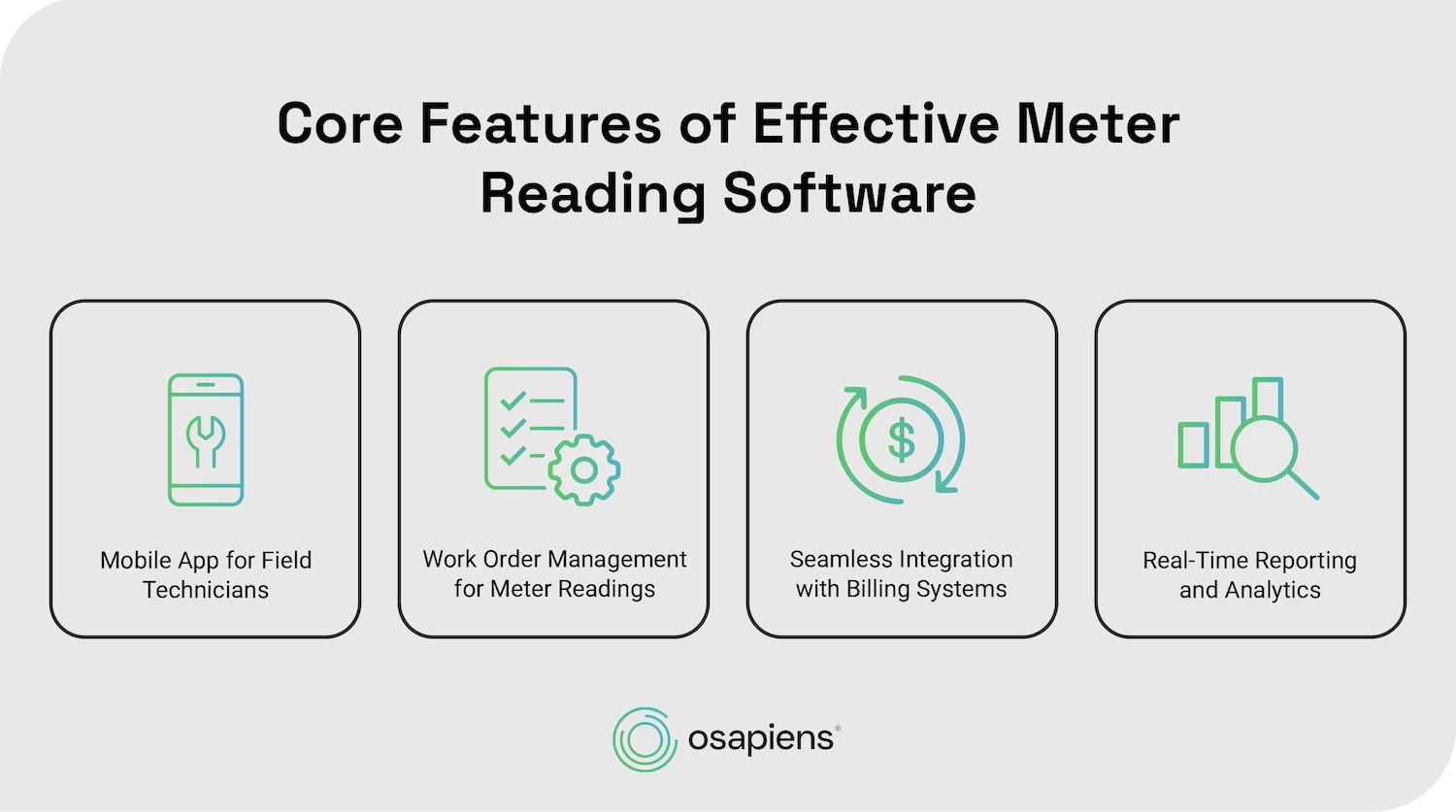
Mobile App for Field Technicians
Mobile apps replace clipboards with digital tools that work on iOS and Android devices. Offline functionality is critical: technicians capture readings, photos, and complete work orders without connectivity, syncing automatically when back online. Barcode scanning eliminates meter identification errors, GPS tracking verifies locations, and digital signatures enable on-site customer confirmation.
Key mobile capabilities:
- Full offline operation with automatic sync
- Barcode/QR code scanning for instant identification
- Photo documentation of conditions and readings
- GPS location verification with timestamps
- Digital signatures for customer confirmation
- Route optimization based on geography
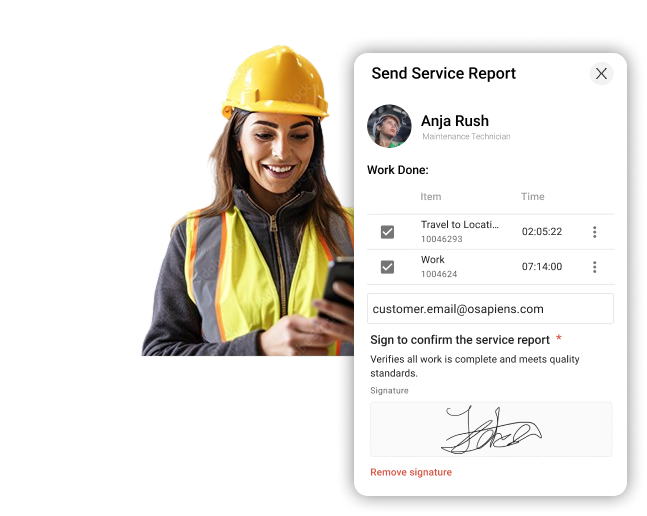
The osapiens HUB app works completely offline and syncs automatically when connectivity returns, supporting technicians across remote infrastructure locations while ensuring no data is lost during field operations.
Work Order Management for Meter Readings Routes
Work order systems generate reading assignments based on billing cycle schedules, ensuring no meters are missed. Routes are assigned to technicians by geographic location, skills, and current workload, optimizing travel time and balancing daily assignments. Real-time tracking shows dispatchers which readings are in progress, completed, or require follow-up across routine readings, meter installations, replacements, and troubleshooting visits.
Platforms like the osapiens HUB connect meter reading with maintenance scheduling in one platform. When technicians complete routine readings, they can immediately respond to nearby meter issues without returning to the office for reassignment.
Seamless Integration with Billing Systems
Integration with billing platforms eliminates manual data transfers and speeds up billing cycles. Modern software connects directly to SAP IS-U, Oracle Utilities, and other systems through APIs or database connections. Meter readings flow automatically from field collection to invoice generation without human intervention, appearing in billing systems within minutes.
This automation validates data at multiple points, catching errors before they reach customers. The result: faster billing cycles that improve cash flow, fewer disputes, and stronger customer relationships.
Real-Time Reporting and Operational Dashboard
Real-time reporting transforms field data into actionable operational insights. Dashboards provide instant visibility into reading completion rates across all routes, helping managers identify bottlenecks before they impact billing cycles. Exception reports automatically flag failed readings, suspicious consumption patterns, and meters that require attention, enabling proactive response rather than reactive troubleshooting.
Essential report types:
- Reading completion dashboards with real-time progress across all routes and technicians
- Exception reports for failed readings, access issues, and validation errors requiring follow-up
- Technician productivity metrics showing readings per hour, route efficiency, and completion times
- Historical comparison reports identifying consumption anomalies and unusual patterns
- Workforce utilization analytics for resource planning and capacity optimization
Choosing the Best Meter Reading Software for Utilities
Selecting the right meter reading software comes down to three key questions: Will it scale with your growth? Does it integrate with your existing systems? Can your team actually use it?
The best solutions grow with you seamlessly, whether you manage 500 meters today or 50,000 in five years. Integration capabilities determine whether the software eliminates system complexity or adds to it, so look for platforms that connect easily with your billing system (particularly SAP IS-U or Schleupen for utilities), ERP, and GIS through certified APIs.
Vendor experience in the utilities sector matters significantly. Providers with proven implementations at energy companies understand regulatory requirements, workforce management complexities, and the unique challenges of field operations. Consider whether cloud deployment offers the scalability and automatic updates your team needs, or if on-premise installation better serves security and compliance requirements.
Meter Reading Software Evaluation Checklist
| Evaluation Criteria | What to Look For | Why It Matters |
|---|---|---|
| Scalability | Handles current meter count + 5-year growth projections | Avoid replacing software as you grow |
| Mobile Capabilities | Offline-capable app for iOS and Android with barcode scanning, plausibility checks, and instant sync | Field technicians need tools that work everywhere |
| Integration | Certified connectors for SAP IS-U, Schleupen, or your billing system | Seamless data flow prevents manual entry and billing delays |
| User Experience | Intuitive interface requiring minimal training for technicians | Faster adoption, less resistance from field teams |
| Vendor Support | Dedicated utilities expertise and responsive help | Quick resolution when issues arise |
| Total Cost | Transparent pricing: license + implementation + maintenance | No surprise costs after commitment |
| Customization | Balance between out-of-the-box features and flexibility | Too much customization delays deployment |
The Best Meter Reading Software Solutions
Meter reading software falls into two categories: specialized platforms focused purely on meter data, and comprehensive workforce management systems that integrate readings with broader field operations. The right choice depends on your company size, existing systems, and complexity of operations.
MaintainX
MaintainX delivers user-friendly maintenance management with intuitive mobile tools for capturing meter readings and completing work orders. The mobile-first approach provides quick adoption across diverse operational contexts, though specialized utilities workflows may require more robust solutions.
Key strengths: Exceptionally intuitive interface, strong mobile functionality, accessible pricing for small to mid-sized operations.
Best for: Teams seeking straightforward digital solutions with minimal training
ToolSense
ToolSense combines meter reading with comprehensive asset tracking through IoT hardware that captures real-time data like temperature, runtime, and location. The platform serves companies where meter management represents one component of broader equipment lifecycle management rather than a standalone process.
Key strengths: IoT hardware integration, real-time asset monitoring, flexible platform for diverse equipment portfolios alongside meters.
UpKeep
UpKeep offers mobile-first CMMS with strong preventive maintenance capabilities and integrated meter reading features. The intuitive interface enables quick technician adoption, with automated work order generation based on meter schedules and usage thresholds.
Key strengths: Highly rated mobile app, preventive maintenance automation, accessible implementation with 24/7 customer support.
Best for: Small to mid-sized utilities prioritizing ease of use
axians
axians focuses on SAP Add-ons for utilities digitalization, with mobile workforce solutions for meter management deeply integrated with SAP IS-U. The company serves primarily mid-to-large European utilities that operate on SAP infrastructure and require deep integration with existing ERP systems.
Key strengths: Deep SAP integration expertise, mobile solutions for meter reading and installation.
LogObject
LogObject provides comprehensive workforce management widely adopted across Switzerland, connecting meter reading routes with maintenance activities for optimized resource allocation. The platform reflects understanding of Swiss regulatory requirements and infrastructure challenges.
Key strengths: Established Swiss market presence, integrated field service coordination, European utilities compliance standards.
Best for: Swiss utilities requiring integrated workforce management
Evora
Evora offers maintenance and meter reading solutions designed specifically for utilities and energy companies, with a focus on combining asset management with field service operations. The platform serves primarily mid-sized to large utilities that require integrated workflows connecting meter data collection with broader infrastructure maintenance. Evora’s approach emphasizes operational efficiency through unified planning tools that coordinate meter reading schedules alongside equipment maintenance, reducing system fragmentation common in the utilities sector.
Key strengths: Utilities-specific functionality, integrated workflows connecting readings with maintenance, established European customer base.
Best for: European utilities requiring integrated asset and field service management
osapiens HUB for Maintenance
The osapiens HUB for Maintenance is a complete workforce management solution made for utilities that handle large and complex field operations. Unlike fragmented systems that force utilities to juggle separate platforms for meter reading, maintenance, and field service, osapiens delivers an integrated approach where all field processes flow through one unified platform.
Key strengths:
- Field-optimized mobile app: Technicians access customer addresses, meter details, and reading notes instantly; validate readings with plausibility checks against historical data; read multiple meters efficiently in multi-unit buildings; and create tickets on-site when issues arise (all with full offline capability)
- Unified workforce management: Single planning board manages technicians for both meter reading and maintenance, eliminating system silos and maximizing field productivity across all operations
- SAP IS-U and Schleupen integration: SAP-certified connectivity with modern, user-friendly mobile interface, combining robust backend integration with high technician adoption
- Proven scalability: Successfully managing 100,000+ electricity, gas, and water meters at major European utilities
- Real-time operational visibility: Dashboards track completion rates, route efficiency, and productivity; GIS integration optimizes routes; exception reporting enables immediate response
Best for: Utilities digitizing manual meter reading operations with SAP IS-U or Schleupen infrastructure, requiring integrated workforce management across reading and maintenance activities

Alberto Ecre, Group Lead Service Digitalization Department
★ ★ ★ ★ ★Nordex
“We were looking for a cloud platform solution that supports all of our regions. Our technicians have to visit the wind turbines every day to fix problems—we need stable solutions that make their work easier. The key was the very simple integration with our ERP system. Now we are gradually expanding: subcontractor management, tool management, and more.”
Transform Manual Meter Reading into Digital Efficiency
Major European utilities like IWB Basel and BKW trust osapiens HUB to streamline their field operations. Discover how our mobile-first solution reduces reading errors and eliminates manual data entry for meter reading workflows.
Conclusion: Transform Your Meter Reading Process with osapiens
Manual meter reading remains the operational reality for most utilities worldwide, but paper-based processes create inefficiencies that utility companies can no longer afford. The best meter reading software eliminates transcription errors, reduces billing disputes, and cuts operational costs by digitizing manual workflows through mobile apps that technicians actually use. Yet many utilities still struggle with fragmented system landscapes where meter reading, maintenance, and field service operate in disconnected silos, preventing efficient resource allocation and creating blind spots in workforce management.
The osapiens HUB for Maintenance solves this by unifying manual meter reading digitization with comprehensive workforce management in one platform. Field technicians use intuitive mobile apps to capture readings from electricity, gas, and water meters with instant plausibility validation, while dispatchers manage both reading routes and maintenance tasks in one planning board. SAP-certified integration with IS-U and Schleupen ensures seamless data flow to billing systems, eliminating manual transfers. With proven success at major European utilities managing 100,000+ meters, osapiens delivers the efficiency of digital tools without requiring expensive smart meter infrastructure, transforming manual processes into streamlined operations that scale.
FAQ
What is meter reading software and how does it work?
Meter reading software digitally captures consumption data from electricity, gas, and water meters through mobile applications used by field technicians. The software provides technicians with customer information, meter details, and reading history directly in the app. Built-in plausibility checks validate readings against historical patterns instantly, flagging anomalies before technicians leave the site. Verified meter data syncs automatically to billing systems like SAP IS-U or Schleupen for invoice generation, eliminating manual transcription and reducing billing errors.
How does meter reading software improve the billing process?
Digital data capture eliminates handwritten notes and manual entry errors that cause billing disputes. Readings flow automatically from mobile apps to billing systems within minutes, accelerating billing cycles and reducing estimated bills that frustrate customers. Built-in validation catches errors at the point of capture before technicians leave customer sites, preventing billing issues rather than correcting them later. The result: faster invoicing that improves cash flow, fewer customer complaints, and reduced administrative workload.
Can meter reading software integrate with existing billing systems?
Yes, modern meter reading software for utilities integrates seamlessly with major billing platforms and ERPs through APIs, automated file transfers, or direct database connections. Solutions like osapiens offer SAP-certified integration with IS-U, ensuring meter data flows automatically to billing systems without manual intervention or data exports.
Can I use my phone as a smart meter display?
Mobile apps allow field technicians to view and record meter readings on smartphones and tablets, supporting professional data collection with barcode scanning and photo documentation. This differs from consumer smart meter displays: technician apps focus on efficient field operations rather than real-time home consumption monitoring.
How can I automate meter reading?
If you’re not ready to invest in AMR/AMI infrastructure, mobile meter reading software like osapiens HUB digitizes manual processes immediately without hardware upgrades. Technicians use mobile apps to capture readings on-site with built-in plausibility checks that validate data against historical patterns. The app provides customer addresses, meter details, special instructions, and optimized views for reading multiple meters in multi-unit buildings. Readings sync automatically with ERP systems like SAP IS-U or Schleupen, eliminating paperwork and manual entry while maintaining the flexibility and cost-effectiveness of manual reading operations. This approach delivers digital efficiency without infrastructure investments, with implementations typically completed in weeks rather than months or years.
osapiens HUB for Maintenance
Discover how our CMMS solution improves your uptime, extends the life of your equipment, and simplifies the management of your work orders.
Book a demo