

Maintenance Checklist

Florian Bartholomäus, osapiens Expert | 1. January 2026 | Lesezeit 9 min.
Most injection molding failures start with small deviations—hydraulic pressure drops, temperature fluctuations, or ejector stiffness—that go unnoticed until they cascade into costly downtime. A structured checklist organized by system ensures nothing is overlooked.
Start using this checklist for free
More than 2200 companies place their trust in osapiens












Table of Contents
- Injection Mold Maintenance: Key Facts
- Why You Need an Injection Mold Maintenance Checklist
- What to Include in Your Injection Mold Maintenance Checklist
- Common Injection Mold Problems Your Maintenance Checklist Prevents
- From Paper Checklist to Digital: How osapiens HUB Automates Your Injection Mold Maintenance Checklist
- FAQ
Injection molding machines are complex assets where hydraulic systems, thermal control, and precision mechanics must work in perfect synchronization. Without structured maintenance, small issues—contaminated hydraulic oil, worn screw flights, or clogged cooling channels—escalate into unplanned downtime, scrap production, and expensive emergency repairs. A systematic injection mold maintenance checklist ensures every critical system receives timely attention, preventing failures before they disrupt production.
Injection Mold Maintenance: Key Facts
- System interdependencies: Injection molding machines integrate hydraulic, electrical, thermal, and mechanical systems—failure in one area often cascades across others, making systematic inspection essential
- High downtime costs: Industry data shows unplanned downtime in manufacturing environments costs approximately $5,000 per hour, making preventive maintenance a critical cost-control strategy
- Documentation requirements: Regulated industries require complete maintenance traceability—timestamps, technician signatures, and corrective actions—to demonstrate compliance during audits
- Digital execution advantage: Mobile CMMS platforms like osapiens HUB for Maintenance eliminate paper checklists, enable real-time documentation, and integrate with SAP PM for seamless enterprise workflows
Why You Need an Injection Mold Maintenance Checklist
Ad-hoc maintenance and experience-based approaches leave critical inspections to chance. Here’s why structured checklists matter:
- Consistency across shifts and sites: Checklists standardize maintenance execution regardless of technician experience level, ensuring every inspection follows the same proven sequence and nothing is missed during shift handovers
- Early detection of failure modes: Systematic inspections catch hydraulic leaks, heater band degradation, and screw wear before they cause catastrophic failures, part quality issues, or safety incidents
- Audit-ready documentation: Structured checklists create verifiable records with timestamps, photos, and technician signatures—essential for ISO 9001, safety audits, and regulatory compliance in pharmaceutical or medical device manufacturing
- Technician guidance and knowledge transfer: Step-by-step procedures support less experienced team members, reduce training time, and preserve institutional knowledge when senior technicians retire or move to other roles
- Reduced reactive maintenance: Preventive checklists shift maintenance from emergency firefighting to planned interventions during scheduled production windows, reducing maintenance costs by 18–25% compared to reactive approaches
- Optimized spare parts planning: Predictable maintenance intervals enable just-in-time parts procurement, reducing inventory carrying costs while ensuring critical components are available when needed
What to Include in Your Injection Mold Maintenance Checklist
An effective injection mold maintenance checklist organizes tasks by physical system or component rather than arbitrary time intervals. This structure ensures technicians inspect related components together and understand how subsystems interact.
The table below provides a system-based checklist framework. Actual intervals and specific tasks should be adapted based on equipment usage, material type (abrasive resins accelerate wear), production environment, and manufacturer recommendations.
| Component / System | Inspection & Maintenance Tasks | Purpose |
|---|---|---|
| Hydraulic System | Check oil level and quality, inspect hoses for wear or leaks, verify pressure readings, test pump performance, inspect filters and replace if contaminated | Prevent pump failure, maintain clamping force, avoid contamination damage to valves and seals |
| Screw & Barrel Assembly | Monitor fill time consistency, check cushion variation, measure part weight stability, inspect screw flights and barrel diameter annually, verify non-return valve function | Maintain process repeatability, prevent material degradation, ensure consistent part quality and dimensional accuracy |
| Heating & Temperature Control | Verify heater band function with temperature probe, check thermocouple accuracy, inspect barrel zone temperatures, test mold temperature stability, clean heat exchanger coils | Prevent thermal instability, reduce warping and surface defects, maintain consistent cycle times and part quality |
| Mold & Ejection System | Clean cavities, runners, and gates after each cycle, inspect ejector pins for wear or binding, verify slide and lifter movement, check mold cooling channels for blockages, test venting adequacy | Prevent resin buildup, reduce ejection problems, maintain surface finish quality, avoid corrosion in cooling circuits |
| Clamp & Platen System | Inspect tiebars and bushings for wear, verify platen parallelism, check clamp force calibration, lubricate moving components, stone platen surfaces between mold changes | Maintain mold sealing, prevent flash formation, protect expensive mold components from accelerated wear |
| Electrical Cabinet & Controls | Clean dust accumulation with compressed air, inspect electrical connections for looseness, verify circuit board condition, check ventilation system function, measure insulation resistance | Prevent electrical fires, reduce control system failures, maintain safe operating conditions and equipment reliability |
| Safety Systems & Interlocks | Test emergency stop buttons, verify guard interlocks, inspect safety barriers, check lockout-tagout points, validate alarm systems | Protect operators from injury, ensure OSHA compliance, prevent accidents during maintenance or production |
This checklist structure enables technicians to work systematically through each machine subsystem. For detailed guidance on implementing preventive maintenance strategies, see our guide on preventive maintenance best practices.
Turn Your Injection Mold Maintenance Checklist into Mobile Work Orders
Create structured checklists for every system—from hydraulic circuits to mold cooling. Execute them on mobile devices, capture photos at critical steps, sync with SAP PM, and maintain complete audit trails automatically.Start with Your Injection Mold Maintenance Checklist
Common Injection Mold Problems Your Maintenance Checklist Prevents
A structured maintenance checklist directly addresses the most common—and costly—failure modes in injection molding operations:
- Hydraulic system contamination and failure: Contaminated hydraulic oil introduces metallic particles that damage precision valves and seals, leading to pump breakdowns and complete system flushing that can cost over $30,000 and require multiple days of downtime—prevented through regular oil analysis and filter replacement
- Screw and barrel wear causing process variability: Abrasive materials accelerate wear on screw flights and barrel surfaces, creating fill time inconsistencies, part weight fluctuations, and dimensional inaccuracies that increase scrap rates—caught early through systematic monitoring of process parameters
- Heater band and temperature control failures: Degraded heater bands cause barrel temperature fluctuations exceeding acceptable limits, resulting in warping, surface defects, and material degradation—identified through quarterly temperature verification before affecting part quality
- Mold fouling and ejection problems: Resin residue accumulation in cavities, runners, and on ejector pins creates surface defects, ejection difficulties, and accelerated component wear—prevented through systematic cleaning protocols after each production cycle
- Cooling system restrictions and corrosion: Mineral deposits and corrosion in mold cooling channels reduce heat transfer efficiency, increase cycle times, and create temperature imbalances that cause part warping—addressed through regular descaling and water quality management
- Electrical cabinet degradation: Dust accumulation, moisture ingress, and loose connections create fire hazards and control system failures that halt production for days while replacement components are sourced—prevented through routine cabinet cleaning and connection inspection
Each of these failure modes is predictable and preventable with systematic inspection. For organizations managing maintenance across multiple sites, asset maintenance software provides centralized visibility into equipment health and maintenance compliance.
From Paper Checklist to Digital: How osapiens HUB Automates Your Injection Mold Maintenance Checklist
Paper checklists, Excel spreadsheets, and PDF forms create friction in maintenance execution. Technicians carry clipboards to equipment, manually document findings, later transcribe data into computer systems, and track information across multiple disconnected files. This workflow generates lost data, illegible notes, and incomplete records that undermine compliance and continuous improvement.
osapiens HUB for Maintenance transforms injection mold maintenance through mobile-first execution and SAP PM integration. Technicians receive work orders on smartphones or tablets, complete interactive checklists with mandatory photo capture at critical steps, and document observations through voice-to-text while working hands-on. The platform operates offline in areas without connectivity, automatically syncing data when connection resumes.
Every completed checklist creates an audit-ready record with timestamps, technician signatures, and attached photos—eliminating manual documentation effort while ensuring compliance. Integration with SAP PM enables seamless data exchange with enterprise systems, maintaining a single source of truth for asset history, parts consumption, and maintenance costs.
| Aspect | Paper or Excel Checklist | Digital Checklist with osapiens HUB |
|---|---|---|
| Data Capture Location | Manual entry on clipboard, later transcribed to computer | Direct entry at equipment via mobile device, no transcription needed |
| Photo Documentation | Separate camera, manual file management, difficult to link to specific tasks | Integrated photo capture linked directly to checklist steps and work orders |
| Offline Capability | Paper works anywhere but creates data entry backlog | Full offline functionality with automatic sync when connectivity returns |
| Audit Trail | Manual signatures, timestamps added later, prone to errors | Automatic timestamps, digital signatures, complete traceability for every action |
| Historical Analysis | Scattered across file cabinets and spreadsheets, difficult to analyze trends | Centralized database enables trend analysis, failure pattern recognition, and KPI tracking |
| Integration with ERP | Manual data transfer, high error rate, significant administrative burden | Seamless SAP PM integration with bidirectional data synchronization |
This digital transformation reduces administrative burden, improves data quality, and enables predictive maintenance strategies based on actual equipment performance. Learn more about digital work order management and how it streamlines maintenance execution.
Stop Losing Production Time to Injection Molding Failures
Digitize your maintenance checklists, automate preventive work orders, and give every technician a mobile tool that works offline. Full SAP PM integration and audit-ready documentation included.Try osapiens HUB for Free
FAQ
What should be included in an injection mold maintenance checklist?
An effective checklist covers all critical systems: hydraulic components (oil quality, pressure, hoses), screw and barrel (wear indicators, process consistency), temperature control (heater bands, thermocouples, mold cooling), mold condition (cleaning, ejection system, cooling channels), clamp system (parallelism, force calibration), electrical cabinet (cleanliness, connections), and safety systems (interlocks, emergency stops). Customize based on equipment type, material processed, and production environment.
How often should I complete my injection mold maintenance checklist?
Maintenance frequency depends on production volume, material type, and equipment criticality. Common practice includes daily operator-level cleaning and visual inspections, weekly checks for leaks and moving component function, monthly deep inspections of heating and cooling systems, and annual comprehensive evaluations including screw extraction and hydraulic system analysis. High-volume operations processing abrasive materials require more frequent intervals than low-volume facilities using standard resins.
Can I customize this injection mold maintenance checklist template?
Customization is essential for effective maintenance. Adapt the checklist to your specific equipment model, manufacturer recommendations, material types processed, production environment, and regulatory requirements. Add equipment-specific tasks, adjust intervals based on actual usage patterns, and incorporate lessons learned from past failures. Digital CMMS platforms like osapiens HUB enable easy customization while maintaining standardization across similar equipment.
How does a digital CMMS improve maintenance checklist management?
A digital CMMS eliminates paper-based friction through mobile execution at equipment, automatic work order generation based on time or usage triggers, mandatory photo documentation at critical steps, real-time visibility for supervisors into completion status, and automatic creation of audit-ready records with timestamps and signatures. Integration with SAP PM ensures maintenance data flows seamlessly into enterprise systems, supporting cost tracking, parts management, and compliance reporting. Explore cloud-based maintenance management benefits for injection molding operations.
Start using osapiens for free
Improve your uptime, extend the life of your equipment, and simplify work order management.
Book a demo
Related content
January 1, 2026
MIG Welding Machine Maintenance Checklist – Tasks, Tips & Template
January 1, 2026
Tablet Press Maintenance Checklist – Tasks, Tips & Template
January 1, 2026
Assembly Line Equipment Maintenance Checklist – Tasks, Tips & Digital Execution
April 17, 2025
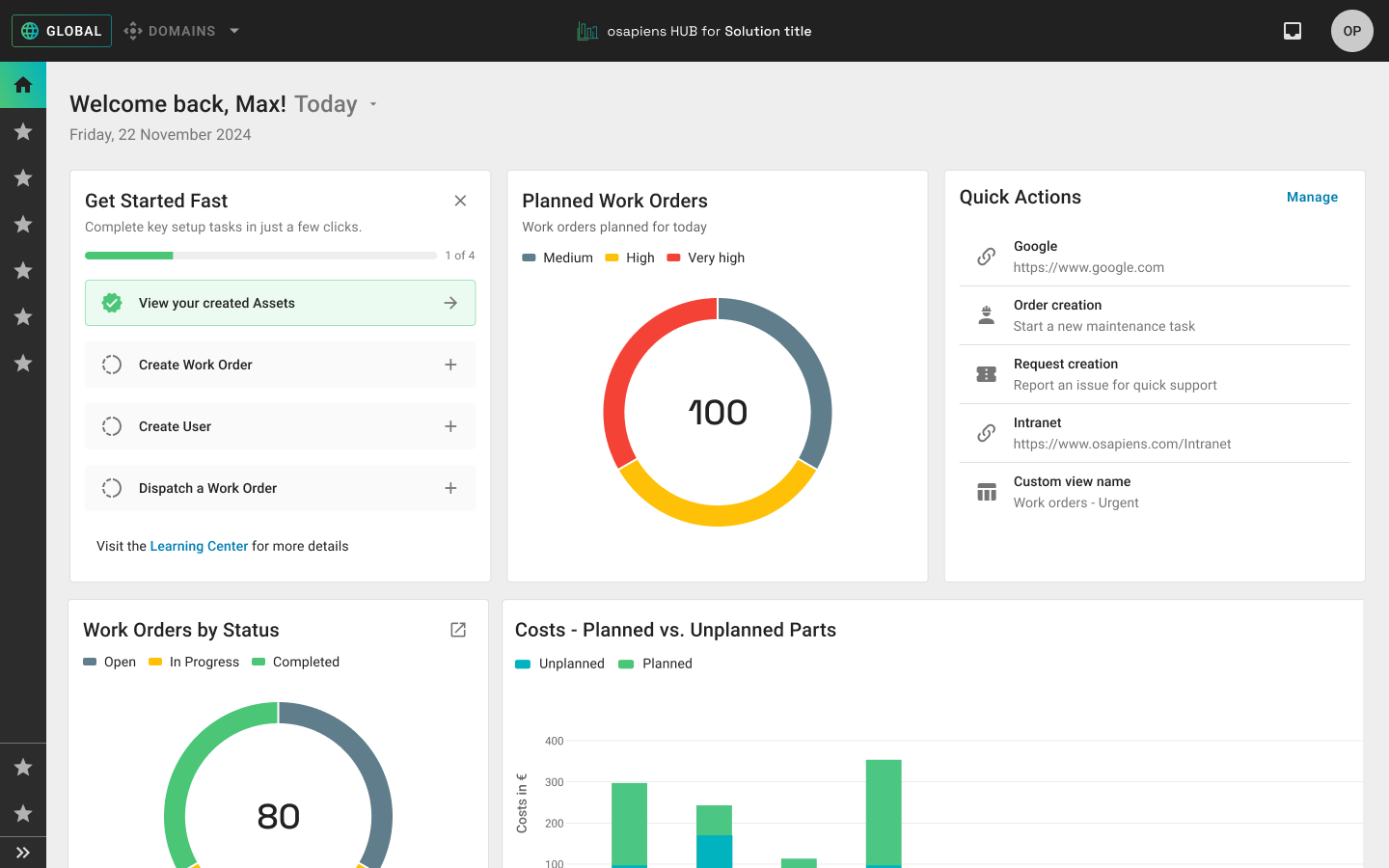
Version 3.15 – New Dashboards, Spare Part Management and Cost Tracking, Simplified Planning
January 1, 2026
Material Handling Equipment Maintenance Checklist: Tasks, Intervals & Digital Execution
January 1, 2026
Access Control Maintenance Checklist – Tasks, Tips & Template
January 1, 2026
Automatic Sliding Door Preventive Maintenance Checklist – Tasks, Tips & Best Practices
January 1, 2026
Conveyor Belt Preventive Maintenance Checklist – Tasks, Tips & Digital Execution
January 1, 2026
Furnace Maintenance Checklist – Tasks, Tips & Template
January 1, 2026
Electrical Preventive Maintenance Checklist – Tasks, Safety & Digital Execution
January 1, 2026
Powder Coating Equipment Maintenance Checklist – Tasks, Safety & Digital Execution

July 21, 2025