

Maintenance Checklist

Florian Bartholomäus, osapiens Expert | 1. January 2026 | Lesezeit 8 min.
Most shot blasting failures trace back to worn blast wheel blades or clogged dust collectors. Measure blade-to-wear-bar gaps weekly and monitor separator pressure daily—catching wear early prevents cascading damage to control cages and liners.
Create your checklist for free













TRUSTED BY LEADING COMPANIES




ENTERPRISE-READY
 SAP Certification
 ISO 27001
 EU Hosting
 Entra ID & Okta
 Multi-Entity
Table of Contents
- Shot Blasting Machine Maintenance: Key Facts
- Why You Need a Shot Blasting Machine Maintenance Checklist
- What to Include in Your Shot Blasting Machine Maintenance Checklist
- Common Shot Blasting Machine Problems Your Maintenance Checklist Prevents
- From Paper Checklist to Digital: How the osapiens HUB Automates Your Shot Blasting Machine Maintenance Checklist
- FAQ
Shot blasting machines operate in one of the harshest industrial environments: accelerating steel shot at high velocity creates extreme wear on blast wheels, liners, and dust collection systems. Without structured maintenance, unplanned downtime becomes difficult to predict, and repair costs escalate as worn components damage surrounding parts. A comprehensive shot blasting machine maintenance checklist transforms reactive repairs into planned interventions, reducing failures and extending equipment life.
Shot Blasting Machine Maintenance: Key Facts
- Systematic maintenance reduces downtime: Structured checklists catch wear before blast wheel blades, control cages, or liners fail catastrophically, preventing multi-component repairs.
- Dust collection is critical: Clogged filters and worn separator screens reduce visibility, contaminate abrasive media, and accelerate corrosion—daily monitoring prevents cascading failures.
- Abrasive quality affects equipment life: Contaminated media increases wear rates on blast wheels and liners; regular media inspection protects equipment and maintains surface quality.
- Digital execution improves consistency: Mobile checklists with preventive maintenance scheduling ensure technicians complete every inspection, capture photos, and build audit-ready records automatically.
Why You Need a Shot Blasting Machine Maintenance Checklist
Shot blasting equipment experiences continuous mechanical stress that creates predictable wear patterns—but only if maintenance teams inspect the right components at the right intervals.
- Consistency across shifts: A structured checklist ensures every operator and technician follows the same inspection sequence, eliminating gaps caused by experience-based maintenance or memory lapses.
- Early detection of wear: Measuring blade gaps, checking separator pressure, and inspecting seals weekly reveals degradation before components fail, preventing emergency shutdowns and secondary damage.
- Technician guidance: Detailed checklists with acceptance criteria help less experienced team members identify abnormal wear, measure critical dimensions, and escalate issues appropriately.
- Audit-ready documentation: Recording inspection results, measurements, and corrective actions creates the traceability that regulatory agencies and quality audits require, supporting compliance and operational resilience.
- Standardization across sites: Facilities operating multiple shot blasting machines benefit from repeatable processes that enable performance comparison and continuous improvement.
- Risk reduction: Worn seals, damaged door gaskets, and degraded electrical components create safety hazards; systematic inspection protects workers and prevents costly incidents.
What to Include in Your Shot Blasting Machine Maintenance Checklist
An effective shot blasting machine checklist organizes tasks by component or system rather than by arbitrary time intervals. This structure reflects how equipment actually wears and helps technicians focus on the specific areas that require attention.
The checklist below provides a component-based framework. Actual inspection frequency depends on machine usage, abrasive type, production hours, and environmental conditions—high-volume operations require more frequent checks than occasional-use equipment.
| Component / System | Inspection & Maintenance Tasks | Purpose |
|---|---|---|
| Blast Wheel & Blades | Measure blade wear and gap to wear bar; inspect for cracks or uneven wear; check wheel balance and vibration; verify directional sleeve position | Maintain blast velocity, prevent secondary damage, ensure pattern uniformity |
| Control Cage & Wear Bar | Inspect control cage for wear and cracks; measure wear bar thickness; check fasteners and mounting; verify alignment | Protect blast wheel assembly, maintain abrasive flow, prevent catastrophic failure |
| Dust Collection System | Inspect filter cartridges for tears or excessive dust; check differential pressure; verify pulse cleaning function; inspect ductwork for leaks; clean separator screens | Maintain visibility, prevent abrasive contamination, protect electrical components |
| Abrasive Media & Separator | Inspect media for contamination and particle size; check separator spiral shell and flow screen; verify hopper gate valve operation; measure media inventory | Ensure blast consistency, reduce equipment wear, maintain surface quality |
| Chamber Liners & Seals | Inspect manganese liners for wear and displacement; check door seals and gaskets; verify rubber guards and top seals; inspect bottom plate grid | Contain abrasive, prevent leakage, protect structural integrity |
| Drive System & Belts | Measure belt tension; inspect for wear and cracking; check alignment; verify motor current; listen for unusual sounds; lubricate bearings | Ensure reliable power transmission, prevent unexpected failures, extend component life |
| Electrical & Controls | Inspect contactors for carbon buildup; check wiring connections; verify limit switches and proximity sensors; test emergency stops; clean control enclosures | Prevent electrical faults, ensure safety systems function, maintain control reliability |
Turn Your Shot Blasting Machine Maintenance Checklist into Digital Work Orders
Create structured checklists for every component—from blast wheels to dust collectors. Execute them on mobile, sync with SAP PM, and keep full audit trails automatically.Start with Your Shot Blasting Machine Maintenance Checklist
Common Shot Blasting Machine Problems Your Maintenance Checklist Prevents
Structured maintenance addresses the failure modes that create the most downtime and cost in shot blasting operations.
- Blast wheel blade failure: Worn blades lose velocity and create uneven patterns; when blades fail suddenly, they damage wear bars and control cages. Weekly measurement and planned replacement prevent cascading damage.
- Dust collector blockage: Clogged filters reduce air flow, decrease visibility, and allow dust to penetrate electrical components. Daily pressure checks and filter inspection prevent system failure.
- Abrasive media contamination: Fines, rust, and mill scale accumulate in recirculated media, reducing blast efficiency and accelerating equipment wear. Regular separator inspection and media quality checks maintain process consistency.
- Seal and gasket deterioration: Worn door seals allow abrasive escape, creating safety hazards and environmental contamination. Routine inspection and replacement maintain containment.
- Bearing and drive failures: Inadequate lubrication and missed vibration warnings lead to bearing seizure and motor damage. Scheduled lubrication and condition-based monitoring prevent unexpected failures.
- Documentation gaps: Missing maintenance records create compliance risk and make troubleshooting difficult. Digital checklists with automatic timestamps and photo capture ensure complete, audit-ready documentation.
From Paper Checklist to Digital: How the osapiens HUB Automates Your Shot Blasting Machine Maintenance Checklist
Paper-based checklists and Excel spreadsheets create friction that undermines even well-designed maintenance programs. Technicians must carry printed forms, record measurements manually, and transcribe notes into separate systems—creating delays, data entry errors, and incomplete records.
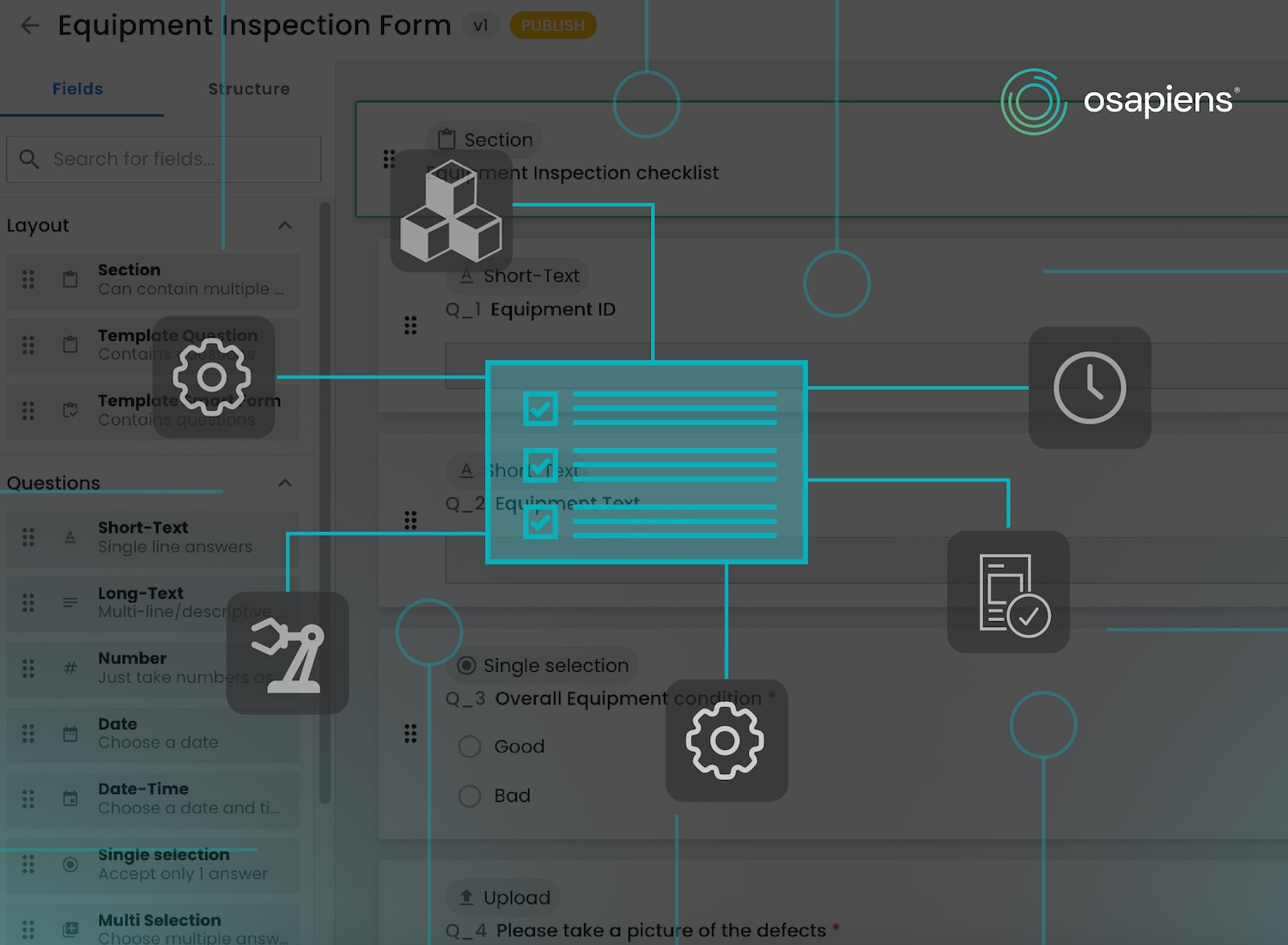
The osapiens HUB for Maintenance eliminates these media breaks by providing mobile-first work order execution that technicians use directly at the equipment. Checklists appear on smartphones or tablets, with step-by-step instructions, acceptance criteria, and historical data accessible in real time.
| Paper or Excel Checklist | Digital Checklist with osapiens HUB |
|---|---|
| Technicians carry printed forms that are easily lost or damaged | Checklists accessible on mobile devices, online and offline |
| Manual data entry creates transcription errors and delays | Data captured once, synced automatically to central system |
| Photos require separate camera, manual attachment | Photos captured directly in work order with timestamps and annotations |
| Historical data requires searching through files or spreadsheets | Complete maintenance history visible in seconds via asset record |
| Compliance documentation assembled manually for audits | Audit trails generated automatically with signatures and timestamps |
| No integration with spare parts or scheduling systems | Full SAP PM integration, parts tracking, and automated scheduling |
The osapiens HUB supports preventive maintenance scheduling based on calendar intervals, operating hours, or production cycles, automatically generating work orders and assigning them to qualified technicians. When inspections reveal wear exceeding thresholds, the system triggers corrective work orders immediately, reducing response time and preventing failures.
For organizations using SAP S/4HANA, the osapiens HUB serves as a mobile execution layer that technicians actually use, while maintaining full data synchronization with SAP PM for financial reporting and enterprise planning. This hybrid approach delivers modern usability without replacing existing ERP investments.
Stop Losing Uptime to Missed Shot Blasting Inspections
Digitize your maintenance checklists, automate work order creation, and give every technician a mobile tool that works—even offline. SAP PM integration included.Try osapiens HUB for Free
FAQ
What should be included in a shot blasting machine maintenance checklist?
A comprehensive checklist covers blast wheel components (blades, control cage, wear bar), dust collection system (filters, separator, ductwork), abrasive media quality (contamination, particle size), chamber liners and seals, drive system and belts, and electrical controls and safety systems. Specific tasks include measuring blade wear, checking filter pressure, inspecting seals, verifying motor current, and documenting all findings. Checklists should specify acceptance criteria and trigger corrective actions when conditions fall outside normal ranges.
How often should I complete my shot blasting machine maintenance checklist?
Inspection frequency depends on production volume, abrasive type, and equipment design. High-volume operations often perform daily operator checks (visual inspection, dust system, media level), weekly technician inspections (blade measurement, belt tension, separator function), and monthly detailed servicing (lubrication, electrical inspection, filter replacement). Equipment used occasionally may extend intervals, but critical wear components like blast wheel blades still require regular measurement. Condition-based approaches using vibration monitoring and current measurement can supplement fixed schedules.
Can I customize this shot blasting machine maintenance checklist template?
Yes—effective checklists must reflect your specific equipment model, manufacturer recommendations, production environment, and operational risk profile. Customize task descriptions, acceptance criteria, and inspection intervals based on your machine’s blast wheel diameter, rotational speed, abrasive type, and historical wear patterns. Digital CMMS platforms like osapiens HUB allow you to create equipment-specific checklists with custom fields, conditional logic, and automated scheduling tailored to each asset.
How does a digital CMMS improve maintenance checklist management?
A modern CMMS eliminates paper-based friction by providing mobile checklist execution directly at the equipment, with photos, measurements, and observations captured in real time. The system automatically schedules recurring inspections, assigns work to qualified technicians, and tracks completion rates. Historical data enables trending analysis to identify wear patterns and optimize maintenance intervals. SAP PM integration ensures maintenance data flows seamlessly into enterprise systems for financial reporting and planning. For shot blasting equipment, this means faster inspections, complete documentation, and fewer missed tasks—reducing unplanned downtime and extending equipment life.
Start using osapiens for free
Improve your uptime, extend the life of your equipment, and simplify work order management.
Book a demo
ENTERPRISE CAPABILITIES
- SAP ECC & S/4HANA Certified
- Infor & MS Dynamics
- Microsoft Entra ID / Okta
- ISO 27001 & 9001
- EU Cloud · Data Sovereignty
- Development, Test, and Production Environments
- Multi-Entity & Multi-Site
- Power BI Integration
- Audit Trail & Compliance
Related content

March 24, 2026
Multi-Site CMMS Software: How to Choose the Right Platform and Roll It Out Across Every Site

December 17, 2025
maintenance Antwerp: Experience the osapiens CMMS live
January 1, 2026
Centrifugal Fan Maintenance Checklist – Tasks, Best Practices & Digital Execution

November 24, 2025
Benefits of Predictive Maintenance in Manufacturing
January 1, 2026
Power Cable Maintenance Checklist – Tasks, Tips & Template

September 19, 2025
Meet the osapiens maintenance experts at Pharma Maintenance Reloaded 2025
January 1, 2026
Turret Punch Press Maintenance Checklist – Tasks, Tips & Template
January 1, 2026
UPS Maintenance Checklist – Tasks, Tips & Template
January 1, 2026
Bioreactor Maintenance Checklist – Tasks, Compliance & Digital Execution
January 1, 2026
Fire Extinguisher Maintenance Checklist – Tasks, Tips & Best Practices

January 30, 2026
Scheduling Software for Field Service: How to Optimize Dispatching

April 10, 2026