

Maintenance Checklist

Florian Bartholomäus, osapiens Expert | 1. January 2026 | Lesezeit 8 min.
Most mixer failures trace back to overlooked seals and bearings. Check these components weekly—not just when you hear unusual noise. A 15-minute inspection can prevent weeks of downtime and costly emergency repairs.
Create your checklist for free













TRUSTED BY LEADING COMPANIES




ENTERPRISE-READY
 SAP Certification
 ISO 27001
 EU Hosting
 Entra ID & Okta
 Multi-Entity
Table of Contents
- Industrial Mixer Maintenance: Key Facts
- Why You Need a Industrial Mixer Maintenance Checklist
- What to Include in Your Industrial Mixer Maintenance Checklist
- Common Industrial Mixer Problems Your Maintenance Checklist Prevents
- From Paper Checklist to Digital: How the osapiens HUB Automates Your Industrial Mixer Maintenance Checklist
- FAQ
Industrial mixers are critical assets in pharmaceutical, chemical, food processing, and specialty manufacturing. When properly maintained, these machines deliver reliable performance, consistent product quality, and long service life. Without structured maintenance, even the most durable equipment suffers costly breakdowns, unplanned downtime, and safety risks.
This guide provides a practical Industrial Mixer maintenance checklist designed to reduce downtime, extend equipment life, and ensure compliance with safety and quality standards. You’ll learn which tasks to perform, how often to perform them, and how digital tools like osapiens HUB for Maintenance transform paper-based checklists into automated, audit-ready workflows.
Industrial Mixer Maintenance: Key Facts
- Consistency: Structured checklists eliminate guesswork and ensure every technician follows proven procedures, reducing variability in maintenance quality.
- Risk reduction: Regular inspections catch developing problems—seal wear, shaft misalignment, bearing degradation—before they escalate into catastrophic failures.
- Documentation: Complete maintenance records support regulatory compliance, enable root cause analysis, and provide legal protection in case of incidents.
- Digital execution: Mobile CMMS platforms like osapiens HUB enable technicians to execute checklists at the equipment, capture photos, and sync data instantly—eliminating paper forms and manual transcription.
Why You Need a Industrial Mixer Maintenance Checklist
Industrial mixers operate under demanding conditions: high torque, variable viscosities, abrasive materials, and continuous duty cycles. Without systematic maintenance, wear patterns accelerate and failures become unpredictable.
A structured checklist addresses these challenges:
- Consistency: Ad-hoc maintenance relies on individual technician memory and experience. When senior technicians retire, institutional knowledge disappears. A documented checklist ensures every technician—regardless of experience level—follows the same proven procedures.
- Risk reduction: Mixer failures often involve seal leaks, bearing failures, shaft misalignment, and impeller damage. These problems rarely appear suddenly—they develop gradually through detectable warning signs. Regular checklist-driven inspections catch these early indicators before they cause equipment failure.
- Documentation: Regulatory bodies and quality management systems require evidence that equipment was maintained according to documented procedures. A checklist creates the audit trail necessary for compliance with GMP, FDA standards, and ISO 9001 requirements.
- Technician guidance: Less experienced team members benefit from clear, step-by-step instructions that specify what to check, how to recognize problems, and when to escalate to senior technicians or equipment specialists.
- Standardization: When multiple mixers operate across shifts or sites, checklists ensure consistent maintenance quality regardless of who performs the work or when it occurs.
- Compliance: In regulated industries like pharmaceuticals and food processing, maintenance documentation supports product quality investigations and demonstrates that equipment was maintained to prevent contamination or quality issues.
What to Include in Your Industrial Mixer Maintenance Checklist
An effective Industrial Mixer maintenance checklist organizes tasks by the physical component or system being maintained, not by arbitrary time intervals. This structure helps technicians focus on the equipment itself rather than calendar schedules.
Your checklist should include logical sections such as visual inspection, functional checks, safety verification, cleaning and servicing, and documentation steps. The specific tasks depend on your mixer type, operating environment, and manufacturer recommendations.
The table below organizes maintenance tasks by component and system. Actual maintenance intervals depend on usage intensity, operating environment, and risk assessment—not fixed schedules alone.
| Component / System | Inspection & Maintenance Tasks | Purpose |
|---|---|---|
| Impellers & Agitators | Inspect for cracks, chips, blade wear, weld integrity; check balance; verify clearance to tank walls | Mixing efficiency, prevent imbalance vibration, avoid contamination from damaged blades |
| Seals & Shaft Sleeves | Check for leaks, cracks, wear; inspect seal faces; verify air pressure (air-purged seals); replace worn seals and sleeves together | Prevent leakage, contamination, and shaft damage; maintain sanitary operation |
| Bearings & Couplings | Inspect for wear, rough spots, grinding noise; verify lubrication; check coupling alignment | Reduce friction, prevent premature failure, ensure smooth shaft rotation |
| Shaft & Alignment | Check shaft straightness; verify alignment; inspect for bending, warping, or vibration; measure runout | Prevent cascading failures, reduce bearing stress, maintain equipment balance |
| Gearbox & Drive System | Check oil levels; inspect for leaks; verify belt/chain tension; lubricate reducer; monitor amperage draw | Reliable power transmission, prevent overheating, extend component life |
| Motor & Electrical | Verify proper operation; check VFD settings; inspect connections; monitor temperature; test grounding | Ensure safe electrical operation, prevent motor failure, maintain speed control |
| Cleaning & Sanitation | Remove material buildup from shafts, impellers, and tank; verify CIP system function; inspect for residue | Product quality, prevent cross-contamination, maintain equipment balance |
| Safety Systems | Test emergency stops; verify lockout/tagout devices; inspect guards and interlocks; check confined space procedures | Worker safety, regulatory compliance, prevent accidental startup |
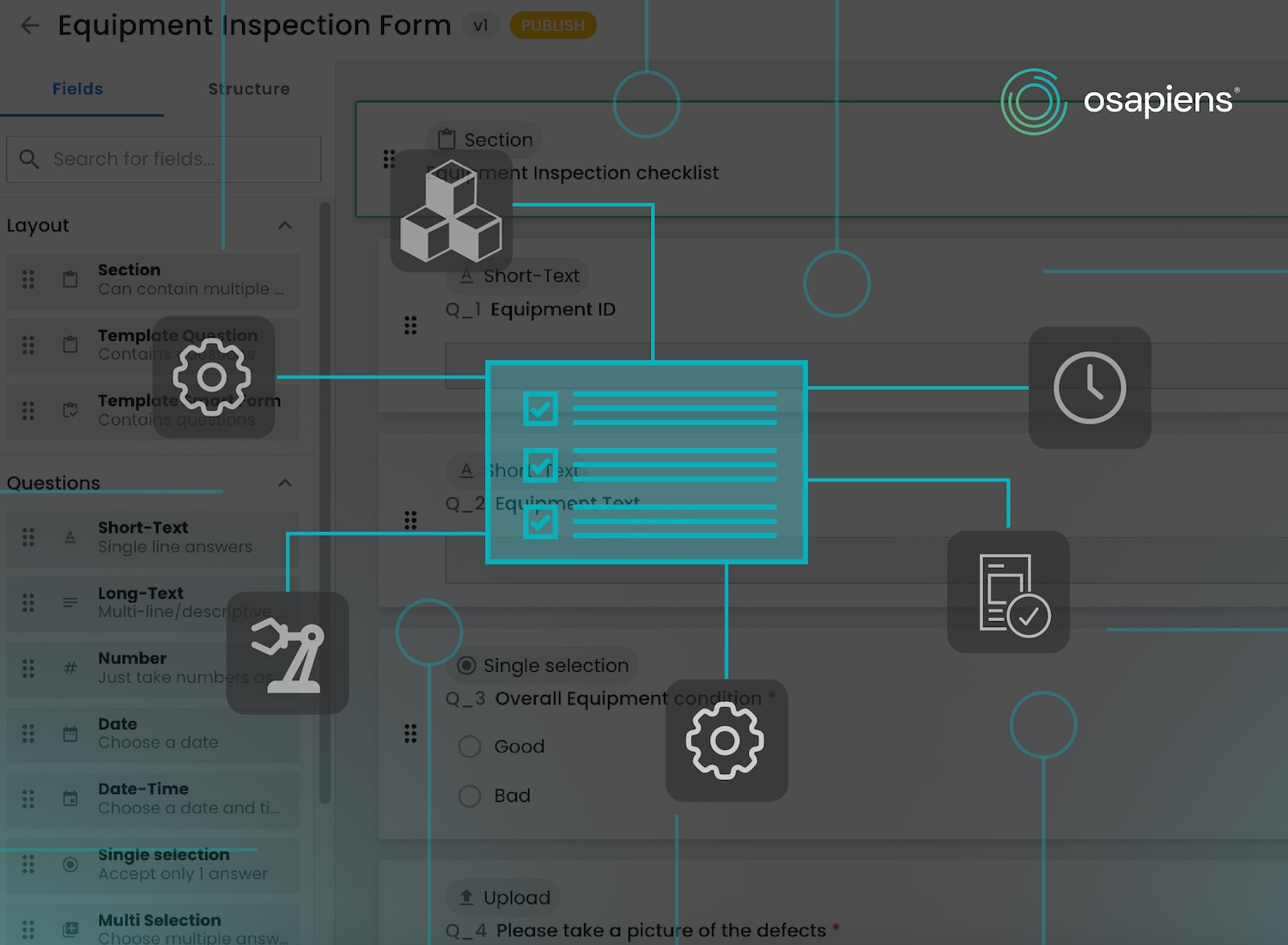
This component-based structure ensures technicians address every critical system during maintenance activities. Digital platforms like osapiens HUB for Maintenance enable you to build equipment-specific checklists that automatically generate work orders based on usage, condition thresholds, or calendar intervals.
Turn Your Industrial Mixer Maintenance Checklist into Digital Work Orders
Create structured checklists for every component—from impellers to seals to gearboxes. Execute them on mobile, sync with SAP PM, and keep full audit trails automatically.Start with Your Industrial Mixer Maintenance Checklist
Common Industrial Mixer Problems Your Maintenance Checklist Prevents
Structured maintenance checklists directly address the most common failure modes that cause unplanned downtime and safety incidents in mixer operations:
- Seal and bearing failures: These components typically last 6–12 months depending on operating conditions. Regular inspection catches early wear signs—leaks, unusual noise, rough rotation—allowing scheduled replacement during planned maintenance windows rather than emergency shutdowns.
- Shaft misalignment and bending: Misalignment generates excessive vibration, accelerates bearing wear, and can bend shafts over time. Monthly alignment checks prevent the cascading failures that result from uncorrected misalignment.
- Impeller damage: Chipped blades, weld cracks, and worn edges reduce mixing efficiency and can introduce metal fragments into product batches. Regular visual inspection identifies damage before it compromises product quality or causes catastrophic blade separation.
- Material buildup: Product accumulation on shafts and impellers creates imbalance, affects mixing performance, and can cause cross-contamination between batches. Scheduled cleaning prevents these problems and maintains equipment balance.
- Lubrication failures: Inadequate lubrication causes overheating, accelerates wear, and leads to premature component failure. Checklist-driven lubrication ensures moving parts receive proper lubricants at appropriate intervals.
- Documentation gaps: When maintenance activities aren’t documented, organizations lack the evidence needed for regulatory compliance, root cause analysis, or legal protection following incidents. Digital checklists automatically create complete, timestamped records.
According to industry research, organizations with predominantly preventive maintenance approaches achieve 60–80% fewer unplanned equipment failures compared to reactive approaches. For more on preventive strategies, see our guide on preventive maintenance best practices.
From Paper Checklist to Digital: How the osapiens HUB Automates Your Industrial Mixer Maintenance Checklist
Paper-based and spreadsheet-driven maintenance creates friction that undermines checklist effectiveness. Technicians must print forms, carry them to equipment, write findings by hand in difficult conditions, and then transcribe results into management systems. This process introduces errors, loses information when forms are damaged, and delays data availability.
Digital maintenance execution through osapiens HUB for Maintenance eliminates these barriers:
| Paper or Excel Checklist | Digital Checklist with osapiens HUB |
|---|---|
| Printed forms that get lost or damaged | Mobile access on smartphones or tablets, available offline |
| Handwritten notes transcribed later | Direct digital entry with photos, timestamps, and signatures |
| No automatic reminders | Automated work order generation based on intervals or conditions |
| Manual tracking of completion | Real-time visibility into work progress and overdue tasks |
| Difficult to analyze trends | Automatic KPI tracking and performance dashboards |
| Compliance documentation scattered | Centralized, audit-ready records with complete traceability |
The osapiens HUB for Maintenance provides mobile-first execution that works even in areas without network connectivity. Technicians receive work orders on mobile devices, access equipment-specific procedures and checklists, document findings with photos and comments, and automatically sync data when connectivity returns.
The platform integrates with SAP PM for organizations using SAP as their enterprise system, enabling seamless data flow between operational maintenance execution and enterprise reporting. This integration maintains the benefits of SAP’s enterprise capabilities while delivering the usability and mobile experience that modern maintenance teams require.
For organizations managing mixers across multiple sites, osapiens HUB provides centralized visibility with site-specific customization. Maintenance managers see performance across their entire portfolio while accommodating regional differences in procedures, compliance requirements, and operational patterns. Learn more about maintenance planning and scheduling.
Stop Losing Uptime to Missed Mixer Inspections
Digitize your maintenance checklists, automate work order creation, and give every technician a mobile tool that works—even offline. SAP PM integration included.Try osapiens HUB for Free
FAQ
What should be included in a Industrial Mixer maintenance checklist?
A comprehensive checklist covers impeller condition, seal and bearing inspection, shaft alignment verification, lubrication of moving parts, gearbox and motor checks, cleaning procedures, and safety system testing. The specific tasks depend on your mixer type and operating environment. Checklists should be customized based on manufacturer recommendations and your facility’s operational experience.
How often should I complete my Industrial Mixer maintenance checklist?
Maintenance frequency depends on usage intensity, operating environment, and risk assessment. Common practice includes daily visual checks for leaks and unusual sounds, weekly seal and bearing inspections, monthly alignment and impeller checks, and semi-annual comprehensive overhauls. High-use mixers in demanding environments require more frequent attention than mixers in benign applications. For guidance on establishing intervals, see our article on predictive maintenance.
Can I customize this Industrial Mixer maintenance checklist template?
Yes—customization is essential. Every mixer operates in unique conditions with specific materials, operating patterns, and risk profiles. Start with a general checklist structure, then adapt it based on manufacturer recommendations, your operational experience, and regulatory requirements. Digital CMMS platforms like osapiens HUB enable easy customization while maintaining standardization across similar equipment.
How does a digital CMMS improve maintenance checklist management?
A digital CMMS automates work order generation, provides mobile access to procedures at the equipment, captures real-time documentation with photos and timestamps, tracks completion rates and overdue tasks, and generates audit-ready compliance reports. For organizations using SAP PM, integration ensures data flows seamlessly between operational execution and enterprise systems. Explore our ROI calculator to see potential savings.
Start using osapiens for free
Improve your uptime, extend the life of your equipment, and simplify work order management.
Book a demo
ENTERPRISE CAPABILITIES
- SAP ECC & S/4HANA Certified
- Infor & MS Dynamics
- Microsoft Entra ID / Okta
- ISO 27001 & 9001
- EU Cloud · Data Sovereignty
- Development, Test, and Production Environments
- Multi-Entity & Multi-Site
- Power BI Integration
- Audit Trail & Compliance
Related content
January 1, 2026
Wheel Loader Maintenance Checklist – Tasks, Tips & Template

June 25, 2025
How Utilities Can Modernize Workforce and Asset Management and Drive Efficiency

April 7, 2026
CMMS Enterprise Rollout: How to Scale Maintenance Operations Across Multiple Sites
January 1, 2026
Roof Coating Maintenance Checklist – Tasks, Best Practices & Digital Execution
January 1, 2026
Injection Mold Maintenance Checklist – Tasks, Systems & Digital Execution
January 1, 2026
Fire Extinguisher Maintenance Checklist – Tasks, Tips & Best Practices

September 19, 2025
Meet the osapiens maintenance experts at Pharma Maintenance Reloaded 2025
January 1, 2026
CNC Machine Maintenance Checklist: What to Inspect, When & How

January 12, 2026
SAP S/4HANA Migration: Complete Guide for a Successful ERP Transition
January 1, 2026
Automated Guided Vehicle Maintenance Checklist – Tasks, Safety & Digital Execution
January 1, 2026
3D Printer Maintenance Checklist – Essential Tasks, Tips & Digital Execution

July 14, 2025