

Maintenance Checklist

Florian Bartholomäus, osapiens Expert | 1. January 2026 | Lesezeit 8 min.
Most bench grinder injuries stem from inadequate guard positioning and skipped ring tests. Verify work rest gaps stay within 1/8 inch and tongue guards within 1/4 inch monthly—small drifts in positioning create serious safety risks over time.
Create your checklist for free













TRUSTED BY LEADING COMPANIES




ENTERPRISE-READY
 SAP Certification
 ISO 27001
 EU Hosting
 Entra ID & Okta
 Multi-Entity
Table of Contents
- Bench Grinder Maintenance: Key Facts
- Why You Need a Bench Grinder Maintenance Checklist
- What to Include in Your Bench Grinder Maintenance Checklist
- Common Bench Grinder Problems Your Maintenance Checklist Prevents
- From Paper Checklist to Digital: How the osapiens HUB Automates Your Bench Grinder Maintenance Checklist
- FAQ
Bench grinders operate at thousands of revolutions per minute, making systematic maintenance essential for both safety and operational reliability. Without structured maintenance, unplanned downtime becomes harder to predict, and safety risks increase as guards drift out of position and wheels develop hidden cracks. A structured bench grinder maintenance checklist ensures consistent inspections, proper documentation, and compliance with OSHA standards—protecting operators while extending equipment life.
Bench Grinder Maintenance: Key Facts
- Safety-critical equipment: Grinding wheel failures can cause catastrophic injuries—systematic maintenance and ring testing prevent most incidents
- Guard positioning matters: OSHA requires work rests within 1/8 inch and tongue guards within 1/4 inch of the wheel—gaps beyond these tolerances create serious hazards
- Documentation protects your organization: Maintenance records demonstrate compliance during audits and reduce liability exposure after incidents
- Digital execution improves consistency: Mobile checklists with photo documentation ensure technicians complete every step and build audit-ready records automatically
Why You Need a Bench Grinder Maintenance Checklist
Ad-hoc maintenance and experience-based inspections fail when technicians change shifts, equipment ages, or operational pressure increases. A structured checklist addresses these gaps:
- Consistency across shifts: Standardized procedures ensure every technician performs the same critical checks regardless of experience level or time pressure
- Risk reduction: Systematic verification of wheel condition, guard positioning, and safety features prevents the failures that cause serious injuries and equipment damage
- Documentation and traceability: Recorded maintenance creates audit trails that demonstrate compliance with regulatory requirements and support incident investigations
- Technician guidance: Step-by-step checklists support less experienced team members and reduce reliance on institutional knowledge that disappears when experienced technicians retire
- Standardization across sites: Repeatable procedures ensure consistent maintenance quality across multiple workshops, shifts, and facilities
- Compliance support: Structured checklists align with OSHA 1910.215 requirements and industry standards, reducing regulatory risk and potential fines
What to Include in Your Bench Grinder Maintenance Checklist
Effective bench grinder maintenance checklists organize tasks by component and system rather than by arbitrary time intervals. Actual maintenance frequency depends on usage intensity, operating environment, and risk assessment—but the checklist structure remains consistent.
Your checklist should cover visual inspection (wheel condition, cracks, chips), functional checks (motor operation, vibration levels), safety verification (guard positioning, emergency stops), cleaning and servicing (debris removal, lubrication), and documentation steps (recording findings, capturing photos).
| Component / System | Inspection & Maintenance Tasks | Purpose |
|---|---|---|
| Grinding Wheel | Visual inspection for cracks/chips, ring test before mounting, check for glazing or loading, verify wheel speed rating matches grinder | Prevent catastrophic wheel failure, maintain grinding efficiency |
| Work Rest & Positioning | Verify gap ≤1/8 inch from wheel, check stability and mounting, adjust as wheel wears, inspect for damage or deformation | Prevent workpiece jamming, comply with OSHA 1910.215 |
| Tongue Guard & Safety Guards | Verify gap ≤1/4 inch from wheel, check angular exposure limits, inspect for cracks or looseness, ensure proper mounting | Contain sparks and fragments, protect operators |
| Spindle & Bearings | Listen for unusual noise or vibration, check bearing temperature, verify lubrication condition, inspect for play or wobble | Prevent bearing failure, maintain wheel balance |
| Motor & Electrical | Inspect electrical connections, verify switch operation, check for moisture ingress, test emergency stop function | Ensure reliable operation, prevent electrical failures |
| Mounting & Stability | Verify secure mounting to bench/pedestal, check for looseness or movement, inspect mounting bolts and hardware | Prevent vibration and instability during operation |
| Documentation & Records | Record maintenance date and technician, document observations and findings, capture photos of wheel condition, log guard adjustments | Create audit trail, support compliance verification |
Turn Your Bench Grinder Maintenance Checklist into Digital Work Orders
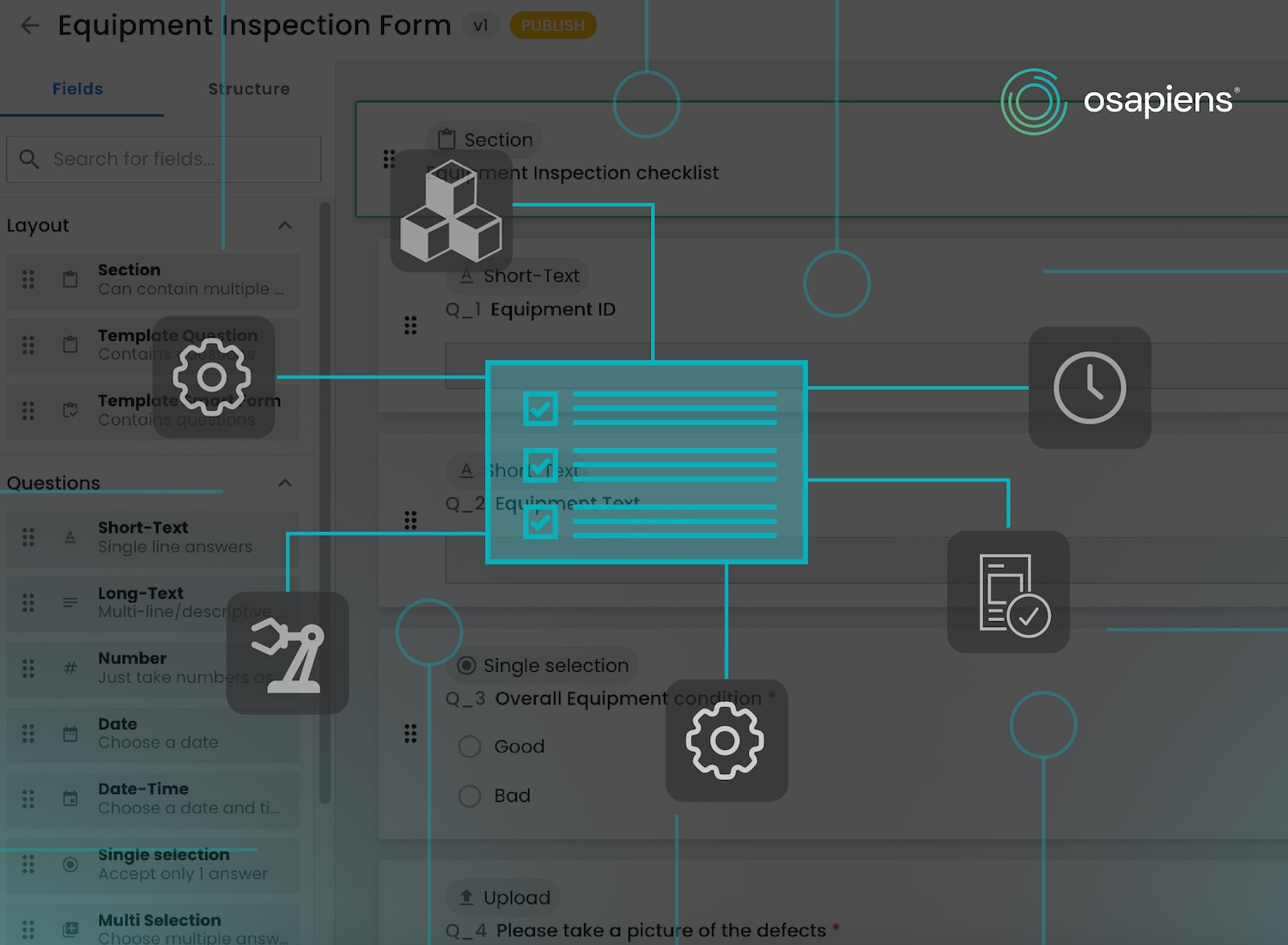
Create structured checklists for every component—from grinding wheels to bearing assemblies. Execute them on mobile, sync with SAP PM, and keep full audit trails automatically.Start with Your Bench Grinder Maintenance Checklist
Common Bench Grinder Problems Your Maintenance Checklist Prevents
Structured maintenance checklists prevent the failure patterns that cause injuries, downtime, and costly repairs:
- Catastrophic wheel failure: Wheels with hidden cracks shatter during operation, ejecting fragments at high velocity—ring testing before mounting and regular visual inspection catch defects before they cause injuries
- Workpiece jamming: When work rests drift beyond the 1/8 inch tolerance, workpieces jam between the wheel and rest, causing wheel breakage or ejection—monthly gap verification prevents this hazard
- Bearing seizure: Inadequate or contaminated lubrication causes bearings to fail rapidly, often within days of when conditions become unacceptable—systematic bearing inspection and lubrication extend bearing life significantly
- Guard positioning drift: As wheels wear and diameter decreases, guards that were properly positioned become ineffective—regular adjustment maintains protective barriers throughout the wheel’s service life
- Wheel glazing and loading: Dulled abrasive grains and metal particle accumulation reduce cutting efficiency, forcing operators to apply excessive pressure that accelerates wear and increases failure risk—wheel dressing procedures restore efficiency and reduce stress
- Documentation gaps: Missing maintenance records create liability exposure during incident investigations and regulatory audits—systematic documentation demonstrates that equipment received proper care according to preventive maintenance standards
From Paper Checklist to Digital: How the osapiens HUB Automates Your Bench Grinder Maintenance Checklist
Paper checklists, Excel spreadsheets, and PDF forms create friction that undermines consistent maintenance execution. Technicians must locate the correct checklist, manually record observations, and transfer information into tracking systems—introducing delays, transcription errors, and lost documentation.
Media breaks between field execution and administrative systems mean maintenance data exists in multiple formats across filing cabinets, spreadsheets, and email threads. When audits or incident investigations require maintenance records, teams spend hours reconstructing incomplete histories from fragmented sources.
The osapiens HUB for Maintenance eliminates these barriers through mobile checklist execution that guides technicians step-by-step through procedures, captures photos and timestamps automatically, and syncs with SAP PM without manual data entry. Technicians access checklists on smartphones, complete tasks in the field, and build audit-ready documentation automatically.
| Aspect | Paper or Excel Checklist | Digital Checklist with osapiens HUB |
|---|---|---|
| Accessibility | Stored in binders or shared drives—technicians must locate and print forms before starting work | Instant mobile access from any location, online or offline, with automatic sync when connectivity returns |
| Guidance | Static text instructions—technicians rely on memory or experience to interpret procedures | Step-by-step workflows with photos, diagrams, and specifications embedded at each task |
| Documentation | Manual entry, handwritten notes, separate photo management—time-consuming and error-prone | Automatic capture of timestamps, user ID, photos, and observations—no duplicate data entry required |
| Compliance | Fragmented records across multiple locations—difficult to produce during audits | Complete audit trail with all maintenance history centralized and instantly accessible |
| Integration | Manual transfer into CMMS or ERP systems—introduces delays and transcription errors | Seamless SAP integration with bidirectional sync—maintenance data flows automatically |
| Analysis | Difficult to identify patterns or optimize intervals—data remains locked in paper or spreadsheets | Real-time analytics reveal failure patterns, optimize maintenance intervals, and track KPIs automatically |
Organizations using the osapiens HUB for bench grinder maintenance report faster checklist completion, improved documentation quality, and better compliance readiness. Maintenance managers gain real-time visibility into which equipment received maintenance, which tasks are overdue, and where safety gaps exist—without chasing paper forms or consolidating spreadsheets.
Stop Missing Critical Bench Grinder Safety Checks
Digitize your maintenance checklists, automate work order creation, and give every technician a mobile tool that works—even offline. SAP PM integration included.Try osapiens HUB for Free
FAQ
What should be included in a bench grinder maintenance checklist?
A complete bench grinder maintenance checklist includes grinding wheel inspection (visual checks for cracks, ring testing, glazing assessment), safety guard verification (work rest positioning within 1/8 inch, tongue guard within 1/4 inch), bearing and spindle checks (listening for unusual noise, checking for vibration), electrical system inspection (verifying switch operation, checking connections), and documentation tasks (recording findings, capturing photos). Checklists should be customized based on equipment usage, operating environment, and manufacturer recommendations. The osapiens HUB for Maintenance allows you to create equipment-specific checklists with step-by-step guidance and automatic documentation.
How often should I complete my bench grinder maintenance checklist?
Maintenance frequency depends on usage intensity, operating environment, and risk assessment rather than fixed regulatory intervals. Common practice includes daily pre-operation checks (wheel condition, guard positioning), monthly routine maintenance (work rest adjustment verification, guard positioning checks), and quarterly or annual deep maintenance (bearing lubrication, electrical system inspection). High-use environments or shared workshops often require more frequent verification. Organizations should base intervals on actual equipment condition, manufacturer guidance, and documented failure patterns rather than arbitrary schedules.
Can I customize this bench grinder maintenance checklist template?
Yes—customization is essential for effective maintenance. Your checklist should reflect specific equipment models, manufacturer recommendations, operating environment conditions, and organizational risk tolerance. Add tasks for specialized grinding applications, incorporate site-specific safety requirements, and adjust intervals based on usage patterns. The osapiens HUB for Maintenance provides flexible checklist templates that you can customize for each asset while maintaining standardized core procedures across your organization.
How does a digital CMMS improve maintenance checklist management?
A digital CMMS like the osapiens HUB transforms checklist execution through mobile access that eliminates paper forms, automatic documentation that captures timestamps and photos without manual entry, intelligent scheduling that generates work orders based on time or usage triggers, and complete audit trails that demonstrate compliance without administrative burden. Digital systems also enable data analysis that reveals failure patterns, optimizes maintenance intervals, and improves resource allocation—capabilities impossible with paper-based approaches. For organizations using SAP PM, the osapiens HUB provides seamless integration that maintains data consistency across enterprise systems.
Start using osapiens for free
Improve your uptime, extend the life of your equipment, and simplify work order management.
Book a demo
ENTERPRISE CAPABILITIES
- SAP ECC & S/4HANA Certified
- Infor & MS Dynamics
- Microsoft Entra ID / Okta
- ISO 27001 & 9001
- EU Cloud · Data Sovereignty
- Development, Test, and Production Environments
- Multi-Entity & Multi-Site
- Power BI Integration
- Audit Trail & Compliance
Related content
January 1, 2026
Tankless Water Heater Maintenance Checklist – Tasks, Tips & Best Practices
January 1, 2026
Industrial Dryer Maintenance Checklist – Tasks, Tips & Digital Execution
January 1, 2026
Battery Energy Storage System Maintenance Checklist – Tasks, Safety & Digital Execution

July 21, 2025
Maintenance Bilbao 2025: Key Insights on Maintenance Management
January 1, 2026
Commercial Building Maintenance Checklist – Tasks, Systems & Digital Execution

June 23, 2026
Best Cloud-Based Inventory Management Software: Top 5 Comparison 2026

September 21, 2026
Best Condition Based Monitoring Software: Top 5 Comparison 2026
January 1, 2026
Surface Grinding Machine Maintenance Checklist – Tasks, Tips & Template
January 1, 2026
Gas Meter Maintenance Checklist – Tasks, Safety & Digital Execution

August 5, 2026
How to Build a Preventive Maintenance Schedule That Your Team Will Actually Follow
January 1, 2026
Hydraulic Shearing Machine Maintenance Checklist – Tasks, Safety & Digital Execution
January 1, 2026