

Maintenance Checklist

Florian Bartholomäus, osapiens Expert | 1. January 2026 | Lesezeit 10 min.
Many facilities overlook sensor alignment and floor mat integrity during routine checks—two of the most common causes of automatic sliding door failures. A structured checklist ensures these critical components receive consistent attention before minor issues escalate into costly repairs or accessibility violations.
Create your checklist for free











TRUSTED BY LEADING COMPANIES




ENTERPRISE-READY
 SAP Certification
 ISO 27001
 EU Hosting
 Entra ID & Okta
 Multi-Entity
Table of Contents
- Automatic Sliding Door Maintenance: Key Facts
- Why You Need an Automatic Sliding Door Preventive Maintenance Checklist
- What to Include in Your Automatic Sliding Door Preventive Maintenance Checklist
- Common Automatic Sliding Door Problems Your Maintenance Checklist Prevents
- From Paper Checklist to Digital: How the osapiens HUB Automates Your Automatic Sliding Door Maintenance Checklist
- FAQ
Automatic sliding doors operate thousands of cycles daily in commercial, healthcare, and industrial facilities, making preventive maintenance essential for operational reliability, occupant safety, and regulatory compliance. Without structured maintenance, unplanned downtime becomes harder to predict, and repair costs increase significantly compared to planned corrective actions.
Automatic Sliding Door Maintenance: Key Facts
- Extended system lifespan: Facilities implementing structured preventive maintenance programs extend automatic sliding door lifespan from an average of 7–9 years to 12–15 years with proper care.
- Reduced compliance issues: Organizations with documented maintenance programs report significantly fewer ADA compliance issues and liability claims compared to facilities without formal programs.
- Lower maintenance costs: Preventive maintenance programs reduce maintenance costs by 25–35% while improving equipment reliability by 40–60% compared to reactive approaches.
- Digital execution advantage: The osapiens HUB for Maintenance enables mobile checklist execution, photo documentation, and SAP PM integration, transforming paper-based workflows into audit-ready digital records.
Why You Need an Automatic Sliding Door Preventive Maintenance Checklist
Automatic sliding doors represent critical infrastructure in commercial and healthcare environments. Ad-hoc or experience-based maintenance fails to address the complexity of these systems, which combine mechanical, electrical, and sensor components that degrade through continuous operational cycles.
- Consistency: Structured checklists eliminate subjective judgments about which maintenance activities warrant attention. Without standardized procedures, technicians of varying experience levels apply different priorities, creating variable outcomes and missed inspections.
- Risk reduction: Sensor failures, motor degradation, and hardware loosening represent the most prevalent failure modes. Missing or inconsistent checks allow these issues to compound, leading to sudden operational failures, accessibility violations, and potential injury risks.
- Documentation: Compliance verification and liability defense require complete audit trails showing exactly what maintenance occurred, when, and who performed it. Paper-based or memory-dependent approaches fail to provide this traceability.
- Technician guidance: Detailed checklists support less experienced team members by providing explicit procedures, success criteria, and intervention thresholds—enabling non-experts to perform maintenance correctly without constant supervisory review.
- Standardization: Repeatability across shifts, sites, and personnel ensures that every door receives the same level of attention. This consistency proves essential for multi-site facilities and organizations with rotating maintenance staff.
- Compliance: Structured checklists support regulatory and internal audit requirements by documenting adherence to maintenance schedules and safety standards, reducing regulatory risk and avoiding fines.
What to Include in Your Automatic Sliding Door Preventive Maintenance Checklist
An effective automatic sliding door maintenance checklist organizes tasks by component or system rather than by frequency alone. This structure ensures that technicians address all critical subsystems during each maintenance cycle, adapting intervals based on usage, environment, and risk assessment.
Your checklist should include logical sections such as visual inspection, functional checks, safety verification, cleaning and servicing, and documentation steps. The tasks below are examples—actual requirements depend on door type, traffic levels, and environmental exposure.
| Component / System | Inspection & Maintenance Tasks | Purpose |
|---|---|---|
| Motion Sensors & Activation Devices | Clean sensor lenses, verify activation distance (approx. 5 feet), test detection zones, check floor mat integrity and electrical contact | Reliable door activation, occupant detection, accessibility compliance |
| Drive System (Motor, Belt, Rollers) | Inspect drive belt for cracking or fraying, check motor for unusual noise or vibration, verify roller condition and smooth movement, lubricate bearings and pivot points | Smooth door operation, prevent motor overload, reduce mechanical wear |
| Track & Guide Rails | Remove debris and foreign objects from bottom track, inspect rollers for wear, verify alignment and smooth sliding motion, check for binding or resistance | Prevent derailment, reduce friction, extend component life |
| Hardware & Fasteners | Tighten pivot screws and mounting hardware, inspect frame fasteners for looseness or corrosion, verify door panel attachment points | Prevent sudden hardware failure, maintain structural integrity |
| Weatherstripping & Seals | Inspect seals for cracks, separation, or deterioration, verify proper fit and compression, check for water intrusion signs | Energy efficiency, weather protection, prevent electrical component damage |
| Safety Systems & Emergency Override | Test emergency stop functions, verify sensor fail-safe operation, confirm manual override accessibility, check closing speed (should not exceed safe parameters) | Occupant safety, fire egress compliance, prevent injury |
| Electrical Connections & Control System | Inspect wiring for damage or corrosion, verify all connections are secure, test control system responsiveness, check battery backup (if applicable) | Reliable operation, prevent intermittent failures, emergency readiness |
Maintenance intervals depend on usage intensity, environmental exposure, and risk assessment. High-traffic entrances cycling hundreds of times daily require more frequent attention than low-traffic interior doors. Outdoor installations exposed to weather, UV radiation, and temperature extremes demand accelerated maintenance schedules compared to protected interior locations.
Industry best practices commonly recommend daily safety checks by facility staff, monthly cleaning and inspection by maintenance teams, quarterly alignment and adjustment by qualified technicians, and annual professional inspection by certified specialists. However, these are guidelines—not fixed legal requirements—and should be adapted based on your specific operational context.
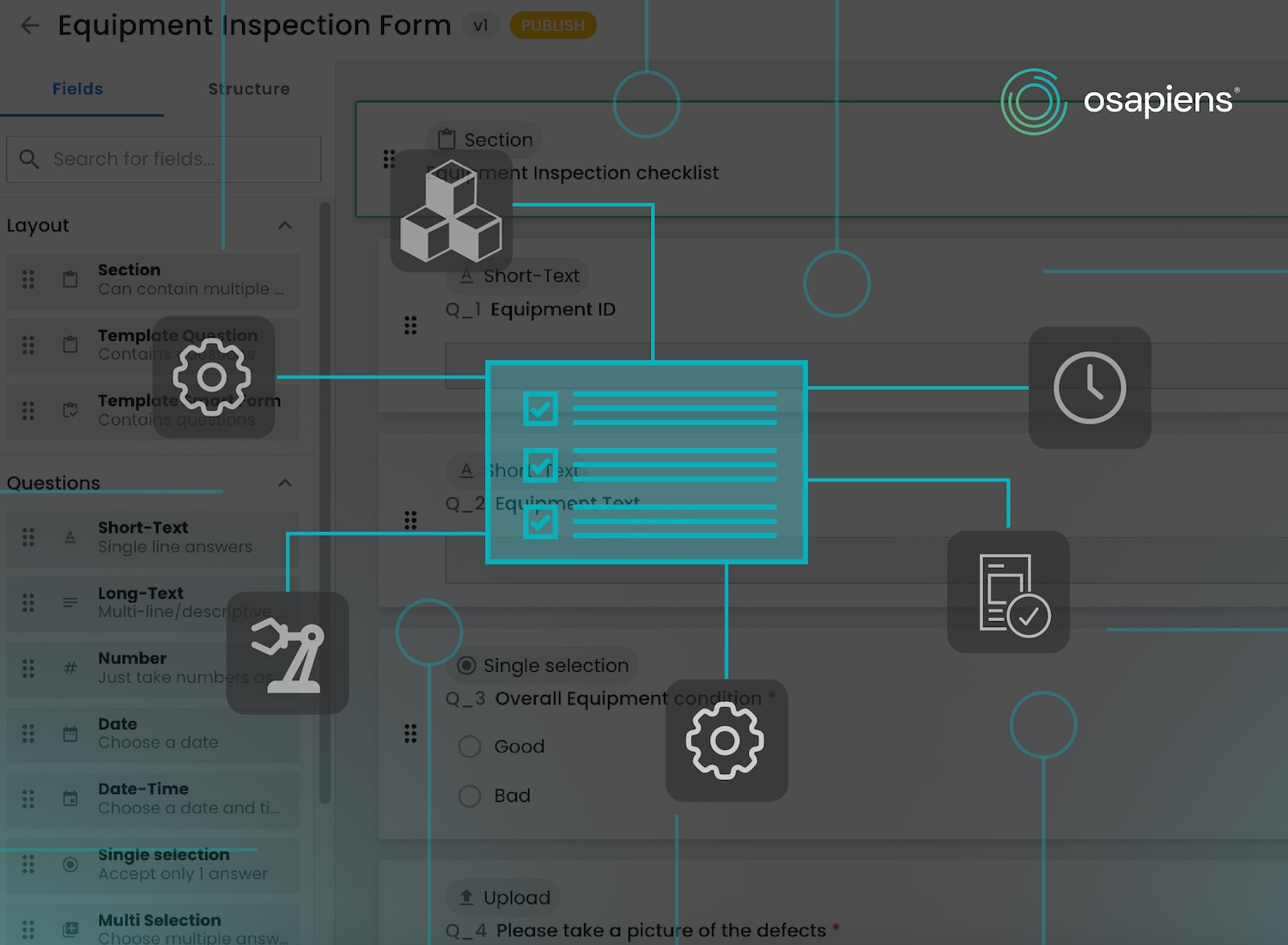
The osapiens HUB for Maintenance enables you to create customizable digital checklists for each door type and location, automatically generating work orders based on time intervals, usage cycles, or condition thresholds. Technicians execute checklists on mobile devices, capturing photos, timestamps, and observations that build comprehensive maintenance history for every asset.
Turn Your Automatic Sliding Door Maintenance Checklist into Digital Work Orders
Create structured checklists for every component — from sensors to drive systems. Execute them on mobile, sync with SAP PM, and keep full audit trails automatically.Start with Your Automatic Sliding Door Maintenance Checklist
Common Automatic Sliding Door Problems Your Maintenance Checklist Prevents
Structured preventive maintenance addresses the most frequent failure modes before they escalate into operational disruptions or safety incidents.
- Sensor failures and misalignment: Dust accumulation on sensor lenses reduces detection sensitivity, causing delayed activation or complete failure to open. Gradual building settlement shifts sensor alignment, creating detection zones that no longer correspond to foot traffic patterns. Regular cleaning and alignment verification prevent these issues.
- Drive system degradation: Motor wear, belt deterioration, and roller damage develop gradually through millions of operational cycles. Drive belts show visible cracking weeks before complete failure, yet technicians often overlook these warning signs. Scheduled inspection catches wear before catastrophic failure.
- Hardware loosening and corrosion: Vibration from repeated operational cycles gradually loosens pivot screws, mounting hardware, and fasteners. A single loose screw may seem inconsequential until it falls out completely, rendering doors suddenly inoperable. Regular tightening and corrosion inspection prevent sudden failures.
- Weathering and seal degradation: Exposure to UV radiation, temperature extremes, and moisture accelerates component degradation. Weatherstripping becomes brittle, seals crack, and water intrusion damages electrical components. Proactive seal replacement prevents energy waste and electrical failures.
- Track debris accumulation: Dirt, foreign objects, and debris in bottom tracks impede roller movement, forcing motors to work at greater capacity and accelerating failure. Regular cleaning eliminates this preventable stress on drive systems.
- Safety system drift: Door closing speeds increase as motors age, creating strike risks. Opening forces increase as components degrade, eventually exceeding ADA-mandated maximums. Regular calibration keeps doors within compliance ranges.
Each of these failure patterns creates operational disruptions, accessibility violations, or safety risks that structured checklists systematically prevent. The osapiens HUB for Maintenance enables condition-based monitoring where observations during routine inspections trigger corrective work orders automatically, addressing developing problems before they cause failures.
From Paper Checklist to Digital: How the osapiens HUB Automates Your Automatic Sliding Door Maintenance Checklist
Traditional paper-based and Excel workflows create friction that reduces data quality, limits real-time visibility, and imposes administrative overhead on maintenance teams.
Technicians complete handwritten checklists while attempting to perform maintenance tasks, often lacking clean surfaces or adequate lighting for legible documentation. Handwritten entries are frequently incomplete, illegible, or abbreviated beyond meaningful interpretation. Completed paper checklists then require return to the office for digital data entry, creating duplicate effort and introducing transcription errors.
The osapiens HUB for Maintenance transforms this workflow through mobile-first digital checklists that technicians execute directly on smartphones or tablets. The platform provides full offline functionality—technicians complete checklists without network connectivity, with data synchronizing automatically when connections restore. This addresses the reality of field environments with patchy wireless coverage or basement mechanical rooms.
| Paper or Excel Checklist | Digital Checklist with osapiens HUB |
|---|---|
| Handwritten notes, often illegible or incomplete | Structured digital forms with required fields and validation |
| No photos or visual documentation | Photo and video attachment directly within work orders |
| Manual transcription required, introducing errors | Automatic data capture with timestamps and technician attribution |
| Delayed visibility—data unavailable until office return | Real-time synchronization when network available |
| Scattered records across filing cabinets or spreadsheets | Centralized maintenance history accessible from any device |
| No integration with enterprise systems | Full SAP PM integration with bidirectional data flow |
| Difficult to verify compliance or generate audit reports | Automatic compliance documentation and audit trails |
Beyond mobile execution, the osapiens HUB for Maintenance provides automated preventive maintenance scheduling that generates work orders based on time intervals, operating hours, or condition thresholds. The system tracks completion rates, identifies overdue tasks, and provides planning and scheduling visibility across all sites and assets.
Media attachment capabilities revolutionize documentation quality—technicians photograph sensor alignment, component wear, or damage directly within maintenance records, creating objective visual evidence that supports replacement justification and enables remote specialist review. Signature capture creates authenticated records documenting who performed service and when, supporting compliance verification and liability defense.
For organizations operating SAP PM environments, the osapiens HUB serves as the mobile execution layer that addresses field usability limitations while maintaining enterprise data integration. Completed work orders from osapiens synchronize with SAP PM through certified integration, allowing financial and historical data to flow back to the enterprise system without requiring technicians to interact directly with SAP interfaces.
Stop Losing Uptime to Missed Automatic Door Inspections
Digitize your maintenance checklists, automate work order creation, and give every technician a mobile tool that works — even offline. SAP PM integration included.Try osapiens HUB for Free
FAQ
What should be included in an automatic sliding door maintenance checklist?
A comprehensive checklist should cover motion sensors and activation devices (cleaning, alignment, detection zone testing), drive system components (motor inspection, belt condition, roller wear, lubrication), track and guide rails (debris removal, alignment verification), hardware and fasteners (tightening, corrosion inspection), weatherstripping and seals (crack inspection, fit verification), safety systems (emergency stop testing, closing speed verification), and electrical connections (wiring inspection, control system testing). Checklists should be customized based on door type, traffic levels, and environmental exposure rather than following generic templates.
How often should I complete my automatic sliding door maintenance checklist?
Maintenance frequency depends on usage intensity, environmental conditions, and risk assessment. Industry best practices commonly recommend daily safety checks by facility staff, monthly cleaning and detailed inspection, quarterly professional alignment and adjustment, and annual comprehensive inspection by certified technicians. However, these are guidelines—not fixed legal requirements. High-traffic entrances or outdoor installations exposed to harsh weather may require more frequent attention, while low-traffic interior doors may operate reliably with less frequent scheduled maintenance.
Can I customize this automatic sliding door maintenance checklist template?
Yes—customization is essential for effective maintenance. Generic checklists fail to address site-specific conditions, door configurations, or operational requirements. Adapt your checklist based on door type (sliding, swinging, revolving), traffic volume, indoor vs. outdoor installation, environmental exposure, and manufacturer specifications. Digital CMMS platforms like the osapiens HUB for Maintenance enable you to create customized checklists for each asset, automatically generating work orders with the correct procedures, required parts, and estimated time based on door-specific parameters.
How does a digital CMMS improve maintenance checklist management?
A digital CMMS transforms checklist execution through mobile accessibility (technicians complete checklists on smartphones without returning to offices), automatic scheduling (work orders generate based on time, usage, or condition thresholds), photo documentation (visual evidence attached directly to maintenance records), real-time visibility (supervisors monitor completion status and identify overdue tasks), audit trails (complete documentation with timestamps and technician attribution), and trend analysis (historical data reveals recurring problems and optimization opportunities). For organizations using SAP PM, platforms like osapiens HUB provide mobile execution capabilities while maintaining enterprise data integration through certified SAP connectivity.
Start using osapiens for free
Improve your uptime, extend the life of your equipment, and simplify work order management.
Book a demo
ENTERPRISE CAPABILITIES
- SAP ECC & S/4HANA Certified
- Infor & MS Dynamics
- Microsoft Entra ID / Okta
- ISO 27001 & 9001
- EU Cloud · Data Sovereignty
- Development, Test, and Production Environments
- Multi-Entity & Multi-Site
- Power BI Integration
- Audit Trail & Compliance
Related content
January 1, 2026
Roof Coating Maintenance Checklist – Tasks, Best Practices & Digital Execution
January 1, 2026
Oxygen Concentrator Maintenance Checklist – Tasks, Documentation & Digital Execution

December 16, 2025
Top MaintainX Alternatives: Find the Best CMMS for Your Maintenance Teams in 2026
January 1, 2026
Commercial Roof Maintenance Checklist – Tasks, Best Practices & Digital Execution
January 1, 2026
Manufacturing Facility Maintenance Checklist – Essential Tasks & Digital Execution

November 28, 2025
Preventive Maintenance Software for Small Companies: Top 6
January 1, 2026
Property Maintenance Checklist – Tasks, Tips & Template
January 1, 2026
Tablet Press Maintenance Checklist – Tasks, Tips & Template
January 1, 2026
Fire Alarm System Maintenance Checklist – Essential Tasks, Compliance & Digital Execution

January 12, 2026
SAP S/4HANA Migration: Complete Guide for a Successful ERP Transition in 2026

April 10, 2026
CMMS ERP Integration for Enterprise: Why SAP Certified Beats API Only
January 1, 2026