

Maintenance Checklist

Florian Bartholomäus, osapiens Expert | 1. January 2026 | Lesezeit 9 min.
Many backhoe operators focus on daily fluid checks but overlook hydraulic hose inspection—one of the most common failure points. Check hoses weekly for bulging, chafing, and cracks to prevent costly hydraulic system failures.
Start using this checklist for free
More than 2200 companies place their trust in osapiens










Table of Contents
Backhoes are versatile workhorses in construction, utilities, and landscaping—but their reliability depends entirely on consistent, structured maintenance. Without a systematic backhoe maintenance checklist, hydraulic failures, engine wear, and safety risks become harder to predict and prevent. This guide provides a practical, component-based checklist designed to reduce unplanned downtime, extend equipment lifespan, and ensure your maintenance documentation is audit-ready.
Backhoe Maintenance: Key Facts
- Hydraulic systems are the most failure-prone subsystem: Contaminated fluid, hose degradation, and seal wear cause most backhoe breakdowns, making regular inspection and fluid analysis essential.
- Preventive maintenance reduces downtime: Structured checklists help maintenance teams catch issues early, preventing the 12–18% unplanned downtime typical of reactive approaches.
- Documentation matters for compliance and liability: OSHA and EPA standards require documented maintenance programs; incomplete records increase regulatory and legal risk.
- Digital checklists improve execution quality: Mobile CMMS platforms like osapiens HUB for Maintenance eliminate paper-based gaps, ensure real-time documentation, and provide complete audit trails.
Why You Need a Backhoe Maintenance Checklist
Ad-hoc or experience-based maintenance leaves critical tasks to chance. A structured backhoe maintenance checklist ensures consistency, reduces risk, and supports your entire maintenance team.
- Consistency: Checklists standardize inspections across shifts and crew members, ensuring no critical steps are skipped regardless of who performs the work.
- Risk reduction: Missing hydraulic leaks, worn bucket teeth, or brake degradation can lead to equipment failure, project delays, and safety incidents that are far costlier than preventive maintenance.
- Documentation: Detailed maintenance records provide traceability for audits, insurance claims, and liability protection—proving you maintained equipment properly if incidents occur.
- Technician guidance: Checklists support less experienced crew members by providing step-by-step guidance, reducing reliance on tribal knowledge and improving training effectiveness.
- Standardization: Repeatable processes across multiple backhoes and job sites improve efficiency, enable performance benchmarking, and support continuous improvement through asset maintenance software.
- Compliance: Structured checklists help meet OSHA safety requirements and EPA emissions standards by ensuring maintenance intervals and safety inspections are completed and documented.
What to Include in Your Backhoe Maintenance Checklist
Effective backhoe maintenance is organized by component or system, not by frequency alone. This approach ensures technicians address all critical subsystems systematically. Actual maintenance intervals depend on usage intensity, environmental conditions, and manufacturer guidance—the tasks below represent common best practices, not exhaustive requirements.
Your checklist should cover visual inspection of all major systems, functional checks to verify operational performance, safety system verification, basic servicing including lubrication and cleaning, and documentation steps to record observations and work completed. The table below organizes tasks by the physical component or subsystem of the backhoe.
| Component / System | Inspection & Maintenance Tasks | Purpose |
|---|---|---|
| Hydraulic System | Check fluid level and color, inspect hoses for bulging/chafing/cracks, verify pressure at cylinders, test for leaks at connections, replace filters per OEM guidance | Prevent hydraulic failures, maintain lifting capacity, ensure precise control |
| Engine & Cooling | Check oil level and condition, inspect air filter and clean/replace as needed, verify coolant level and concentration, inspect belts for tension and wear, clean radiator fins | Prevent engine damage, maintain fuel efficiency, avoid overheating |
| Loader Arm & Bucket | Inspect bucket teeth and cutting edges for wear, check pins and bushings for play, lubricate pivot points, verify cylinder operation and smooth movement | Maintain digging efficiency, reduce operator fatigue, prevent structural damage |
| Backhoe Boom & Dipper | Inspect boom pivot points and lubricate, check dipper stick for cracks or damage, verify stabilizer operation and foot condition, test swing function smoothness | Ensure safe operation, maintain precision, prevent catastrophic structural failure |
| Undercarriage & Tires | Check tire pressure and tread depth, inspect for sidewall damage or bulging, verify lug nut torque, inspect axles and bearings for wear | Prevent blowouts, ensure transport safety, maintain traction and stability |
| Brake & Safety Systems | Test brake function and stopping power, inspect brake pads and fluid level, verify ROPS integrity and seatbelt function, test lights, horn, and backup alarm | Operator safety, regulatory compliance, site communication |
| Electrical & Battery | Inspect battery terminals for corrosion, verify connections are tight, test all lights and indicators, check wiring for damage or chafing | Prevent no-start conditions, ensure visibility, maintain control system reliability |
| Transmission & Drivetrain | Check transmission fluid level and condition, inspect driveshaft and universal joints, verify smooth gear shifting, listen for unusual noises | Prevent transmission failure, maintain power delivery, extend component life |
Turn Your Backhoe Maintenance Checklist into Digital Work Orders
Create structured checklists for every component—from hydraulic systems to bucket assemblies. Execute them on mobile, sync with SAP PM, and keep full audit trails automatically.Start with Your Backhoe Maintenance Checklist
Common Backhoe Problems Your Maintenance Checklist Prevents
A well-executed backhoe maintenance checklist addresses the most common failure modes before they escalate into costly repairs or safety incidents.
- Hydraulic system failure: Contaminated fluid and worn hoses cause loss of lift capacity, erratic bucket control, and complete hydraulic failure. Regular fluid analysis and hose inspection catch degradation early, as outlined in preventive maintenance best practices.
- Engine damage from neglected air filters: Dust-laden environments rapidly clog air filters, causing bypass that allows dirt into the engine. Structured checklists ensure filters are inspected and replaced before engine damage occurs.
- Worn bucket teeth reducing productivity: Blunted or chipped bucket teeth reduce digging efficiency and increase operator effort. Checklists prompt timely replacement, maintaining productivity and reducing operator strain.
- Brake system degradation: Gradual brake pad wear and fluid contamination compromise stopping power. Regular inspection ensures brakes remain effective, preventing transport accidents and OSHA violations.
- Pin and bushing wear causing imprecise control: Worn loader arm pins create slack that reduces bucket positioning accuracy and increases stress on hydraulic cylinders. Systematic inspection identifies wear before it impacts performance.
- Missing documentation during audits: Paper-based or ad-hoc maintenance leaves gaps in records that create liability exposure and compliance risk. Digital checklists via work order management systems ensure complete, timestamped documentation.
From Paper Checklist to Digital: How the osapiens HUB Automates Your Backhoe Maintenance Checklist
Paper checklists, Excel spreadsheets, and PDF templates create media breaks that undermine maintenance quality. Technicians lose forms, handwriting becomes illegible, and information isn’t searchable or analyzable. These gaps prevent maintenance managers from identifying recurring failures, optimizing intervals, or demonstrating compliance during audits.
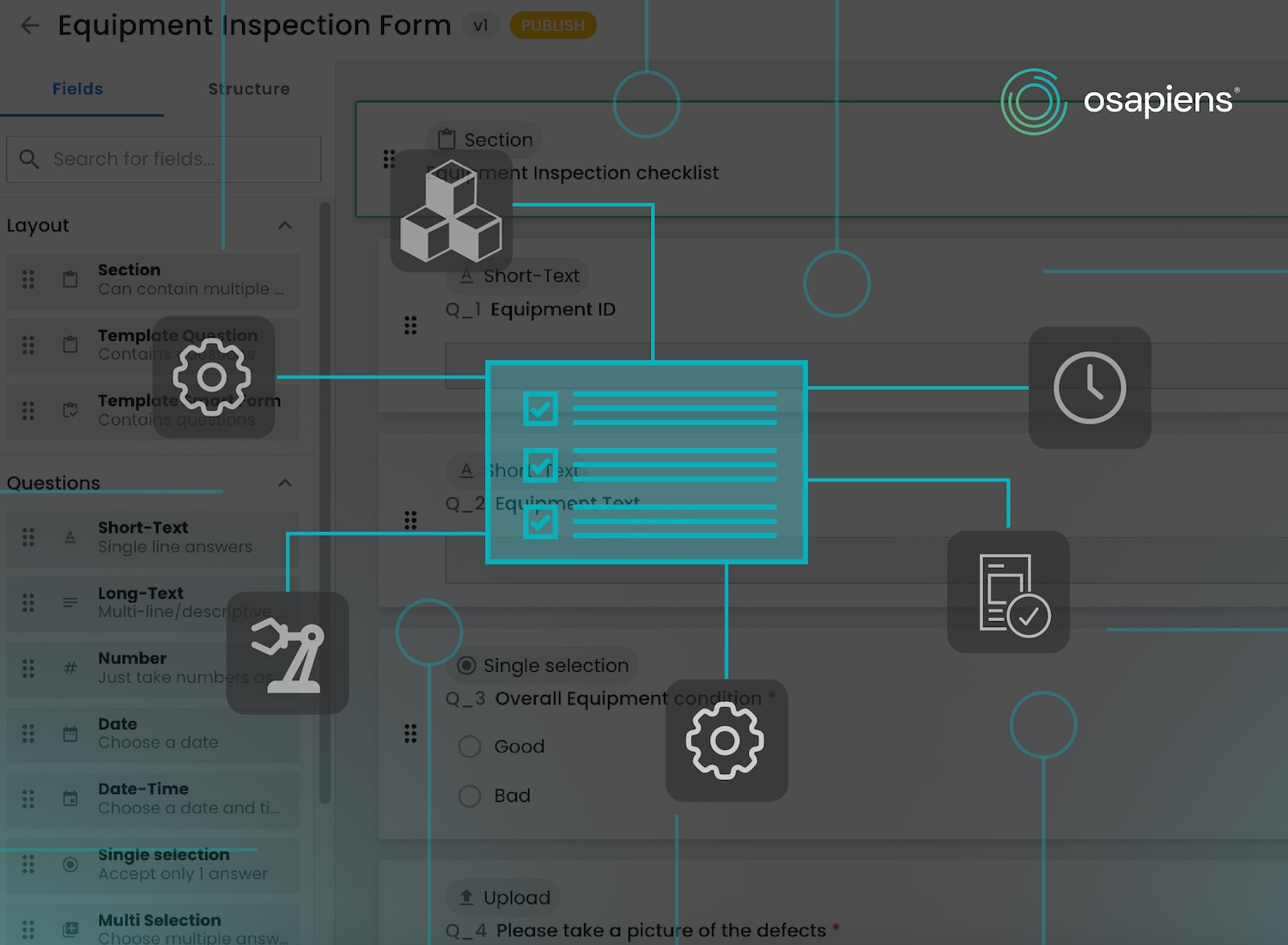
osapiens HUB for Maintenance transforms backhoe maintenance execution through mobile-first digital checklists. Technicians access work orders on smartphones or tablets, complete structured checklists in the field, attach photos showing equipment condition before and after maintenance, and submit completed records in real-time—all with offline capability for remote job sites. Data automatically syncs to centralized systems, providing maintenance managers with immediate visibility into completion status and asset history.
The platform’s SAP PM integration ensures field maintenance data flows seamlessly into enterprise systems for financial tracking and compliance reporting, eliminating duplicate data entry. This two-tier architecture leverages SAP PM as the system of record while osapiens HUB serves as the system of action for field execution, as detailed in SAP-integrated maintenance solutions.
| Aspect | Paper or Excel Checklist | Digital Checklist with osapiens HUB |
|---|---|---|
| Accessibility | Physical forms must be retrieved from office, easily lost or damaged in field conditions | Mobile access from any location, online or offline, with automatic sync when connectivity returns |
| Documentation Quality | Handwritten notes often illegible, incomplete, or recorded from memory after work completion | Real-time data capture with photos, timestamps, and structured fields ensuring completeness |
| Audit Readiness | Records scattered across file cabinets, difficult to retrieve, gaps in documentation common | Centralized, searchable records with complete audit trails instantly accessible for compliance reviews |
| Failure Pattern Analysis | Manual review of paper records required, patterns difficult to identify across equipment fleet | Automated analytics identify recurring issues, optimize maintenance intervals, and support data-driven decisions |
| Technician Efficiency | Time wasted searching for equipment history, returning to office to file paperwork | QR code scanning provides instant access to complete asset history, work completed before leaving job site |
| Integration | Manual re-entry into ERP or financial systems creates errors and delays | Automatic synchronization with SAP PM and enterprise systems eliminates duplicate entry |
Stop Losing Uptime to Missed Backhoe Inspections
Digitize your maintenance checklists, automate work order creation, and give every technician a mobile tool that works—even offline. SAP PM integration included.Try osapiens HUB for Free
FAQ
What should be included in a backhoe maintenance checklist?
A complete backhoe maintenance checklist should cover all critical subsystems: hydraulic system inspection (fluid level, hose condition, leak detection), engine maintenance (oil, air filter, coolant), loader arm and bucket assessment (teeth wear, pin condition, lubrication), backhoe boom and stabilizers (pivot points, structural integrity), undercarriage and tires (pressure, tread, damage), brake and safety systems (function tests, ROPS, lighting), and electrical components (battery, connections, wiring). Checklists should be customized based on your specific equipment model, operating environment, and manufacturer recommendations, as explained in asset management best practices.
How often should I complete my backhoe maintenance checklist?
Maintenance frequency depends on usage intensity, environmental conditions, and equipment age rather than fixed calendar intervals. Daily pre-operation inspections by operators typically cover fluid levels, visual leak checks, tire condition, and safety system function tests. Weekly technician maintenance includes detailed hydraulic hose inspection, lubrication of pivot points, and air filter assessment. Monthly or usage-based maintenance (every 50–250 operating hours) includes oil changes, filter replacement, and deeper component inspection. Annual or high-hour maintenance addresses transmission fluid, hydraulic fluid analysis, and structural integrity. Organizations often implement condition-based maintenance approaches that trigger tasks based on actual equipment condition rather than arbitrary schedules.
Can I customize this backhoe maintenance checklist template?
Yes—customization is essential for effective maintenance. Your checklist should reflect your specific backhoe model, manufacturer guidance, operating conditions (wet vs. dry, heavy vs. light duty), regulatory requirements in your jurisdiction, and lessons learned from your equipment’s failure history. Digital CMMS platforms like osapiens HUB for Maintenance enable easy checklist customization with equipment-specific templates, conditional tasks that appear based on inspection findings, and integration with manufacturer specifications. Customization ensures your checklist addresses actual risks rather than generic best practices, as discussed in maintenance planning and scheduling strategies.
How does a digital CMMS improve maintenance checklist management?
A digital CMMS transforms checklist execution through mobile access that enables technicians to complete work in the field without returning to the office, real-time documentation with photos and timestamps that eliminate information loss, automatic work order generation based on inspection findings or usage triggers, centralized maintenance history providing instant access to complete asset records via QR code scanning, and analytics that identify recurring failures and optimize maintenance intervals. SAP PM integration ensures field data flows into enterprise systems for financial tracking and compliance reporting without manual re-entry. Organizations using digital checklists report time savings of 30–60 minutes per inspection and significant improvements in data quality, as detailed in maintenance audit readiness resources.
Start using osapiens for free
Improve your uptime, extend the life of your equipment, and simplify work order management.
Book a demo
Related content
January 1, 2026
Electrical Preventive Maintenance Checklist – Tasks, Safety & Digital Execution
January 1, 2026
Pneumatic System Maintenance Checklist – Essential Tasks & Best Practices
January 1, 2026
Shot Blasting Machine Maintenance Checklist – Tasks, Tips & Digital Execution
January 1, 2026
Water Treatment Plant Maintenance Checklist – Tasks, Compliance & Digital Execution
January 1, 2026
Compactor Maintenance Checklist – Essential Tasks & Digital Execution
January 1, 2026
Fire Extinguisher Maintenance Checklist – Tasks, Tips & Best Practices
January 1, 2026
Laser Cutting Machine Maintenance Checklist: Prevent Downtime & Extend Equipment Life
January 1, 2026
CFR 21 Part 11 Compliance Maintenance Checklist – Tasks, Validation & Audit Readiness
January 1, 2026
Diesel Generator Set Maintenance Checklist – Tasks, Best Practices & Digital Execution
January 1, 2026
Milling Machine Maintenance Checklist – Tasks, Best Practices & Digital Execution
January 1, 2026
Generator Maintenance Checklist – Tasks, Tips & Best Practices

January 15, 2026