

Maintenance Checklist

Florian Bartholomäus, osapiens Expert | 1. January 2026 | Lesezeit 12 min.
Many isolator failures occur silently—contact resistance rises, gaskets degrade, moisture infiltrates—without visible symptoms until catastrophic failure. A structured checklist organized by component ensures you catch these early indicators before they escalate into safety incidents or unplanned downtime.
Create your checklist for free













TRUSTED BY LEADING COMPANIES




ENTERPRISE-READY
 SAP Certification
 ISO 27001
 EU Hosting
 Entra ID & Okta
 Multi-Entity
Table of Contents
- Isolator System Maintenance: Key Facts
- Why You Need an Isolator System Maintenance Checklist
- What to Include in Your Isolator System Maintenance Checklist
- Common Isolator System Problems Your Maintenance Checklist Prevents
- From Paper Checklist to Digital: How the osapiens HUB Automates Your Isolator System Maintenance Checklist
- FAQ
Isolator systems—whether electrical isolation switches protecting maintenance personnel from hazardous energy or pharmaceutical containment isolators maintaining sterile barriers—serve critical safety and operational functions across industrial environments. Yet many organizations still manage isolator maintenance reactively, relying on experience-based judgment or ad-hoc inspections rather than structured preventive maintenance checklists. Without consistent documentation and systematic procedures, early warning signs of degradation go unnoticed until failures occur suddenly, often with severe consequences including unplanned downtime, safety incidents, or compliance violations.
This guide provides a practical, component-based Isolator System maintenance checklist designed to prevent failures before they happen. You’ll learn which inspection tasks matter most, how to organize maintenance by system component rather than arbitrary time intervals, and how digital execution through platforms like osapiens HUB for Maintenance transforms paper checklists into audit-ready, mobile-accessible work orders that technicians can execute efficiently in the field.
Isolator System Maintenance: Key Facts
- Silent degradation patterns: Most isolator failures develop gradually through contact wear, insulation moisture ingress, or gasket material fatigue—conditions detectable through structured inspections long before catastrophic failure occurs.
- Component-based organization: Effective checklists organize tasks by physical component or subsystem (contacts, insulation, enclosures, safety mechanisms) rather than generic daily/weekly/monthly frequencies, ensuring technicians focus on the right inspection points.
- Documentation drives compliance: Regulatory frameworks including OSHA 1910.147 for electrical systems and FDA GMP requirements for pharmaceutical isolators demand documented maintenance procedures with complete audit trails—requirements that paper-based approaches struggle to satisfy consistently.
- Digital execution eliminates gaps: Organizations implementing mobile CMMS platforms for checklist execution report significant reductions in missed inspections, incomplete documentation, and technician time spent on administrative tasks, enabling maintenance teams to focus on actual equipment condition assessment.
Why You Need an Isolator System Maintenance Checklist
Isolator system failures rarely announce themselves gradually—instead, degradation progresses silently until sudden, often catastrophic failure occurs. A structured maintenance checklist addresses this challenge by ensuring consistent inspection of critical failure indicators across all isolator systems, regardless of which technician performs the work or when maintenance occurs.
- Consistency across technicians and shifts: Ad-hoc maintenance relies on individual technician experience and memory, creating variability in inspection quality and coverage. Checklists standardize procedures, ensuring every technician examines the same critical components using the same assessment criteria, regardless of experience level or shift assignment.
- Risk reduction through early detection: Contact resistance increases, insulation resistance declines, gasket materials become brittle, and mechanical linkages develop excessive play—all detectable through systematic inspection before they progress to complete failure. Without structured checklists directing technician attention to these indicators, early-stage degradation remains invisible until emergency conditions develop.
- Documentation and audit readiness: Regulatory requirements for electrical isolation (OSHA 1910.147) and pharmaceutical containment (FDA GMP) demand documented evidence that maintenance procedures were followed, by qualified personnel, at appropriate intervals. Paper-based or memory-dependent approaches create compliance gaps that surface during regulatory inspections, while structured digital checklists provide automatic audit trails with timestamps, technician identification, and photographic evidence.
- Technician guidance and knowledge transfer: Experienced technicians may recognize subtle indicators of developing problems through years of field observation, but this expertise remains locked in individual knowledge rather than organizational capability. Detailed checklists capture this expertise in documented procedures that guide less-experienced technicians through proper inspection techniques, assessment criteria, and intervention thresholds.
- Standardization across sites and equipment variations: Organizations managing multiple facilities or diverse isolator types face the challenge of maintaining consistent maintenance quality across different locations and equipment configurations. Standardized checklists adapted to specific equipment variations ensure repeatability while accommodating necessary differences in procedures for electrical versus pharmaceutical isolators, or high-voltage versus low-voltage systems.
- Handover quality between shifts: Maintenance work often spans multiple shifts, requiring clear communication of equipment status, work completed, and remaining tasks. Structured digital checklists provide real-time visibility into maintenance progress, enabling seamless handovers without information loss or miscommunication that paper-based approaches frequently experience.
What to Include in Your Isolator System Maintenance Checklist
Effective isolator maintenance checklists organize tasks by the physical component or subsystem requiring attention, rather than by arbitrary time frequencies. This component-based structure ensures technicians focus inspection effort on the specific systems most prone to failure, with tasks tailored to the unique degradation patterns each component experiences.
The following checklist framework applies across both electrical isolation switches and pharmaceutical containment isolators, with specific tasks adapted to equipment type. Actual maintenance intervals depend on usage intensity, environmental conditions, and risk assessment—consult manufacturer guidance and operational history when establishing your maintenance schedule.
| Component / System | Inspection & Maintenance Tasks | Purpose |
|---|---|---|
| Main Contacts & Switching Mechanism | Measure contact resistance with microohmmeter; inspect contact surfaces for pitting, welding, or discoloration; verify smooth operation through full switching range; check mechanical linkages for wear or excessive play | Detect contact degradation before resistance increases cause overheating; identify arcing damage; ensure reliable isolation function |
| Insulation System & Barriers | Perform megohmmeter testing of insulation resistance; inspect insulation surfaces for tracking, carbonization, or moisture; check for contamination or dust accumulation; verify sealed enclosures remain moisture-free | Maintain electrical isolation integrity; prevent leakage currents; detect moisture ingress early |
| Terminals & Connections | Verify all electrical connections are properly torqued; inspect terminals for discoloration or overheating signs; perform infrared thermography during operation; check conductor strand condition at connection points | Prevent terminal overheating; detect loose connections before failure; identify high-resistance joints |
| Enclosure & Environmental Protection | Inspect door seals and gaskets for integrity; verify enclosure ratings maintained; check for corrosion, physical damage, or unauthorized modifications; ensure drainage paths clear | Maintain environmental protection rating; prevent moisture and contaminant ingress; ensure personnel safety |
| Safety Mechanisms & Interlocks | Test lockout/tagout provisions function properly; verify warning labels legible and properly affixed; check grounding connections secure; test interlocks with related equipment; verify visible isolation indication clear | Ensure personnel safety during maintenance; maintain compliance with OSHA 1910.147; prevent inadvertent energization |
| Operating Mechanisms (Pharmaceutical Isolators) | Inspect glove ports and sleeves for tears or degradation; verify hatch sealing surfaces and gaskets pliable; test chamber height adjustment systems; check access port locking mechanisms | Maintain containment integrity; ensure operator safety; prevent contamination pathways |
| Decontamination & Filtration Systems (Pharmaceutical) | Verify biocide concentration sensing accuracy; test decontamination cycle sequencing; inspect HEPA filters for damage or bypass; measure pressure differential across filters; check drain systems clear | Maintain sterile barrier function; ensure product protection; comply with GMP requirements |
| Monitoring & Control Systems | Verify position indication accuracy; test alarm functions; check control circuit continuity; inspect wiring for damage or degradation; validate sensor calibration | Ensure accurate system status indication; maintain control reliability; support safe operation |
This checklist provides a foundation—customize it based on your specific isolator types, manufacturer recommendations, and operational experience. Organizations using digital work order systems can embed these checklists directly into mobile maintenance workflows, with conditional logic that adapts questions based on equipment type and previous inspection results.
Turn Your Isolator System Maintenance Checklist into Digital Work Orders
Create structured checklists for every component—from contacts and insulation to safety mechanisms and seals. Execute them on mobile, sync with SAP PM, and keep full audit trails automatically.Start with Your Isolator System Maintenance Checklist
Common Isolator System Problems Your Maintenance Checklist Prevents
Structured maintenance checklists prevent the most common and costly isolator system failures by directing technician attention to early warning indicators before catastrophic conditions develop.
- Contact welding and seizure: Electrical isolation switches experiencing high inrush currents during closure operations can develop contact welding, where arcing melts contact surfaces that fuse together as they cool. Checklists directing technicians to measure contact resistance trends and inspect for arcing damage identify this degradation early, enabling contact replacement before complete welding prevents switch operation and creates hazardous conditions for maintenance personnel.
- Terminal overheating and connection failure: Loose electrical connections create high-resistance joints that generate heat proportional to current squared, establishing a feedback loop where heat accelerates degradation. Regular inspection of terminal tightness, combined with infrared thermography during operation, detects developing hot spots before insulation melts, conductors fail, or fires ignite—failures that often cascade to adjacent equipment and create extended outages.
- Insulation breakdown and tracking: Moisture infiltration combined with surface contamination creates conductive paths on insulation surfaces, enabling leakage currents that gradually carbonize insulation and establish permanent tracking. Systematic inspection for condensation, contamination, and declining insulation resistance identifies this degradation while still reversible through cleaning and drying, preventing the insulation failures that create ground faults and personnel hazards.
- Gasket degradation in pharmaceutical isolators: Repeated exposure to chemical decontaminants and temperature cycling causes elastomer gasket materials to become brittle and lose sealing capability, typically within three years of continuous use. Checklists directing visual inspection and tactile assessment of gasket condition enable scheduled replacement before catastrophic seal failure during decontamination cycles contaminates product batches worth millions of dollars.
- Safety mechanism degradation: Lockout/tagout provisions, grounding connections, and interlock systems experience mechanical wear and corrosion that can prevent proper function when needed during maintenance activities. Regular functional testing of these safety mechanisms—often overlooked in favor of operational components—ensures they remain effective when technicians depend on them for protection from hazardous energy sources.
- Documentation gaps creating compliance risk: Organizations relying on memory-based or paper checklist approaches frequently discover during regulatory audits that maintenance records are incomplete, lack required signatures or dates, or cannot demonstrate that procedures were actually followed. Digital checklist execution with automatic audit trails eliminates these gaps, providing timestamped, photo-documented evidence that satisfies regulatory requirements without additional administrative burden.
From Paper Checklist to Digital: How the osapiens HUB Automates Your Isolator System Maintenance Checklist
Paper-based and spreadsheet maintenance checklists create systematic friction that undermines even well-designed preventive maintenance programs. Technicians must carry printed checklists to job sites, take handwritten notes documenting findings, return to offices to transcribe field notes into digital systems, and rely on supervisors to manually track completion rates and identify overdue tasks. This workflow creates multiple opportunities for lost documentation, transcription errors, and delayed response to identified problems.
The osapiens HUB for Maintenance eliminates these friction points through mobile-first checklist execution that brings structured procedures directly to technicians in the field. Technicians receive work orders on mobile devices with embedded checklists tailored to specific isolator types, access complete maintenance history and previous inspection findings at the point of work, capture photos and measurements directly into digital records with automatic timestamps, and close work orders before leaving the site with all documentation automatically synchronized to central systems.
This approach delivers measurable improvements: 17 minutes saved per work order through elimination of duplicate data entry, 8% reduction in unplanned downtime through faster response to identified issues, and complete audit trails satisfying regulatory requirements without additional administrative effort. For organizations operating within SAP PM environments, osapiens HUB provides certified integration that maintains data consistency across enterprise systems while delivering the mobile usability that SAP PM’s interface cannot provide directly.
| Aspect | Paper or Excel Checklist | Digital Checklist with osapiens HUB |
|---|---|---|
| Technician Access | Must print and carry physical checklists; no access to historical data in field | Complete checklist and asset history accessible on mobile device; works offline in areas without connectivity |
| Documentation Quality | Handwritten notes often incomplete or illegible; photos taken separately and difficult to associate with specific findings | Structured data entry with conditional logic; photos attached directly to inspection points with automatic timestamps and GPS location |
| Response Time | Issues identified in field must be communicated separately; work orders created manually after technician returns to office | Corrective work orders generated automatically when inspection identifies problems; maintenance planners notified in real-time |
| Compliance & Audit Trails | Paper records easily lost or incomplete; difficult to prove maintenance was performed as documented; signatures and dates often missing | Immutable audit trails with technician identification, timestamps, and photographic evidence; automatically satisfies regulatory documentation requirements |
| Trend Analysis | Historical data locked in paper files or disconnected spreadsheets; trending requires manual data extraction and compilation | Automatic trending of measured values (contact resistance, insulation resistance); alerts when degradation patterns indicate intervention needed |
| Schedule Compliance | Requires manual tracking of due dates; overdue tasks easily overlooked; completion rates calculated manually | Automatic scheduling based on time intervals, operating hours, or condition thresholds; real-time visibility into overdue tasks and completion rates |
Beyond checklist execution, osapiens HUB supports the complete maintenance lifecycle through integrated planning and scheduling, spare parts inventory management that ensures required components are available when inspections identify replacement needs, and comprehensive analytics that identify which isolator systems require more frequent attention based on actual failure patterns rather than generic manufacturer recommendations.
Stop Losing Uptime to Missed Isolator Inspections
Digitize your maintenance checklists, automate work order creation, and give every technician a mobile tool that works—even offline. SAP PM integration included.Try osapiens HUB for Free
FAQ
What should be included in an Isolator System maintenance checklist?
A comprehensive isolator maintenance checklist should include component-specific inspection tasks organized by physical system: main contacts and switching mechanisms (contact resistance measurement, visual inspection for arcing damage), insulation systems (megohmmeter testing, moisture and contamination inspection), terminals and connections (torque verification, infrared thermography), enclosures and environmental protection (seal integrity, corrosion inspection), and safety mechanisms (lockout/tagout function testing, grounding verification). For pharmaceutical isolators, add glove port inspection, gasket condition assessment, decontamination system testing, and HEPA filter integrity verification. Customize based on your specific equipment types and manufacturer recommendations.
How often should I complete my Isolator System maintenance checklist?
Maintenance frequency depends on usage intensity, environmental conditions, and risk assessment rather than fixed universal intervals. Electrical isolators in outdoor or corrosive environments typically require more frequent inspection than indoor installations in controlled conditions. Pharmaceutical isolators in continuous production often need more frequent gasket and seal inspection than those in intermittent use. Common practice includes annual comprehensive inspections for most electrical isolation switches, with more frequent visual checks in harsh environments, and quarterly to semi-annual inspections for pharmaceutical isolators depending on usage intensity. Establish intervals based on manufacturer guidance, regulatory requirements, and your operational experience—then refine based on actual condition trends observed through systematic documentation.
Can I customize this Isolator System maintenance checklist template?
Customization is essential—no generic checklist can address the specific variations in isolator types, operating environments, and regulatory contexts across different organizations. Start with the component-based framework provided, then adapt inspection tasks to your specific equipment (high-voltage versus low-voltage electrical isolators, biological safety isolators versus pharmaceutical containment isolators), incorporate manufacturer-specific procedures and specifications, add organization-specific safety requirements or compliance documentation needs, and refine based on historical failure patterns observed in your equipment population. Digital CMMS platforms enable this customization while maintaining standardization across similar equipment types and multiple facilities.
How does a digital CMMS improve maintenance checklist management?
Digital CMMS platforms transform checklist management from administrative burden into strategic asset management tool through several key capabilities: mobile execution that brings checklists directly to technicians in the field with offline capability in areas without connectivity, automatic audit trails that satisfy regulatory documentation requirements without additional administrative effort, real-time visibility into completion rates and overdue tasks enabling proactive intervention before schedules slip, trending and analytics that identify which equipment requires more frequent attention based on actual condition data, and integration with broader maintenance workflows including automatic generation of corrective work orders when inspections identify problems. For organizations operating within SAP PM environments, platforms like osapiens HUB provide the mobile usability and field-friendly workflows that SAP PM cannot deliver directly, while maintaining certified integration that preserves enterprise data consistency.
Start using osapiens for free
Improve your uptime, extend the life of your equipment, and simplify work order management.
Book a demo
ENTERPRISE CAPABILITIES
- SAP ECC & S/4HANA Certified
- Infor & MS Dynamics
- Microsoft Entra ID / Okta
- ISO 27001 & 9001
- EU Cloud · Data Sovereignty
- Development, Test, and Production Environments
- Multi-Entity & Multi-Site
- Power BI Integration
- Audit Trail & Compliance
Related content
January 1, 2026
Overhead Crane Maintenance Checklist: What to Inspect & When
January 1, 2026
Pharmaceutical Mixer Maintenance Checklist – GMP Tasks, Safety & Digital Execution
January 1, 2026
Busbar Maintenance Checklist: What to Inspect & When
April 17, 2025
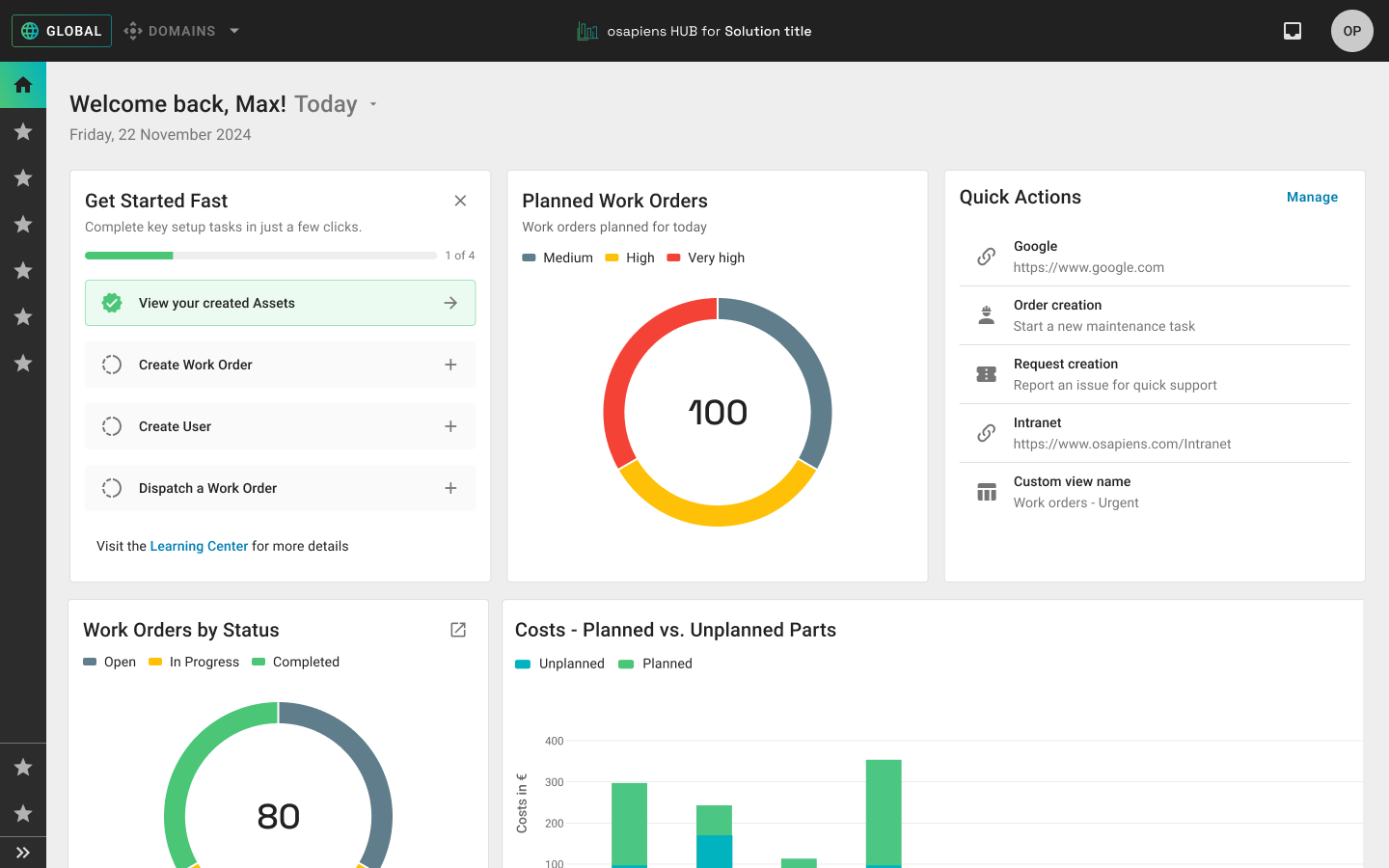
Version 3.15 – New Dashboards, Spare Part Management and Cost Tracking, Simplified Planning
January 1, 2026
Excavator Maintenance Checklist: What to Inspect, When & How
January 1, 2026
Surface Grinding Machine Maintenance Checklist – Tasks, Tips & Template

March 9, 2026
Field Service Management: How to optimize your resource planning
January 1, 2026
Gas Meter Maintenance Checklist – Tasks, Safety & Digital Execution
January 1, 2026
Cooling System Maintenance Checklist – Tasks, Tips & Template
January 1, 2026
Tankless Water Heater Maintenance Checklist – Tasks, Tips & Best Practices
January 1, 2026
Centrifuge Maintenance Checklist – Tasks, Safety & Digital Execution

February 6, 2026