

Maintenance Checklist

Florian Bartholomäus, osapiens Expert | 1. January 2026 | Lesezeit 11 min.
Most transformer failures show warning signs weeks or months before catastrophic breakdown—but only if you're systematically monitoring oil quality, thermal patterns, and insulation condition. Are your inspection intervals aligned with actual load profiles and environmental exposure?
Start using this checklist for free
More than 2200 companies place their trust in osapiens










Table of Contents
- Transformer Maintenance: Key Facts
- Why You Need a Transformer Maintenance Checklist
- What to Include in Your Transformer Maintenance Checklist
- Common Transformer Problems Your Maintenance Checklist Prevents
- From Paper Checklist to Digital: How the osapiens HUB Automates Your Transformer Maintenance Checklist
- FAQ
Transformers are among the most durable electrical assets in industrial infrastructure, often operating reliably for decades—yet when they fail, the consequences cascade across entire facilities. Unplanned transformer outages can halt production, trigger safety incidents, and create environmental hazards that extend far beyond the immediate repair costs. A structured transformer maintenance checklist helps organizations detect incipient faults before they escalate, maintain regulatory compliance, and protect operational continuity through systematic inspection, testing, and documentation.
Transformer Maintenance: Key Facts
- Failure consequences extend beyond repair costs: Transformer failures often trigger production stoppages, safety risks, and environmental incidents that cost organizations significantly more than the equipment itself.
- Systematic inspection detects problems early: Most transformer failures show detectable warning signs through dissolved gas analysis, thermal imaging, and insulation testing—but only when maintenance is proactive rather than reactive.
- Documentation supports compliance and audit readiness: Regulatory frameworks including NFPA 70, IEEE standards, and industry-specific requirements demand verifiable maintenance records and testing protocols.
- Digital execution improves data quality and traceability: Mobile CMMS platforms like osapiens HUB for Maintenance enable technicians to capture measurements, photos, and observations at the point of work, eliminating transcription errors and documentation delays.
Why You Need a Transformer Maintenance Checklist
Without structured maintenance protocols, transformer care becomes inconsistent—relying on individual technician experience rather than systematic procedures. This variability creates gaps where critical inspections are missed, test intervals drift, or abnormal conditions go undetected until they escalate into failures.
- Consistency across shifts and sites: A standardized checklist ensures every technician performs the same inspections regardless of experience level, eliminating the risk that less experienced personnel overlook critical warning signs.
- Risk reduction through early detection: Transformers degrade progressively through thermal stress, moisture ingress, and insulation breakdown—conditions that remain invisible without systematic oil sampling, thermal scanning, and electrical testing.
- Documentation for compliance and audit readiness: Regulatory bodies and insurance carriers increasingly require documented maintenance programs. A structured checklist creates verifiable records demonstrating adherence to IEEE, NFPA, and NETA standards, supporting compliance verification during audits or incident investigations.
- Technician guidance and knowledge transfer: Detailed checklists guide less experienced technicians through complex inspection sequences, capturing institutional knowledge that might otherwise walk out the door with retiring personnel.
- Standardization enables trending analysis: When inspections follow consistent procedures and capture data in standardized formats, organizations can identify gradual degradation patterns—such as rising oil moisture content or increasing dissolved gas concentrations—that indicate developing problems.
- Handover quality between maintenance teams: Structured documentation improves shift transitions and contractor handovers by providing clear records of what was inspected, what was found, and what requires follow-up attention.
Organizations operating transformers without systematic checklists often discover problems only after they manifest as operational disruptions. By that point, what could have been a planned intervention becomes an emergency repair with associated rush-order premiums, production losses, and safety risks. Learn more about preventive maintenance strategies that shift maintenance from reactive to proactive.
What to Include in Your Transformer Maintenance Checklist
An effective transformer maintenance checklist organizes tasks by the physical component or system being inspected, rather than by arbitrary time intervals. This component-based structure ensures technicians systematically evaluate every critical subsystem during each maintenance cycle.
The checklist below represents commonly recommended inspection and maintenance tasks. Actual requirements vary based on transformer type (oil-filled vs. dry-type), voltage class, operating environment, load profile, and manufacturer specifications. Organizations should adapt these tasks to their specific equipment and operational context.
| Component / System | Inspection & Maintenance Tasks | Purpose |
|---|---|---|
| Insulating Oil & Conservator | Check oil level and color; sample for dissolved gas analysis (DGA); test dielectric strength; inspect conservator bladder/diaphragm; verify moisture content | Detect internal faults, contamination, and moisture ingress that degrade insulation |
| Bushings & Terminals | Inspect for cracks, tracking, or contamination; clean surfaces; measure power factor; check connection tightness; verify grounding continuity | Prevent flashover, arcing, and connection failures at high-voltage interfaces |
| Cooling System | Inspect radiators/fans for blockage or damage; verify fan operation and control circuits; check coolant flow; measure temperature rise under load | Maintain thermal performance and prevent overheating that accelerates insulation aging |
| Tap Changer (if equipped) | Inspect contacts and mechanisms; sample tap changer oil separately; verify position indication; test control circuits; measure contact resistance | Ensure reliable voltage regulation and detect contact wear before failure |
| Core & Windings | Measure insulation resistance (megger test); perform turns ratio testing (TTR); conduct winding resistance measurement; verify core grounding | Detect insulation degradation, winding damage, and electrical imbalances |
| Protective Devices | Test Buchholz relay operation; verify sudden pressure relay function; inspect surge arresters; calibrate protective relays; check alarm circuits | Ensure protective systems respond correctly to abnormal conditions |
| Enclosure & Structural | Inspect tank for leaks, corrosion, or damage; check gaskets and seals; verify paint condition; assess foundation and mounting; inspect grounding grid | Prevent oil leaks, moisture ingress, and structural failures |
| Documentation & Records | Record all test values and observations; photograph abnormal conditions; update maintenance history; compare results to baseline data; document corrective actions | Enable trending analysis, support compliance verification, and inform future maintenance decisions |
Testing intervals depend on multiple factors including equipment criticality, operating conditions, and regulatory requirements. Organizations commonly perform daily operational checks (oil level, temperature, unusual noise), monthly visual inspections (external condition, cooling system function), quarterly condition-based testing (oil sampling, infrared thermography), and annual comprehensive electrical testing (insulation resistance, power factor, turns ratio). For guidance on structuring maintenance schedules, see maintenance schedule templates.
Critical transformers in high-consequence applications may justify more frequent testing or continuous condition monitoring through permanently installed sensors. Conversely, transformers in light-duty applications with low operational impact may require less intensive protocols. The key is aligning maintenance intensity with actual risk rather than applying uniform intervals across all equipment.
Turn Your Transformer Maintenance Checklist into Mobile Work Orders
Create structured checklists for every component—from insulating oil to protective relays. Execute them on mobile devices, sync with SAP PM, and maintain complete audit trails automatically.Start with Your Transformer Maintenance Checklist
Common Transformer Problems Your Maintenance Checklist Prevents
Systematic transformer maintenance addresses the failure mechanisms that account for most unplanned outages and catastrophic failures. Understanding these failure modes clarifies why specific checklist tasks matter.
- Insulation breakdown from moisture ingress: Water enters transformer oil through breathing, gasket leaks, or maintenance activities, reducing dielectric strength and creating sites for partial discharge. Regular oil sampling detects rising moisture levels before insulation failure occurs, while gasket inspection and breather maintenance prevent moisture entry.
- Thermal degradation from overloading or cooling system failure: Transformers operating above rated capacity or with blocked cooling systems experience accelerated insulation aging. Temperature monitoring, thermal imaging, and cooling system inspection detect overheating conditions before they cause permanent damage.
- Dissolved gas accumulation indicating internal faults: Overheating, arcing, and partial discharge generate specific gases (hydrogen, acetylene, ethylene, methane) dissolved in transformer oil. Quarterly dissolved gas analysis provides early warning of developing faults weeks or months before conventional inspections would detect problems.
- Connection failures from thermal cycling and vibration: Bolted connections gradually loosen due to thermal expansion/contraction and continuous vibration at power frequency. Infrared thermography identifies hot spots at connections before they progress to arcing or complete failure, while torque verification during maintenance prevents loosening.
- Bushing deterioration from contamination and tracking: Dirt, salt, and moisture accumulation on bushing surfaces create conductive paths that can lead to flashover. Regular cleaning and visual inspection prevent tracking patterns from developing, while power factor testing detects internal bushing degradation.
- Tap changer contact wear and contamination: Load tap changers experience mechanical wear and carbon accumulation that increases contact resistance and can lead to failure during switching operations. Separate oil sampling and contact inspection detect tap changer problems before they cause voltage regulation failures or internal arcing.
- Documentation gaps that prevent trending analysis: When maintenance is performed inconsistently or results are not recorded systematically, organizations lose the ability to identify gradual degradation patterns. Digital maintenance platforms like osapiens work order management ensure every inspection is documented with complete context, enabling meaningful trend analysis.
Each of these failure mechanisms follows predictable progression when left unaddressed, but remains manageable when detected early through systematic inspection and testing. The economic case for preventive maintenance becomes clear when comparing the cost of routine oil sampling and testing against the consequences of catastrophic transformer failure—production losses, emergency repair premiums, environmental cleanup, and potential safety incidents.
From Paper Checklist to Digital: How the osapiens HUB Automates Your Transformer Maintenance Checklist
Many organizations still execute transformer maintenance using paper forms or Excel spreadsheets—workflows that introduce multiple friction points between field execution and data analysis. Technicians arrive at transformer locations with printed checklists, record measurements by hand, return to offices, and later transcribe data into desktop systems. This pattern creates transcription errors, documentation delays, and incomplete records that undermine the value of maintenance programs.
Paper and Excel limitations include data entry errors during transcription, delayed visibility when documentation lags days or weeks behind field work, incomplete context when technicians record only final values without ambient conditions or observations, difficult trending analysis requiring manual data compilation across multiple sources, and lost institutional knowledge when handwritten notes become illegible or are misplaced.
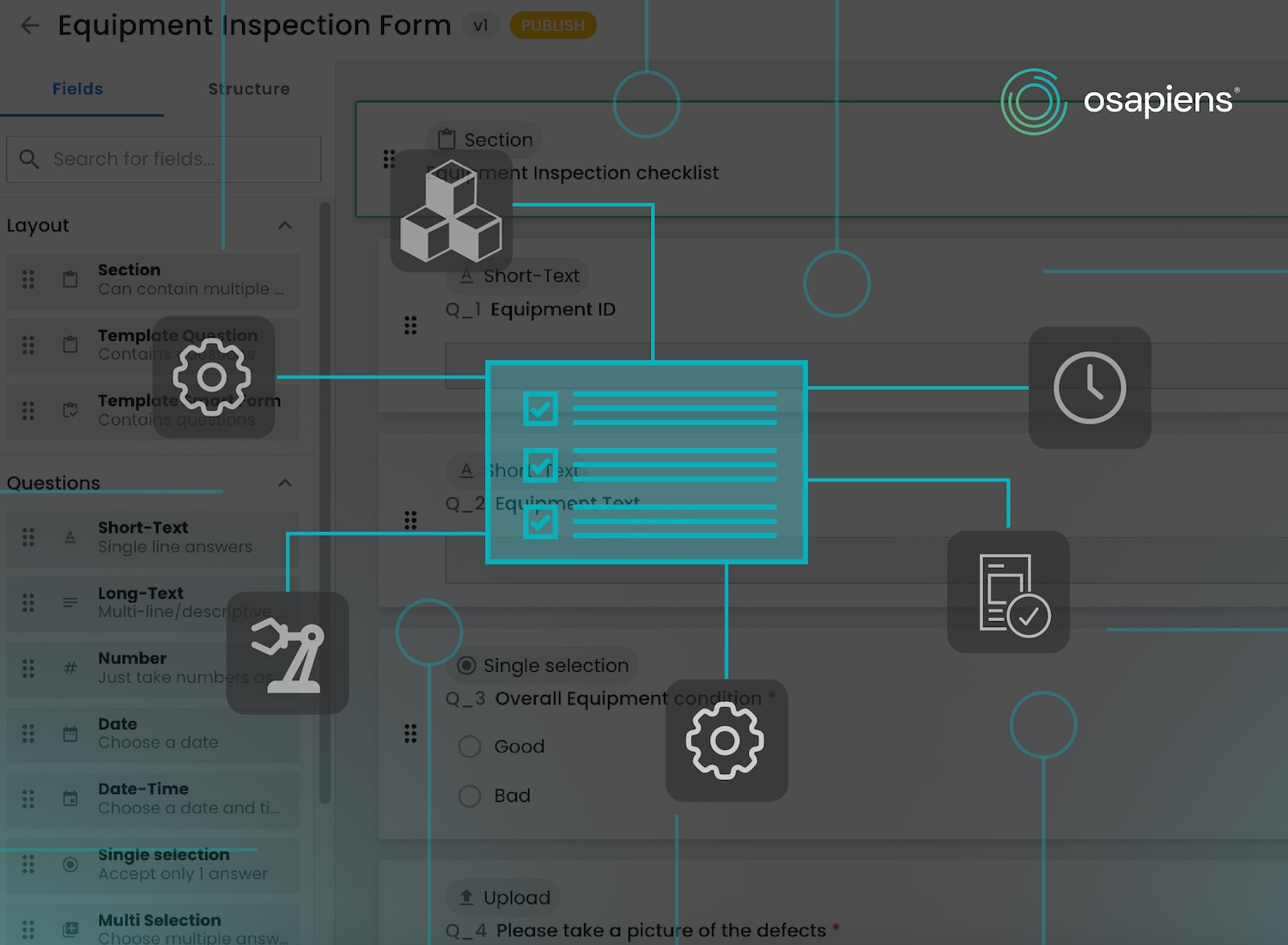
The osapiens HUB for Maintenance addresses these limitations through mobile-first execution that places comprehensive maintenance functionality directly in technicians’ hands. Field personnel access complete transformer documentation, previous test values, and step-by-step procedures on smartphones or tablets at the work site. They record measurements, capture photos of equipment condition, and document observations at the moment work occurs—eliminating transcription steps and ensuring data accuracy.
Key capabilities supporting transformer maintenance include offline functionality that enables work to continue in substations or industrial facilities with poor connectivity, with automatic synchronization when connection returns; photo and timestamp capture integrated into work order execution, documenting conditions visually rather than through narrative descriptions; barcode and QR code scanning to instantly retrieve asset records and maintenance history without manual lookup; and digital signatures and audit trails captured at the moment of work completion, demonstrating when maintenance was performed and by whom.
For organizations operating within SAP PM environments, osapiens HUB provides SAP-certified integration that bridges the gap between enterprise planning systems and field execution. Maintenance plans and work orders flow from SAP PM to mobile devices, while completion data, test results, and documentation flow back automatically—eliminating manual data entry and ensuring system consistency.
| Aspect | Paper or Excel Checklist | Digital Checklist with osapiens HUB |
|---|---|---|
| Data Entry | Manual transcription from handwritten notes | Direct entry at point of work with validation |
| Error Rate | Transcription errors, misplaced decimals, unit confusion | Structured data entry reduces input errors |
| Management Visibility | Delayed until paperwork is processed | Real-time visibility as work progresses |
| Photo Documentation | Separate camera, manual file management | Integrated photo capture linked to work orders |
| Trending Analysis | Manual data compilation across multiple sources | Automatic trending with historical comparison |
| Audit Readiness | Scattered paper records, difficult retrieval | Centralized digital records, instant retrieval |
| Technician Efficiency | Multiple steps: inspect, record, return, transcribe | Single-step documentation at point of work |
Organizations transitioning from paper-based maintenance to digital execution typically report improved data quality, faster decision-making regarding equipment interventions, reduced administrative burden on technicians and planners, and enhanced audit readiness through complete, traceable documentation. For transformer maintenance specifically, the ability to compare current test values against historical baselines immediately—while still at the equipment location—enables technicians to recognize abnormal trends and escalate concerns without delay. Explore how asset maintenance software transforms maintenance execution across equipment types.
Stop Losing Uptime to Missed Transformer Inspections
Digitize your maintenance checklists, automate work order creation, and give every technician a mobile tool that works—even offline. SAP PM integration included.Try osapiens HUB for Free
FAQ
What should be included in a transformer maintenance checklist?
A comprehensive transformer maintenance checklist should cover insulating oil condition (level, color, dissolved gas analysis, dielectric strength), bushing inspection and cleaning, cooling system operation, protective device testing (Buchholz relay, sudden pressure relay), electrical testing (insulation resistance, turns ratio, winding resistance), connection tightness verification, and complete documentation of all findings. The specific tasks depend on transformer type, voltage class, and operating environment—oil-filled transformers require oil sampling and analysis, while dry-type units focus on ventilation and insulation condition. Checklists should be customized based on manufacturer recommendations and operational risk assessment rather than applying generic templates.
How often should I complete my transformer maintenance checklist?
Maintenance frequency depends on equipment criticality, operating conditions, load profile, and environmental exposure rather than fixed universal intervals. Many organizations perform daily operational checks (oil level, temperature, unusual sounds), monthly visual inspections (external condition, cooling system), quarterly condition-based testing (oil sampling, infrared thermography), and annual comprehensive electrical testing (insulation resistance, power factor, turns ratio). Critical transformers in high-consequence applications may justify more frequent testing or continuous monitoring, while transformers in light-duty service may require less intensive protocols. The key is aligning maintenance intensity with actual risk through systematic assessment.
Can I customize this transformer maintenance checklist template?
Yes—and you should. While the checklist provided offers a foundation covering commonly recommended tasks, effective transformer maintenance requires adaptation to your specific equipment (oil-filled vs. dry-type, voltage class, capacity), operating environment (indoor vs. outdoor, temperature extremes, contamination exposure), load profile (continuous high load vs. intermittent operation), and regulatory requirements (industry-specific standards, insurance carrier requirements). Digital CMMS platforms like osapiens HUB enable organizations to create customized checklists with equipment-specific procedures, required test values, and pass/fail criteria while maintaining standardization across similar assets.
How does a digital CMMS improve maintenance checklist management?
A digital CMMS transforms checklist execution from paper-based documentation to structured, traceable workflows that improve data quality and enable meaningful analysis. Technicians access checklists on mobile devices at the equipment location, record measurements with built-in validation, capture photos of equipment condition, and document observations at the moment work occurs—eliminating transcription errors and documentation delays. The system automatically compares current test values against historical baselines, alerts managers when results fall outside acceptable ranges, and generates trend reports showing gradual changes in transformer condition over months or years. For organizations using SAP PM, integration ensures maintenance data flows seamlessly between field execution and enterprise planning systems without manual data entry.
Start using osapiens for free
Improve your uptime, extend the life of your equipment, and simplify work order management.
Book a demo
Related content
January 1, 2026
Dock Leveler Maintenance Checklist – Tasks, Tips & Template

July 14, 2025
Unlocking Operational Excellence Through Preventive Maintenance
January 1, 2026
Crane Maintenance Checklist – Essential Tasks, Safety Checks & Digital Template

November 21, 2025
Field Service Management Solutions Comparison: The 6 Best FSM Solutions for Small Businesses
January 1, 2026
Backflow Preventer Maintenance Checklist – Tasks, Compliance & Digital Execution
January 1, 2026
Switchgear Maintenance Checklist – Tasks, Tips & Template
January 1, 2026
Oxygen Concentrator Maintenance Checklist – Tasks, Documentation & Digital Execution
January 1, 2026
Turret Punch Press Maintenance Checklist – Tasks, Tips & Template
January 1, 2026
Welding Machine Maintenance Checklist – What to Inspect, When & How
January 1, 2026
Industrial Mixer Maintenance Checklist – Tasks, Tips & Template
January 1, 2026
Commercial Roof Maintenance Checklist – Tasks, Best Practices & Digital Execution
January 1, 2026