

SAP
 Remi Morisot,
osapiens Expert | 12. January 2026 | Lesezeit 13 min.
Remi Morisot,
osapiens Expert | 12. January 2026 | Lesezeit 13 min.
SAP S/4HANA migration until 2027: Greenfield vs. Brownfield strategies & securing critical maintenance data. osapiens HUB for seamless EAM migration.
Book a demo
Table of Contents
- Key Takeaways
- What is SAP S/4HANA and Why Do You Need to Migrate?
- The Three Main SAP S/4HANA Migration Strategies: Greenfield, Brownfield, and Hybrid
- Cloud ERP vs. On-Premise: Deployment Options for SAP S/4HANA
- From SAP PM to SAP EAM: What Changes for Maintenance Under S/4HANA?
- The Biggest Challenges in Your SAP S/4HANA Migration Project
- How to Secure Your Maintenance Data During SAP Migration
- Master Your SAP S/4HANA Migration with osapiens HUB for Maintenance
- FAQ
By the end of 2027, official support for SAP ECC will expire. For many organizations, transitioning to S/4HANA is practically unavoidable. Companies can choose between three approaches: Greenfield (new implementation), Brownfield (system conversion), or Hybrid (combination of both). The migration of maintenance data from SAP PM to SAP EAM is particularly critical – there’s a risk of data loss in asset structures and historical maintenance information.
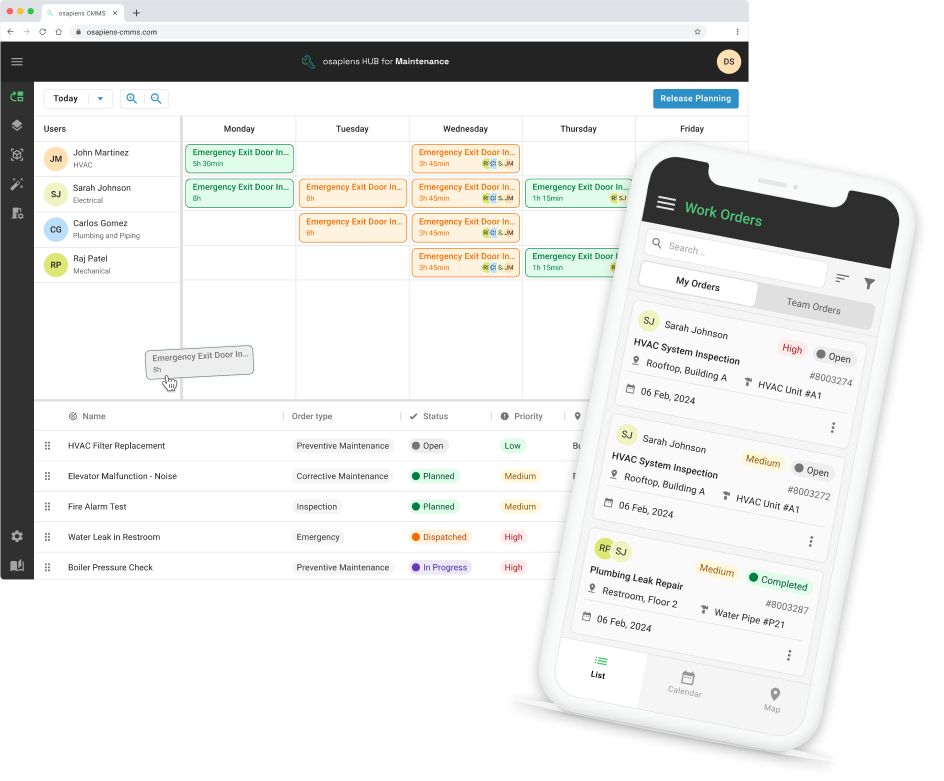
The osapiens HUB for Maintenance operates completely independently and supports the entire maintenance process before, during, and after an SAP migration. The system can synchronize master data from SAP while also maintaining it independently. It generates all transactional data such as work orders, confirmations, and spare parts consumption, storing them completely in the system. The solution enables work on desktop and mobile devices and covers comprehensive maintenance management.
Key Takeaways
- Migration until 2027: SAP ECC support ends in 2027, requiring companies to plan their S/4HANA migration now – choosing between Greenfield, Brownfield, or Hybrid approach determines project success.
- Mastering complex data migration: The SAP S/4HANA Migration Cockpit supports data transfer but reaches its limits with complex IT landscapes, unclean master data, and inconsistent business processes.
- Maintenance as a critical area: Maintenance data with historical asset structures, bills of materials, and task lists require special attention. Errors jeopardize asset availability and lead to costly production downtime.
- Transformation as opportunity: S/4HANA migration enables not just a technical upgrade but opens access to innovations like real-time analytics, AI-powered automation, and cloud-based solutions for increased competitiveness.
- osapiens as migration solution: The osapiens HUB for Maintenance simplifies maintenance data migration as a modern CMMS through SAP-certified integration, ensures data quality, and offers a mobile-first approach for modern maintenance processes in S/4HANA.
What is SAP S/4HANA and Why Do You Need to Migrate?
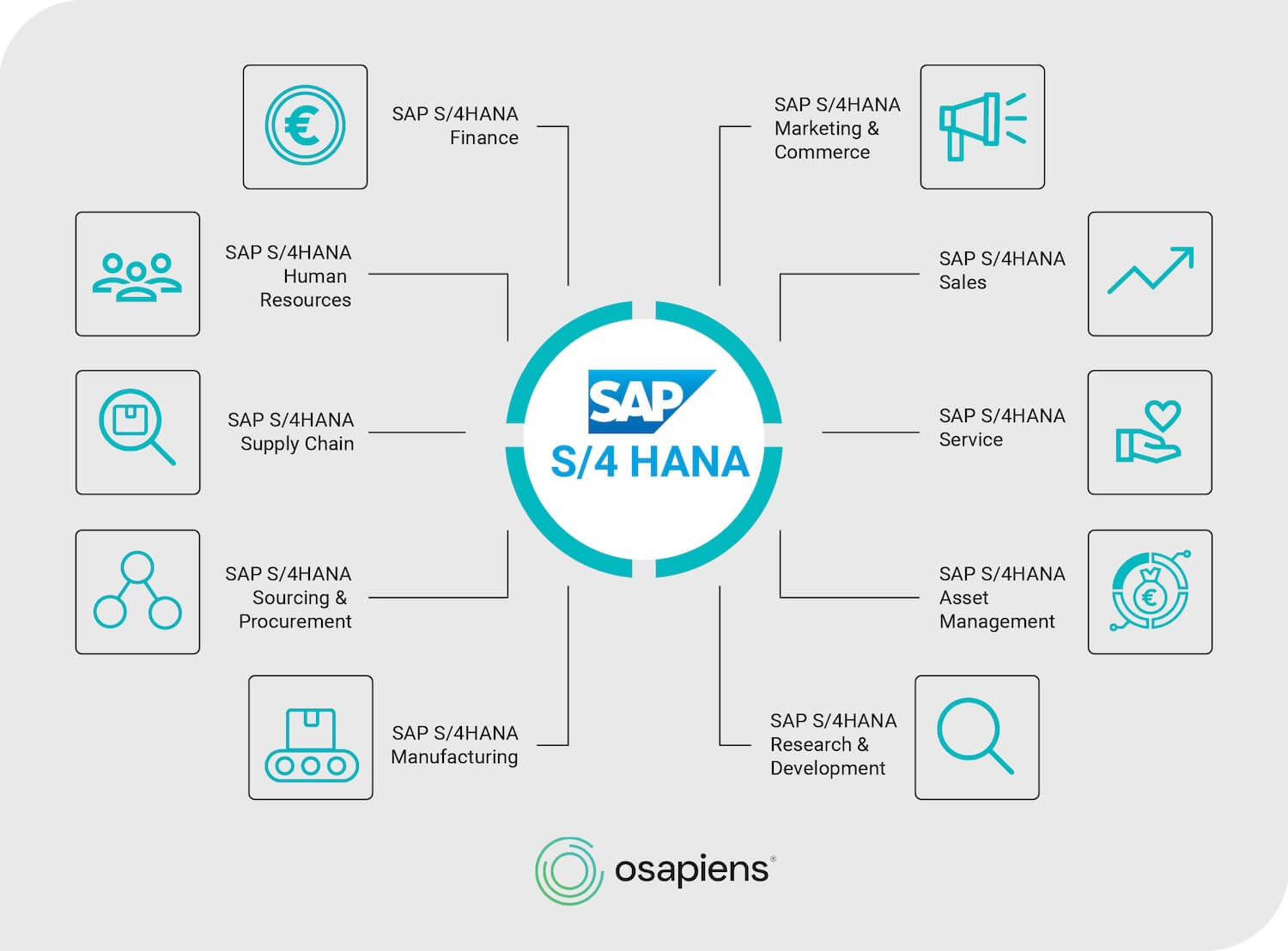
SAP S/4HANA is the fourth generation of the SAP Business Suite and represents SAP’s most modern ERP system. The technological foundation is the in-memory database SAP HANA, which processes data directly in working memory, enabling significantly faster data analysis. Unlike SAP ECC, which runs on conventional databases, S/4HANA offers a fundamentally redesigned system architecture with simplified data models and real-time processing capability.
Why SAP Migration is Necessary: End of Support for SAP ECC
For companies currently using SAP ECC, there’s a clear timeline for migration:
- December 2027: End of standard support for SAP ECC 6.0
- December 2030: End of extended maintenance
- Optional until 2033: Cloud Transition Option for certain customers with cloud contracts
After 2030, companies will no longer receive security updates, patches, or technical support for SAP ECC. This means: Without migration, significant risks arise for IT security, compliance requirements, and business continuity. For organizations, it’s no longer a question of “whether” but only “when” migration occurs.
Why is SAP Pushing the Switch to S/4HANA?
SAP has strategic reasons for focusing on S/4HANA:
- Technological advancement: The old ECC architecture is based on 1990s technology and can only limitedly support modern requirements like AI, IoT, or cloud integration
- Maintenance effort: SAP wants to concentrate development and support efforts on a single, modern platform rather than maintaining parallel systems
- Cloud strategy: S/4HANA is the foundation for SAP’s cloud offerings (public/private cloud), while ECC is primarily designed for on-premise
- Competitive pressure: Competitors like Oracle, Microsoft, and Salesforce already offer modern cloud ERP solutions
The Three Main SAP S/4HANA Migration Strategies: Greenfield, Brownfield, and Hybrid
Migration from SAP ECC to S/4HANA can be realized through three different approaches, each offering distinct advantages and disadvantages. Choosing the right strategy depends on factors such as your IT landscape’s complexity, your system’s degree of customization, and your business objectives.
Particularly for maintenance-intensive areas like maintenance operations, this decision is critically important as it directly impacts asset availability and the continuity of critical business processes.
| Greenfield Migration | Brownfield Migration | Hybrid Approach | |
|---|---|---|---|
| Characteristics | Complete new implementation without legacy burdens, entirely new S/4HANA system is set up | System conversion: technical upgrade of your existing SAP ECC system with data and settings migration | Selective data transition: combination of Greenfield and Brownfield, transferring only the data that adds value to the new system |
| Advantages | Comprehensive process optimization possible, no technical legacy issues, best practices from the start, ideal for cloud deployment | Faster transition, shorter project duration, proven processes remain intact, lower risk | Flexibility in transformation, gradual modernization possible, balance between innovation and continuity |
| Disadvantages | Higher effort, longer project duration, extensive training required, all processes must be reconfigured | Legacy issues are transferred, limited process optimization, technical debt remains | Higher planning complexity, requires comprehensive knowledge of both approaches, longer preparation phase |
| Suitable for | Cloud migration, comprehensive transformation, companies with heavily outdated processes | On-premise deployment, quick migration, companies with well-functioning processes | Large enterprises with complex IT landscapes, gradual consolidation of multiple ERP systems |
Cloud ERP vs. On-Premise: Deployment Options for SAP S/4HANA
Beyond choosing the migration approach, companies must decide where their new S/4HANA system will operate.
The SAP S/4HANA Cloud Public Edition is multi-tenant, highly standardized, and operational within weeks—ideal for companies wanting to start quickly and benefit from best practices.
The SAP S/4HANA Cloud Private Edition offers a dedicated cloud environment with more customization options and suits companies with specific requirements. The on-premise variant enables complete control and maximum flexibility in customizations but requires internal IT resources for operation and maintenance.
The osapiens HUB for Maintenance supports both cloud and on-premise deployments and integrates seamlessly with all S/4HANA variants. But which deployment model is right for your organization? The decision depends on several factors:
- Company size and complexity: SMEs often benefit from public cloud, while large enterprises with complex processes tend to choose private cloud or on-premise
- Customization needs: High customization requirements favor private cloud or on-premise, standard processes enable public cloud
- Data privacy and compliance: Strict regulatory requirements may necessitate on-premise or private cloud
- IT resources and expertise: Cloud solutions reduce internal IT effort, on-premise requires internal expertise for operations and updates
From SAP PM to SAP EAM: What Changes for Maintenance Under S/4HANA?
For maintenance managers, a central question arises during SAP S/4HANA migration: What happens to SAP PM (Plant Maintenance), and which functions remain? The good news: SAP PM hasn’t been eliminated but has been fully integrated into the new SAP EAM (Enterprise Asset Management) module. All familiar PM functions are available under S/4HANA—with extended capabilities and a modernized user interface.
New Functions in SAP EAM: What’s Added in S/4HANA?
Beyond functional continuity, SAP EAM brings additional capabilities that go beyond classic maintenance management. These enhancements leverage SAP HANA database performance and modern technologies like AI and IoT:
- AI-based Predictive Maintenance: Through machine learning and real-time data analysis, the system identifies upcoming maintenance needs and potential machine failures before they occur. The more data available to the system, the more precise the predictions.
- Real-time analytics: The SAP HANA in-memory database enables analysis of large data volumes in fractions of a second. KPIs for asset availability, maintenance costs, and MTBF (Mean Time Between Failures) are available in real-time at any moment. Business process analytics provide unprecedented visibility into maintenance performance and enable data-driven decision-making.
- Remote asset monitoring: Integration with IoT sensors and the SAP Asset Intelligence Network (AIN) allows central monitoring of assets at different locations—without physical on-site inspection.
- Enhanced mobile functions: SAP tools like Fiori apps provide technicians mobile access to work orders, checklists, and asset documentation—even offline. After synchronization, all changes are automatically transferred to the system.
- Enhanced Work Clearance Management (eWCM): Digital work clearance processing for safe maintenance operations with approval workflows and documentation of safety measures.
Do SAP Modules and Transactions Remain the Same During Migration?
Many maintenance managers fear that functions from SAP PM will be moved to other modules or eliminated. This concern is unfounded. SAP EAM is the direct successor to SAP PM and assumes all functionality. The module structure remains intact:
- Technical objects: Locations, equipment, and asset structures are managed identically
- Maintenance planning: Maintenance plans, maintenance strategies, and preventive maintenance function unchanged
- Work orders: Creation, confirmation, and settlement of work orders operate as usual
- Spare parts management: Integration with SAP MM (Materials Management) for material requirements planning remains intact
The main difference lies in the interface and user guidance. SAP Fiori offers a role-based, modern UI specifically optimized for mobile devices. Technicians work through apps like “Manage Work Orders,” “Create Notifications,” or “Perform Work Clearance”—instead of transaction codes in SAP GUI.
Integration with osapiens HUB for Maintenance
The osapiens HUB for Maintenance offers a specialized solution that seamlessly supports both SAP PM (ECC) and SAP EAM (S/4HANA). During migration, osapiens serves as a stable platform for maintenance teams—regardless of whether SAP ECC or S/4HANA is running in the background.
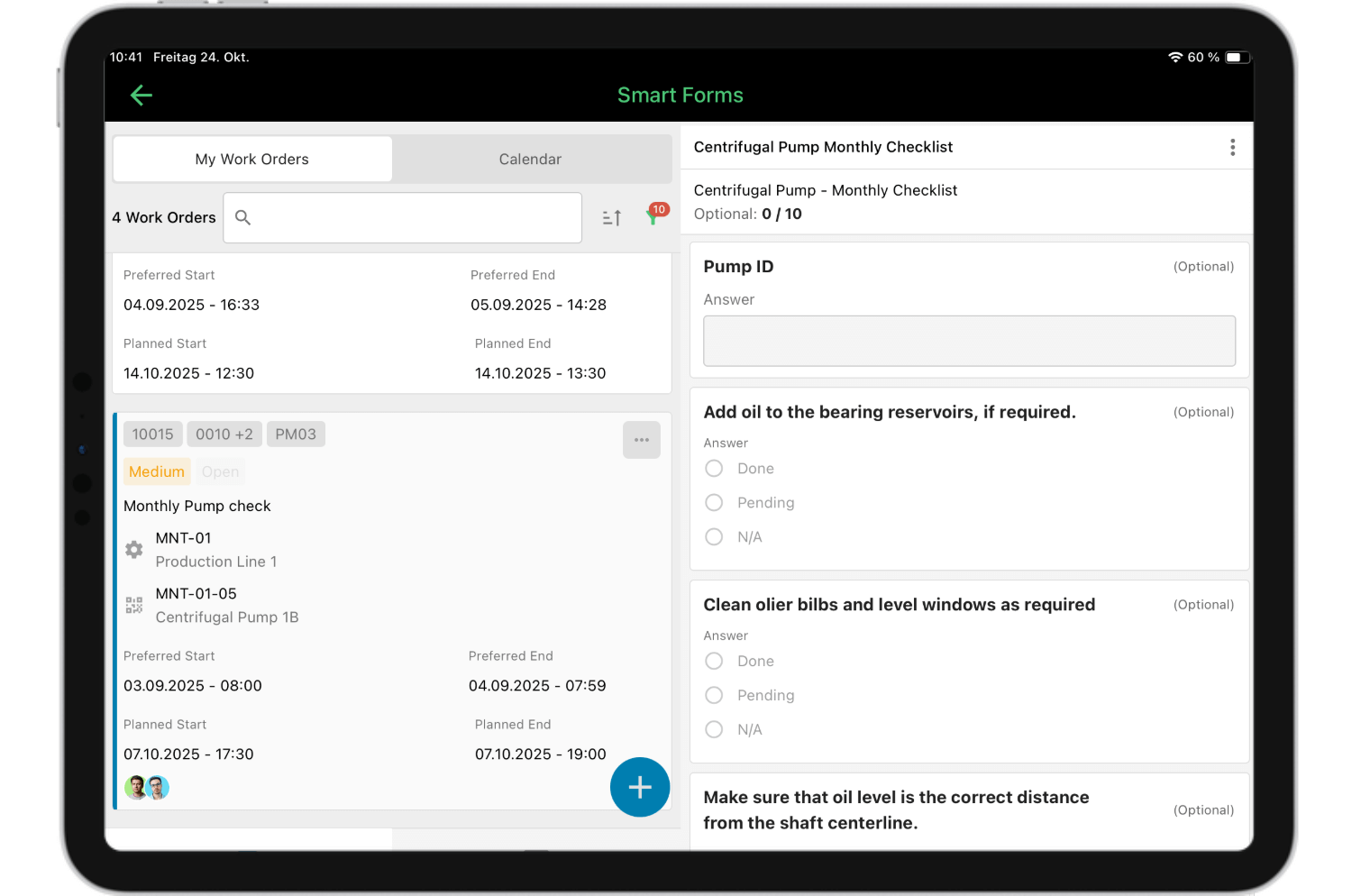
osapiens’ mobile-first architecture goes beyond standard Fiori apps and offers extended functions such as:
- Offline-capable work orders with automatic synchronization after network connection
- Checklists and step-by-step instructions directly on tablet or smartphone
- Real-time dashboards for maintenance managers with KPIs on asset availability and order progress
- Automatic validation of maintenance data during SAP migration
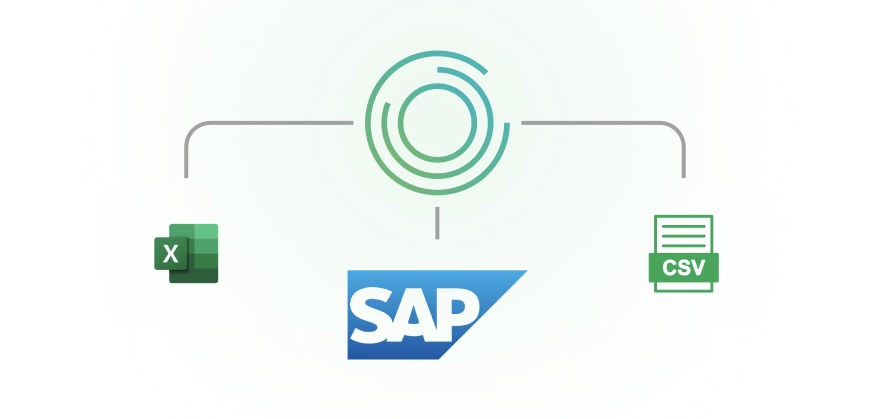
osapiens’ certified SAP connector synchronizes all maintenance data in real-time between the osapiens HUB and SAP EAM—ensuring seamless data integrity during and after migration.
The Biggest Challenges in Your SAP S/4HANA Migration Project
Implementing SAP S/4HANA is a complex transformation project that goes far beyond a technical upgrade:
- Complex legacy IT landscapes: Grown system structures with numerous interfaces and dependencies significantly complicate migration. A complete inventory is essential to capture all connections between the ECC system and third-party systems.
- High degree of customization: Years of accumulated customizations and customer-specific code must be checked for S/4HANA compatibility. Custom code analysis is essential to identify which modifications can be transferred one-to-one and which require redevelopment.
- Unclean master data: Inconsistent, outdated, or duplicate master data jeopardizes data quality in the new system. Data cleansing before migration is time-consuming but essential for successful transition.
- Data volume management: Years of accumulated transactional data in SAP ECC can slow down migration and impact S/4HANA performance. Archiving cold data (historical records rarely accessed but required for compliance) reduces migration complexity and optimizes system performance.
- Inconsistent business processes: Different business processes across various business areas must be harmonized before migration. Without this standardization, media breaks and efficiency losses threaten. Streamlined business processes are critical for maximizing S/4HANA’s capabilities.
- Immature change management: Lacking strategy for organizational transformation leads to employee resistance. Training and early involvement of all stakeholders are critical for success in this digital transformation.
- Resistance from individual stakeholders: Individual executives or departments can slow down or block the migration process. Clear communication of benefits and the business case is necessary to get everyone on board.
Particularly in maintenance, additional challenges arise that require special solutions—from migrating historical maintenance data to seamlessly integrating mobile technician workflows into the new S/4HANA system.
How to Secure Your Maintenance Data During SAP Migration
Maintenance is among the most demanding areas in SAP S/4HANA migration, where protecting critical data like asset histories, failure patterns, and compliance documentation is paramount for business continuity. While financial data and master data are often structured, maintenance data is significantly more complex:
- Historical maintenance histories spanning years or decades,
- nested asset structures with hierarchies,
- detailed bills of materials with thousands of components,
- customized task lists, and
- extensive spare parts management must be transferred without errors.
Additionally, mobile technician workflows must continue seamlessly to avoid production downtime.
The risks of faulty maintenance data migration are substantial: Data loss leads to missing knowledge about past repairs and vulnerabilities, inconsistencies in asset structures cause incorrect maintenance planning, and missing spare parts information can trigger unplanned shutdowns. For manufacturing companies and utilities, where each hour of production downtime can cost millions, asset availability is business-critical.
The osapiens HUB for Maintenance protects your critical maintenance data during S/4HANA migration: Historical asset structures and maintenance histories remain permanently available, even if they aren’t fully transferred in the standard migration process. Automatic data validation checks for inconsistencies in bills of materials, task lists, and asset hierarchies before migration. Your technicians continue working without interruption—ensuring maximum asset availability and zero production downtime during transformation.
Master Your SAP S/4HANA Migration with osapiens HUB for Maintenance
Migration to SAP S/4HANA is unavoidable for companies—all SAP customers must act by the end of ECC support in 2027 at the latest. Choosing between Greenfield, Brownfield, and Hybrid approach depends on individual company requirements: Greenfield enables a complete restart with best practices, Brownfield offers a faster path through system conversion, and the Hybrid approach combines both strategies for complex IT landscapes.
Particularly maintenance with its complex data structures, historical maintenance information, and critical asset dependencies deserves special attention—errors here can lead to costly production failures.
The osapiens HUB for Maintenance offers the ideal solution for smooth migration of maintenance data while establishing itself as a modern platform for maintenance in S/4HANA. With SAP-certified integration, mobile-first approach, and automatic validations, osapiens ensures data quality and asset availability throughout the entire transformation.
FAQ
What is SAP S/4HANA migration?
SAP S/4HANA migration is the process of transitioning from SAP ECC (or other legacy SAP systems) to SAP’s next-generation ERP platform, S/4HANA. This involves moving data, processes, and customizations to the new system while leveraging its in-memory database technology for real-time analytics and improved performance. Companies can choose between Greenfield (new implementation), Brownfield (system conversion), or Hybrid approaches depending on their specific requirements.
What is the deadline for migrating to SAP S/4HANA?
SAP ECC standard support ends in December 2027, with extended maintenance available until December 2030. After 2030, companies will no longer receive security updates, patches, or technical support for SAP ECC. Since migration projects typically take 12-24 months, organizations should begin planning by 2025 at the latest to ensure a timely transition.
What is the SAP S/4HANA movement?
The SAP S/4HANA movement refers to SAP’s strategic shift to consolidate all customers onto its modern, cloud-ready ERP platform built on HANA in-memory database technology. This initiative aims to replace legacy systems like SAP ECC with a unified platform that supports AI, IoT, real-time analytics, and cloud deployment. SAP is driving this transition to reduce maintenance complexity and enable customers to leverage next-generation business innovations.
What are the 4 types of data migration?
The four main types of data migration strategies are: Storage migration (moving data between storage systems), Database migration (transferring data between database platforms), Application migration (moving data to a new application while potentially transforming its structure), and Cloud migration (relocating data from on-premise to cloud environments or between cloud platforms). In SAP S/4HANA context, organizations typically use a combination of these approaches depending on whether they choose Greenfield, Brownfield, or Hybrid migration strategies.
osapiens HUB for Maintenance
Discover how our CMMS solution improves your uptime, extends the life of your equipment, and simplifies the management of your work orders.
Book a demo