

Maintenance Checklist

Florian Bartholomäus, osapiens Expert | 1. January 2026 | Lesezeit 10 min.
Many conveyor failures start with small, visible warning signs—belt edge fraying, unusual roller noise, or slight tracking drift. A structured checklist ensures technicians catch these early indicators before they escalate into costly breakdowns or safety incidents.
Create your checklist for free










TRUSTED BY LEADING COMPANIES




ENTERPRISE-READY
 SAP Certification
 ISO 27001
 EU Hosting
 Entra ID & Okta
 Multi-Entity
Table of Contents
- Conveyor Belt Maintenance: Key Facts
- Why You Need a Conveyor Belt Preventive Maintenance Checklist
- What to Include in Your Conveyor Belt Preventive Maintenance Checklist
- Common Conveyor Belt Problems Your Maintenance Checklist Prevents
- From Paper Checklist to Digital: How the osapiens HUB Automates Your Conveyor Belt Preventive Maintenance Checklist
- FAQ
Conveyor belt systems are critical assets in manufacturing, logistics, food processing, mining, and distribution operations. When functioning properly, conveyors enable seamless material handling and production flow. When they fail, the consequences ripple through entire operations, causing production halts and unplanned downtime that can be extremely costly. Without structured maintenance, unplanned downtime for conveyor systems becomes harder to predict—and repair costs increase significantly compared to planned corrective actions.
This guide provides a practical, equipment-specific conveyor belt preventive maintenance checklist designed for maintenance managers, plant operators, and technicians. You’ll learn what to inspect, how to organize tasks by component rather than frequency, and how digital tools like the osapiens HUB for Maintenance transform paper-based checklists into mobile, audit-ready workflows that reduce downtime and improve documentation quality.
Conveyor Belt Maintenance: Key Facts
- Consistency and early detection: Structured checklists ensure that critical inspection tasks are performed systematically, catching early warning signs like belt misalignment, roller seizure, or pulley wear before they escalate into major failures.
- Risk reduction and safety: Regular maintenance reduces the likelihood of accidents caused by worn guards, failed emergency stops, or unexpected belt failures—protecting both workers and production schedules.
- Documentation and traceability: Digital checklists provide audit-ready documentation, capturing timestamps, photos, and technician signatures that support compliance and root cause analysis.
- Technician guidance and standardization: Clear, component-based checklists support less experienced technicians and ensure repeatability across shifts, sites, and maintenance teams.
Why You Need a Conveyor Belt Preventive Maintenance Checklist
A structured conveyor belt maintenance checklist is not optional—it’s a strategic tool that prevents costly failures, ensures worker safety, and supports regulatory compliance. Here’s why it matters:
- Consistency: Ad-hoc or experience-based maintenance fails because it relies on individual memory and informal knowledge. Checklists ensure that every technician performs the same essential procedures, regardless of experience level or shift.
- Risk reduction: Missing or inconsistent checks lead to failures that disrupt production. A small tear that could be repaired quickly becomes a major belt failure if ignored; acoustic signals indicating early bearing wear escalate into complete roller seizure if not addressed.
- Documentation: Traceability and audit readiness are essential for compliance with safety regulations and internal policies. Digital checklists capture maintenance history, photos, and completion timestamps automatically, eliminating gaps in paper-based records.
- Technician guidance: Structured procedures support less experienced team members by providing clear, step-by-step instructions. This reduces errors, improves training efficiency, and ensures that critical tasks are never overlooked.
- Standardization: Repeatability matters across shifts and sites. A well-designed checklist ensures that maintenance quality remains consistent, even as personnel change or operational demands fluctuate.
- Compliance: Checklists support regulatory and internal audit requirements by documenting that safety devices, guards, and emergency stops are inspected and functional. This reduces liability exposure and strengthens compliance posture.
What to Include in Your Conveyor Belt Preventive Maintenance Checklist
Effective conveyor maintenance checklists are organized by component or system, not by frequency (daily/weekly/monthly). This structure ensures that technicians understand which parts of the conveyor require attention and what specific tasks apply to each component. The checklist below is designed to be adapted based on your conveyor type, usage patterns, and operational environment.
Tasks are examples, not exhaustive. Actual intervals depend on usage intensity, environmental conditions, material type, and manufacturer guidance. Always consult equipment manuals and adjust based on historical failure data and risk assessment.
| Component / System | Inspection & Maintenance Tasks | Purpose |
|---|---|---|
| Belt Surface & Edges | Inspect for cuts, tears, cracks, fraying, glazing, uneven wear patterns; check for material buildup or sticking; verify belt thickness uniformity | Detect early damage, prevent catastrophic failure, maintain material flow consistency |
| Belt Tracking & Alignment | Verify belt runs centered on pulleys and idlers; check for lateral drift; inspect for rubbing against guards or frame; adjust tracking mechanisms as needed | Prevent edge wear, material spillage, and accelerated belt degradation |
| Belt Tension | Check tension during operation and idle state; adjust tensioning mechanism per manufacturer specs; verify no slippage during start-up or under load; ensure sag within permissible limits | Prevent slippage, reduce bearing wear, maintain power transmission efficiency |
| Rollers & Idlers | Inspect for free rotation, structural damage, debris buildup; check for seized, noisy, or wobbling rollers; grease bearings; verify alignment; replace worn or damaged rollers | Prevent roller seizure, reduce drag, maintain smooth belt movement |
| Pulleys (Head, Tail, Drive) | Inspect for wear, damage, material buildup; check pulley lagging condition; verify pulley alignment and squareness; clean accumulated debris; inspect for cracks or deformation | Maintain traction, prevent slippage, ensure proper belt tracking |
| Drive System (Motor, Gearbox, Couplings) | Check motor temperature, vibration, and amperage; inspect gearbox oil level, condition, and temperature; verify coupling alignment; listen for abnormal noise; test motor mounting bolts | Prevent motor burnout, reduce mechanical stress, detect early drive system failure |
| Scrapers & Cleaners | Inspect primary and secondary scrapers for wear, proper installation, and sizing; adjust tension to ensure even wear; clean accumulated material; replace worn blades | Reduce material carryback, prevent buildup, maintain belt cleanliness |
| Safety Systems | Test emergency stop buttons and pull cords (empty and loaded conditions); verify guards are secure and functional; check warning labels visibility; inspect interlocks and sensors | Worker safety, regulatory compliance, prevent accidents |
| Frame & Structure | Inspect for damage, loose hardware, cracks, or deformation; check bearing mounting bolts; verify frame is level and square; tighten fasteners; inspect support structures | Maintain structural integrity, prevent misalignment, ensure stability |
| Lubrication Points | Apply manufacturer-recommended lubricants to chains, bearings, shafts at defined intervals; check automatic lubrication systems (timers, pumps, reservoirs); verify delivery lines unobstructed | Reduce friction, prevent bearing failure, extend component lifespan |
Turn Your Conveyor Belt Maintenance Checklist into Digital Work Orders
Create structured checklists for every component—from belt surface to drive system. Execute them on mobile, sync with SAP PM, and keep full audit trails automatically.Start with Your Conveyor Belt Preventive Maintenance Checklist
Common Conveyor Belt Problems Your Maintenance Checklist Prevents
A structured preventive maintenance checklist addresses the most common failure modes that disrupt conveyor operations and create safety hazards. Here’s what systematic maintenance prevents:
- Belt misalignment and tracking issues: When belts drift laterally from their intended centerline, they create uneven wear, friction against guards, and material spillage. Regular tracking checks and pulley alignment verification catch misalignment early, before it damages belt edges or causes secondary failures affecting rollers and pulleys.
- Belt damage and premature failure: Visible fraying, cracks, glazing, and uneven wear patterns indicate developing problems. A checklist ensures technicians inspect the full belt surface regularly, identifying damage when it’s still repairable rather than waiting until catastrophic failure occurs.
- Roller and bearing failures: Rollers that don’t rotate freely due to bearing corrosion, contamination, or fatigue generate grinding, squeaking, or rattling noises. Systematic inspection and lubrication prevent roller seizure, which creates drag, increases motor load, and accelerates belt wear.
- Excessive vibration and motor overload: Abnormal vibration and motor amperage spikes signal developing mechanical issues such as failing bearings, structural imbalance, or motor degradation. Checklists ensure these warning signs are captured and investigated before cascading failures occur.
- Material spillage and dust buildup: Spillage indicates underlying tracking misalignment, improper belt tension, or component wear. Dust accumulation poses fire and explosion hazards in certain environments, reduces cooling efficiency, and contaminates products. Regular cleaning and inspection prevent these compounding risks.
- Debris accumulation and blockages: Transported materials shed fragments, environmental contamination settles onto surfaces, and product carryback adheres to the belt underside. Checklists ensure debris is removed systematically, preventing blockages that halt material flow and create hazards during manual cleaning.
- Safety device failures: Worn guards, degraded safety interlocks, and failed emergency stop devices eliminate protective barriers that prevent worker contact with moving belts, rollers, and pulleys. Regular testing and inspection ensure safety systems function reliably and meet regulatory requirements.
From Paper Checklist to Digital: How the osapiens HUB Automates Your Conveyor Belt Preventive Maintenance Checklist
Paper checklists, Excel spreadsheets, and PDF maintenance procedures create media breaks that undermine maintenance execution. Technicians arrive at a conveyor with a printed checklist, inspect components, make notes on paper, and then return to the office to manually enter findings into a CMMS—a process that introduces delays, transcription errors, and loss of information.
The osapiens HUB for Maintenance eliminates these friction points by placing work order management, maintenance history, and inspection checklists directly in technicians’ hands via smartphones or tablets. Here’s how digital execution transforms conveyor maintenance:
| Paper or Excel Checklist | Digital Checklist with osapiens HUB |
|---|---|
| Technicians carry printed checklists that can be lost, damaged, or incomplete | Interactive checklists displayed on mobile devices, accessible offline, with automatic sync when connectivity returns |
| Manual data entry after work completion introduces delays and errors | Technicians close work orders directly from mobile device; data syncs instantly to central database |
| Photos and notes captured separately, often not linked to specific work orders | Photos, measurements, and digital signatures captured directly into the system at the point of work |
| Maintenance history scattered across spreadsheets, paper files, and informal notes | Complete maintenance history accessible at the point of work, enabling informed decision-making and troubleshooting |
| Difficult to track compliance, generate reports, or analyze failure trends | Automated KPI tracking, real-time dashboards, and compliance reports generated automatically |
| No integration with spare parts inventory or procurement systems | Real-time visibility into spare parts availability; automatic stock updates when parts are used |
The osapiens HUB supports offline functionality, which is critical for industrial facilities with poor cellular coverage. Technicians can execute maintenance work, capture data, take photos, and document findings while offline; when connectivity is restored, the application automatically synchronizes local data to the central system, ensuring no information is lost.
Beyond mobile execution, the osapiens HUB provides full SAP PM integration, enabling seamless data exchange with existing enterprise systems while avoiding data silos and manual transfers. This is particularly valuable for organizations that use SAP PM as their system of record for financial tracking and asset hierarchies but need a mobile-first execution interface that technicians will actually use. Learn more about SAP-integrated maintenance software.
Stop Losing Uptime to Missed Conveyor Inspections
Digitize your maintenance checklists, automate work order creation, and give every technician a mobile tool that works—even offline. SAP PM integration included.Try osapiens HUB for Free
FAQ
What should be included in a conveyor belt maintenance checklist?
A comprehensive checklist should cover belt surface inspection (cuts, tears, fraying, wear patterns), tracking and alignment verification, belt tension checks, roller and idler inspection (free rotation, bearing condition, debris buildup), pulley condition assessment (wear, lagging, alignment), drive system checks (motor temperature, vibration, gearbox oil), scraper and cleaner maintenance, safety system testing (emergency stops, guards, interlocks), and frame and structure inspection. The checklist should be adapted to your specific conveyor type, usage patterns, and environmental conditions.
How often should I complete my conveyor belt maintenance checklist?
Maintenance frequency depends on usage intensity, environmental conditions, material type, and risk assessment. Common practice includes daily visual inspections during operation (debris, noise, tracking), weekly hands-on checks (lubrication, detailed roller inspection, belt tension), monthly comprehensive inspections during scheduled downtime (belt integrity, pulley condition, safety mechanisms), and quarterly or annual major assessments (motor replacement, structural inspection, comprehensive testing). High-use or critical systems may require more frequent inspections, while less critical equipment may follow extended intervals based on condition monitoring data.
Can I customize this conveyor belt maintenance checklist template?
Yes—customization is essential. Every conveyor system operates under different conditions, transports different materials, and faces different failure modes. Your checklist should reflect manufacturer specifications, historical failure patterns, operational environment (dust, moisture, temperature), material characteristics (abrasive, sticky, corrosive), and asset criticality. Digital CMMS platforms like the osapiens HUB for Maintenance allow you to create equipment-specific checklists with conditional logic, photos, and step-by-step instructions tailored to your exact needs.
How does a digital CMMS improve maintenance checklist management?
A digital CMMS like the osapiens HUB transforms checklist execution through mobile access (technicians execute checklists on smartphones or tablets at the point of work), offline functionality (work continues in areas without connectivity, with automatic sync when connection returns), automated documentation (photos, timestamps, and signatures captured directly into the system), real-time visibility (maintenance managers see work order status and completion rates instantly), integrated spare parts tracking (parts usage automatically updates inventory levels), and SAP PM integration (financial data flows to SAP while operational data remains accessible in the CMMS). This eliminates media breaks, reduces data entry errors, and provides complete audit trails for compliance. Explore preventive maintenance software options.
Start using osapiens for free
Improve your uptime, extend the life of your equipment, and simplify work order management.
Book a demo
ENTERPRISE CAPABILITIES
- SAP ECC & S/4HANA Certified
- Infor & MS Dynamics
- Microsoft Entra ID / Okta
- ISO 27001 & 9001
- EU Cloud · Data Sovereignty
- Development, Test, and Production Environments
- Multi-Entity & Multi-Site
- Power BI Integration
- Audit Trail & Compliance
Related content
January 1, 2026
Assembly Line Equipment Maintenance Checklist – Tasks, Tips & Digital Execution
January 1, 2026
Battery Energy Storage System Maintenance Checklist – Tasks, Safety & Digital Execution
August 19, 2025
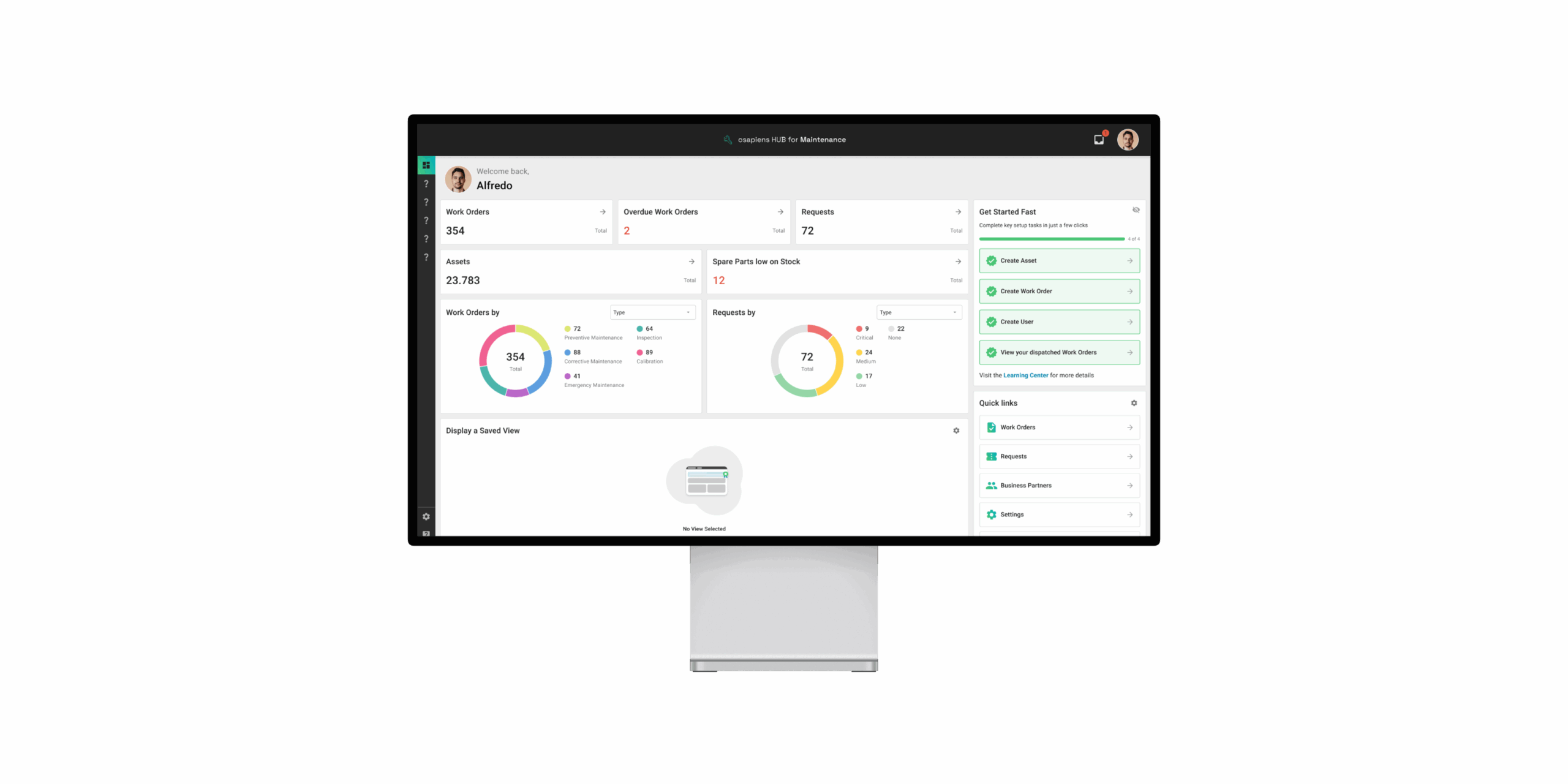
Version 3.17: The Next-Gen Cockpit for Your Maintenance
January 1, 2026
Lorry Maintenance Checklist – Tasks, Tips & Template
January 1, 2026
Press Machine Maintenance Checklist – Tasks, Tips & Template
January 1, 2026
Fire Extinguisher Maintenance Checklist – Tasks, Tips & Best Practices

November 27, 2025
Condition Based Maintenance (CBM): Definition, Types & Implementation Guide
January 1, 2026
Water Treatment Plant Maintenance Checklist – Tasks, Compliance & Digital Execution
January 1, 2026
Lathe Machine Maintenance Checklist – Tasks, Safety & Digital Execution

March 11, 2026
The Best Maintenance Reporting Software in 2026: A Practical Comparison

August 17, 2026
Best Fleet Maintenance Software for Enterprise: Top 5 in 2026

January 22, 2026