

Maintenance Checklist

Florian Bartholomäus, osapiens Expert | 1. January 2026 | Lesezeit 8 min.
Many laboratories still rely on paper checklists or spreadsheets for maintenance tracking, creating documentation delays and transcription errors. A structured digital checklist ensures that critical inspection tasks—from calibration verification to safety equipment testing—are completed on time, documented accurately, and accessible during audits.
Create your checklist for free











TRUSTED BY LEADING COMPANIES




ENTERPRISE-READY
 SAP Certification
 ISO 27001
 EU Hosting
 Entra ID & Okta
 Multi-Entity
Table of Contents
- Laboratory Equipment Maintenance: Key Facts
- Why You Need a Laboratory Equipment Maintenance Checklist
- What to Include in Your Laboratory Equipment Maintenance Checklist
- Common Laboratory Equipment Problems Your Maintenance Checklist Prevents
- From Paper Checklist to Digital: How the osapiens HUB Automates Your Laboratory Equipment Maintenance Checklist
- FAQ
Laboratory equipment maintenance represents the foundation of reliable scientific research and operational safety. Without structured maintenance practices, laboratories face equipment failures that compromise data integrity, create safety hazards, and generate costly unplanned downtime.
Laboratory Equipment Maintenance: Key Facts
A structured laboratory equipment maintenance checklist delivers measurable operational improvements:
- Consistency: Structured checklists ensure that every technician follows the same procedures, eliminating variation that compromises equipment performance and data quality.
- Risk reduction: According to research on equipment failure patterns, approximately 35 to 40 percent of equipment failures result from inadequate lubrication and contamination—issues that systematic maintenance checklists prevent.
- Documentation: Complete maintenance records create audit-ready documentation that proves compliance with regulatory requirements and supports warranty claims.
- Technician guidance: Detailed checklists support less experienced team members by providing step-by-step instructions that prevent procedural omissions.
Why You Need a Laboratory Equipment Maintenance Checklist
Laboratory equipment encompasses diverse instruments—centrifuges, spectrophotometers, chromatography systems, incubators, biosafety cabinets, and analytical balances. Each requires specific maintenance to function reliably.
Without structured maintenance, problems accumulate silently until they cascade into failures. Here’s why a maintenance checklist matters:
- Consistency: Ad-hoc maintenance based on memory or informal experience creates gaps. Checklists ensure that every inspection, calibration, and cleaning task occurs on schedule, regardless of which technician performs the work.
- Risk reduction: Missing routine inspections allows minor issues—worn seals, contaminated filters, calibration drift—to escalate into equipment failures that halt experiments and compromise sample integrity.
- Documentation: Regulatory frameworks including CLIA, ISO 17025, and FDA requirements mandate documented proof that maintenance occurred. Checklists create timestamped records that demonstrate compliance during audits.
- Technician guidance: Detailed checklists provide clear procedures for less experienced staff, reducing the risk of errors and ensuring maintenance quality remains consistent across your team.
- Standardization: Checklists enable repeatability across shifts, sites, and personnel changes, preserving institutional knowledge even when experienced technicians leave.
- Compliance: Many laboratory environments operate under strict regulatory oversight. Structured checklists support preventive maintenance requirements and provide the documentation auditors expect.
What to Include in Your Laboratory Equipment Maintenance Checklist
An effective laboratory equipment maintenance checklist organizes tasks by component or system rather than by frequency alone. This structure ensures comprehensive coverage of all critical equipment elements.
The checklist should address:
- Visual inspection: Check for visible damage, leaks, wear, unusual vibrations, or abnormal sounds that indicate developing problems.
- Functional checks: Verify that equipment operates within expected parameters—temperatures, pressures, flow rates, and performance metrics.
- Safety checks: Test emergency stops, verify guard functionality, confirm proper ventilation, and ensure safety interlocks operate correctly.
- Cleaning and basic servicing: Remove dust and contaminants, clean optical surfaces, replace filters, and lubricate moving parts according to manufacturer specifications.
- Documentation steps: Record inspection results, performance verification data, parts replaced, and any issues discovered during maintenance.
Important: The tasks below represent common maintenance activities. Actual maintenance requirements depend on equipment type, usage intensity, environmental conditions, and manufacturer recommendations. Always consult equipment manuals and conduct risk assessments to determine appropriate maintenance intervals for your specific laboratory.
| Component / System | Inspection & Maintenance Tasks | Purpose |
|---|---|---|
| Analytical Balances | Verify calibration with certified weights, clean weighing chamber, check level indicator, inspect draft shield | Measurement accuracy, contamination prevention |
| Centrifuges | Inspect rotor for wear and corrosion, check lid interlock, verify speed accuracy, lubricate bearings, examine gaskets | Sample integrity, operator safety |
| Spectrophotometers | Clean optical surfaces, verify wavelength accuracy, check lamp intensity, inspect sample compartment | Data accuracy, light path integrity |
| Chromatography Systems | Check pump flow rate, inspect seals and fittings, replace inlet liners, verify detector response, monitor column performance | Separation quality, system reliability |
| Incubators & Ovens | Verify temperature uniformity, calibrate temperature sensors, inspect door seals, clean interior surfaces | Temperature control, contamination prevention |
| Biosafety Cabinets | Test airflow velocity, verify HEPA filter integrity, inspect sash operation, check alarm functionality | Personnel protection, containment |
| Fume Hoods | Measure face velocity, verify sash operation, inspect baffles, test alarm systems | Chemical vapor containment, safety |
| Refrigerators & Freezers | Verify temperature accuracy, inspect door seals, clean condenser coils, test alarm systems | Sample preservation, temperature stability |
Turn Your Laboratory Equipment Maintenance Checklist into Digital Work Orders
Create structured checklists for every instrument—from centrifuges to chromatography systems. Execute them on mobile, sync with SAP PM, and keep full audit trails automatically.Start with Your Laboratory Equipment Maintenance Checklist
Common Laboratory Equipment Problems Your Maintenance Checklist Prevents
Structured maintenance checklists prevent predictable failure patterns that disrupt laboratory operations:
- Calibration drift: Analytical instruments gradually drift out of specification without regular calibration verification. Checklists ensure timely calibration, preventing invalid test results and failed audits.
- Contamination accumulation: Dust, chemical residues, and biological materials accumulate in equipment, degrading performance and introducing cross-contamination. Regular cleaning tasks in your checklist maintain equipment cleanliness.
- Component wear: Seals, gaskets, filters, and moving parts deteriorate with use. Scheduled inspections identify wear before components fail, preventing sample loss and equipment damage.
- Safety system failures: Emergency stops, interlocks, and ventilation systems require regular testing to ensure they function during critical incidents. Checklist-driven testing verifies safety system readiness.
- Environmental issues: Temperature, humidity, and vibration affect equipment performance. Monitoring tasks in your checklist identify environmental problems before they compromise results.
- Documentation gaps: Missing maintenance records create compliance vulnerabilities during regulatory inspections. Checklist-based documentation provides complete audit trails that demonstrate regulatory adherence.
From Paper Checklist to Digital: How the osapiens HUB Automates Your Laboratory Equipment Maintenance Checklist
Paper checklists, Excel spreadsheets, and PDF forms create friction that undermines maintenance effectiveness. Technicians must remember to bring printed checklists to equipment locations, manually record observations, and later transcribe handwritten notes into computerized systems—introducing delays, transcription errors, and incomplete documentation.
The osapiens HUB for Maintenance transforms laboratory equipment maintenance from manual paperwork into streamlined digital workflows:
- Mobile checklist execution: Technicians access equipment-specific checklists directly on smartphones or tablets at the point of work, eliminating trips to retrieve printed forms.
- Real-time documentation: Photos, timestamps, performance measurements, and observations are captured during maintenance execution, creating accurate records without transcription delays.
- Automated scheduling: The system generates work orders automatically based on calendar intervals, usage hours, or condition thresholds, ensuring maintenance occurs on schedule.
- SAP PM integration: For organizations using SAP Plant Maintenance, osapiens HUB provides SAP-certified integration that synchronizes maintenance data bidirectionally without custom development.
- Audit-ready documentation: Complete maintenance history, calibration records, and performance verification data remain accessible for regulatory inspections and quality audits.
- Offline capability: Technicians can complete checklists even in areas without network connectivity, with automatic synchronization when connection resumes.
| Aspect | Paper or Excel Checklist | Digital Checklist with osapiens HUB |
|---|---|---|
| Accessibility | Requires physical retrieval or desktop access | Available on mobile devices at equipment location |
| Documentation | Manual handwriting, later transcription | Real-time digital capture with photos and timestamps |
| Scheduling | Manual tracking, easy to forget or defer | Automated work order generation based on intervals |
| Audit readiness | Scattered records, difficult to compile | Centralized history, instantly accessible |
| Data accuracy | Transcription errors, missing information | Complete, accurate records captured at source |
| Integration | Manual data entry into multiple systems | Automatic synchronization with SAP PM and other systems |
Organizations implementing digital maintenance management through osapiens HUB report significant operational improvements. The platform supports preventive maintenance strategies that reduce unplanned downtime while providing the transparency needed for continuous improvement.
Stop Losing Research Time to Missed Laboratory Inspections
Digitize your maintenance checklists, automate work order creation, and give every technician a mobile tool that works—even offline. SAP PM integration included.Try osapiens HUB for Free
FAQ
What should be included in a laboratory equipment maintenance checklist?
A comprehensive laboratory equipment maintenance checklist should include visual inspections for damage and wear, functional checks verifying performance parameters, safety system testing, cleaning and lubrication tasks, calibration verification, and documentation requirements. The specific tasks depend on equipment type—analytical balances require calibration verification with certified weights, centrifuges need rotor inspection and interlock testing, and biosafety cabinets require airflow velocity measurement and HEPA filter integrity verification. Organize your checklist by component or system rather than frequency alone to ensure comprehensive coverage. Consult manufacturer recommendations and conduct risk assessments to determine appropriate maintenance intervals for your specific laboratory environment.
How often should I complete my laboratory equipment maintenance checklist?
Maintenance frequency depends on equipment criticality, usage intensity, environmental conditions, and manufacturer recommendations rather than fixed universal intervals. High-use analytical instruments often require daily visual checks and weekly functional verification, while less critical equipment may need only monthly or quarterly attention. Regulatory frameworks like CLIA and ISO 17025 establish minimum calibration verification frequencies—commonly every six months—but actual intervals should reflect your operational context. Risk-based approaches concentrate frequent maintenance on equipment where failures create the greatest operational or safety impact. Digital maintenance management systems help optimize intervals by tracking equipment performance trends and adjusting schedules based on actual condition data.
Can I customize this laboratory equipment maintenance checklist template?
Yes, customization is essential. Generic checklists provide starting points, but effective maintenance requires tailoring tasks to your specific equipment models, usage patterns, environmental conditions, and regulatory requirements. Customize your checklist by consulting manufacturer maintenance manuals for equipment-specific procedures, incorporating regulatory requirements applicable to your laboratory type, adjusting task frequencies based on usage intensity and historical failure patterns, and adding facility-specific tasks addressing your unique environmental conditions. Digital platforms like osapiens HUB enable flexible checklist customization while maintaining standardized documentation and audit trails. Regular checklist reviews ensure maintenance practices evolve as equipment ages, usage patterns change, or new regulatory requirements emerge.
How does a digital CMMS improve maintenance checklist management?
Digital CMMS platforms transform maintenance checklist management by eliminating manual paperwork and providing real-time visibility. Technicians access equipment-specific checklists on mobile devices at the point of work, capturing photos, timestamps, and performance data during maintenance execution without transcription delays. Automated scheduling generates work orders based on calendar intervals, usage hours, or condition thresholds, ensuring maintenance occurs on schedule. Complete maintenance history remains accessible for audits, troubleshooting, and continuous improvement. For organizations using SAP Plant Maintenance, platforms like osapiens HUB provide certified integration that synchronizes maintenance data bidirectionally. Digital systems also enable data-driven optimization—analyzing maintenance history to identify recurring problems, adjust intervals based on actual equipment performance, and allocate resources to equipment where maintenance delivers the greatest impact.
Start using osapiens for free
Improve your uptime, extend the life of your equipment, and simplify work order management.
Book a demo
ENTERPRISE CAPABILITIES
- SAP ECC & S/4HANA Certified
- Infor & MS Dynamics
- Microsoft Entra ID / Okta
- ISO 27001 & 9001
- EU Cloud · Data Sovereignty
- Development, Test, and Production Environments
- Multi-Entity & Multi-Site
- Power BI Integration
- Audit Trail & Compliance
Related content
July 22, 2025
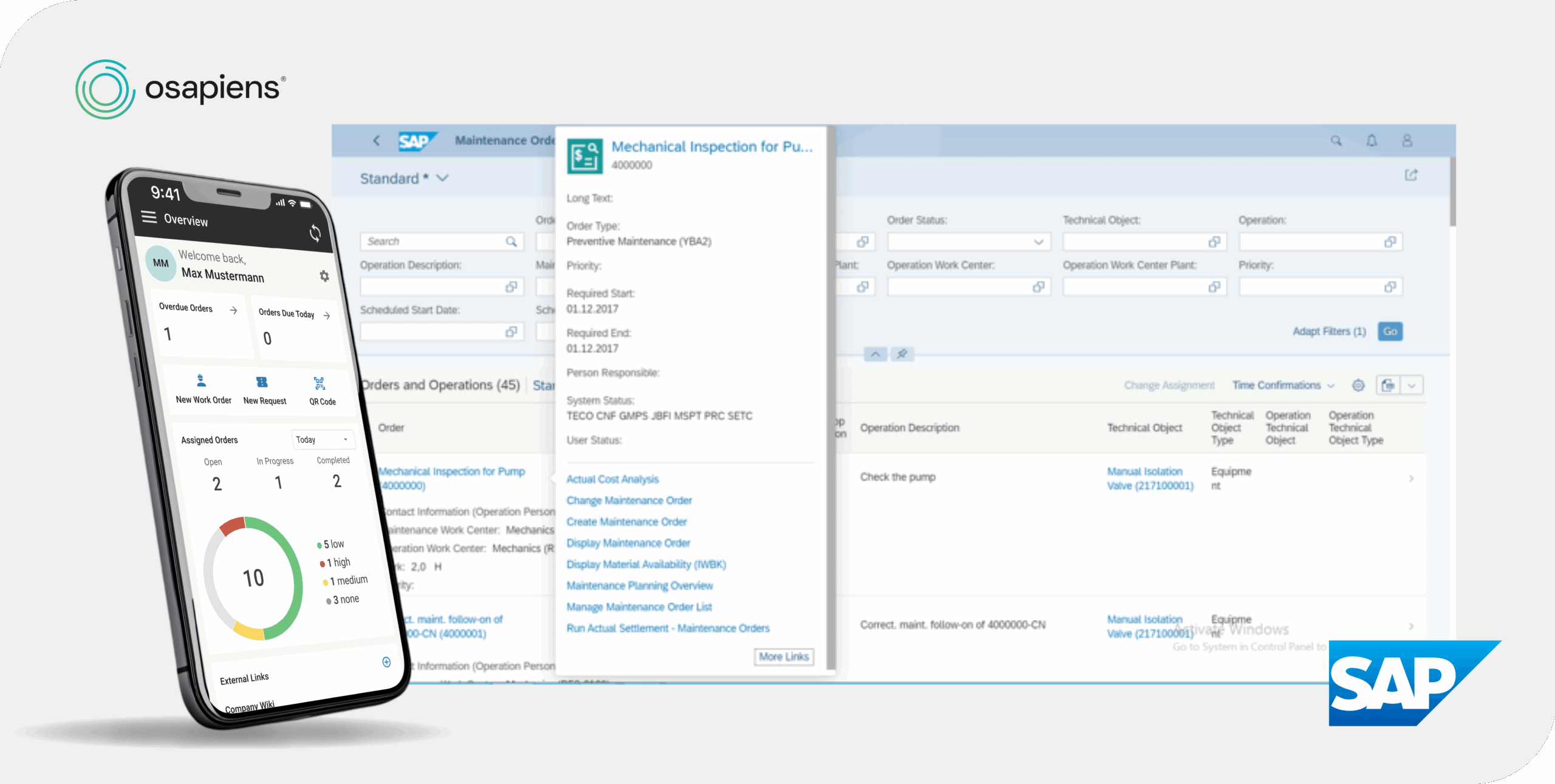
Simplify Maintenance with SAP and osapiens
March 19, 2026
Best CMMS Software for Microsoft Dynamics 365 Integration
January 1, 2026
Wheel Loader Maintenance Checklist – Tasks, Tips & Template
January 1, 2026
Robotic Assembly System Maintenance Checklist – Tasks, Tips & Digital Execution

May 4, 2026
CMMS for Pharmaceuticals: Meeting GxP, CSV and Audit Trail Requirements in Life Sciences

November 21, 2025
Field Service Management Solutions Comparison: The 6 Best FSM Solutions for Small Businesses
January 1, 2026
Tankless Water Heater Maintenance Checklist – Tasks, Tips & Best Practices

February 6, 2026
Asset Maintenance Software: Find the Right Solution for Your Facility
January 1, 2026
Gear Cutting Machine Maintenance Checklist – Tasks, Safety & Digital Execution
January 1, 2026
Water Heater Maintenance Checklist – Tasks, Tips & Best Practices
January 1, 2026
Ventilation System Maintenance Checklist – Tasks, Tips & Template
January 1, 2026