

CMMS

Florian Bartholomäus, osapiens Expert | 24. March 2026 | Lesezeit 18 min.
The biggest mistake we see in multi-site maintenance is treating each location as a separate problem. The moment you connect them in one platform, patterns emerge, and that's where real efficiency gains begin.
Manage All Sites From One Place









TRUSTED BY LEADING COMPANIES




ENTERPRISE-READY
 SAP Certification
 ISO 27001
 EU Hosting
 Entra ID & Okta
 Multi-Entity
Table of Contents
- Key Facts
- What Is Multi-Site Maintenance Management?
- The Most Common Challenges in Multi-Site Maintenance
- Key Components: How a CMMS Solves Multi-Site Maintenance Challenges
- How Multi-Site CMMS Software Vendors Actually Compare
- What to Look for in a CMMS for Multi-Site Operations
- How to Roll Out a Multi-Site CMMS Without Disrupting Operations
- Expert tip from osapiens
- Multi-Site Maintenance in Practice: Lessons from Nordex and Coca-Cola
- From Chaos to Control: Multi-Site Maintenance Done Right with osapiens HUB
- FAQ
What happens when your maintenance team grows faster than your processes? Picture this: you are a maintenance leader with 10 plants, each running its own spreadsheets, its own naming conventions, and its own definition of what a “completed” work order actually means. You have no single dashboard, no consistent maintenance data, and no way to compare asset performance across sites.
Scaling maintenance operations across multiple locations without losing visibility is one of the hardest challenges in operations. The osapiens HUB for Maintenance gives multi site organizations a centralized platform to standardize workflows, unify maintenance teams, and manage every site from one place. In this article, you will learn what multi-site maintenance management actually requires at scale and how a multi-site CMMS software solves these problems in practice.
Key Facts
- Scaling pain: Growing from a few sites to many without a unified system leads to data silos, inconsistent standards, and compliance gaps that compound over time.
- Master data chaos: Each site develops its own naming conventions, templates, and ways to capture parts, mostly in Excel or via email. Without consistent standards, master data becomes impossible to manage at scale.
- Visibility is everything: Real-time cross-site reporting on KPIs like MTTR, PM compliance, and downtime is what separates reactive organizations from proactive ones.
- Standardize the framework, flex the execution: The best multi-site strategies enforce shared data taxonomies and workflows while allowing site-level adaptation – local asset templates, regional suppliers, and machine-specific procedures. Planning is always driven by local production schedules and the asset base.
- Spare parts chaos multiplies: Without centralized inventory visibility, organizations overspend on emergency parts and duplicate stock across locations. Learn how to prevent spare parts chaos.
- One platform for all sites: The osapiens HUB for Maintenance enables enterprises like Coca-Cola North America (35 sites, 1,500 users), Puratos (65 sites) and Nordex (11,400+ wind turbines) to manage maintenance from a single system.
What Is Multi-Site Maintenance Management?
Multi-site maintenance management is the centralized coordination of work orders, asset tracking, inspections, and compliance documentation across multiple geographically distributed facilities, typically managed through a single CMMS platform. Rather than treating each location as an isolated operation, it brings all maintenance activities onto the same page through a unified system.
What is the difference between single-site and multi-site CMMS? A single-site CMMS manages assets, work orders, and teams within one location. A multi-site CMMS does the same across dozens or hundreds of facilities with added layers of role-based access, cross-site reporting, and standardized workflows that ensure every location operates from the same playbook.
Given these differences, multi-site maintenance management is essential for any organization managing more than one location. Every new location adds complexity: different teams, different equipment, and different compliance requirements. Without a unified strategy for asset management, standards diverge, maintenance data becomes fragmented, and visibility disappears. This challenge is especially critical in manufacturing, energy, facilities management, and pharma, where regulatory compliance and operational efficiency depend on consistency across every single site. So how do you manage maintenance across multiple locations without losing control? It starts with understanding where things break down and to identify the best CMMS for multiple facilities.
The Most Common Challenges in Multi-Site Maintenance
Managing maintenance at a single site is fundamentally different from coordinating it across many. The challenges that emerge are not simply “more of the same.” They are qualitatively different problems that require different solutions. When disconnected systems, local teams, and inconsistent processes multiply across multiple locations, the result is not just inefficiency. It is compounding operational risk that grows with every new facility added to the portfolio.
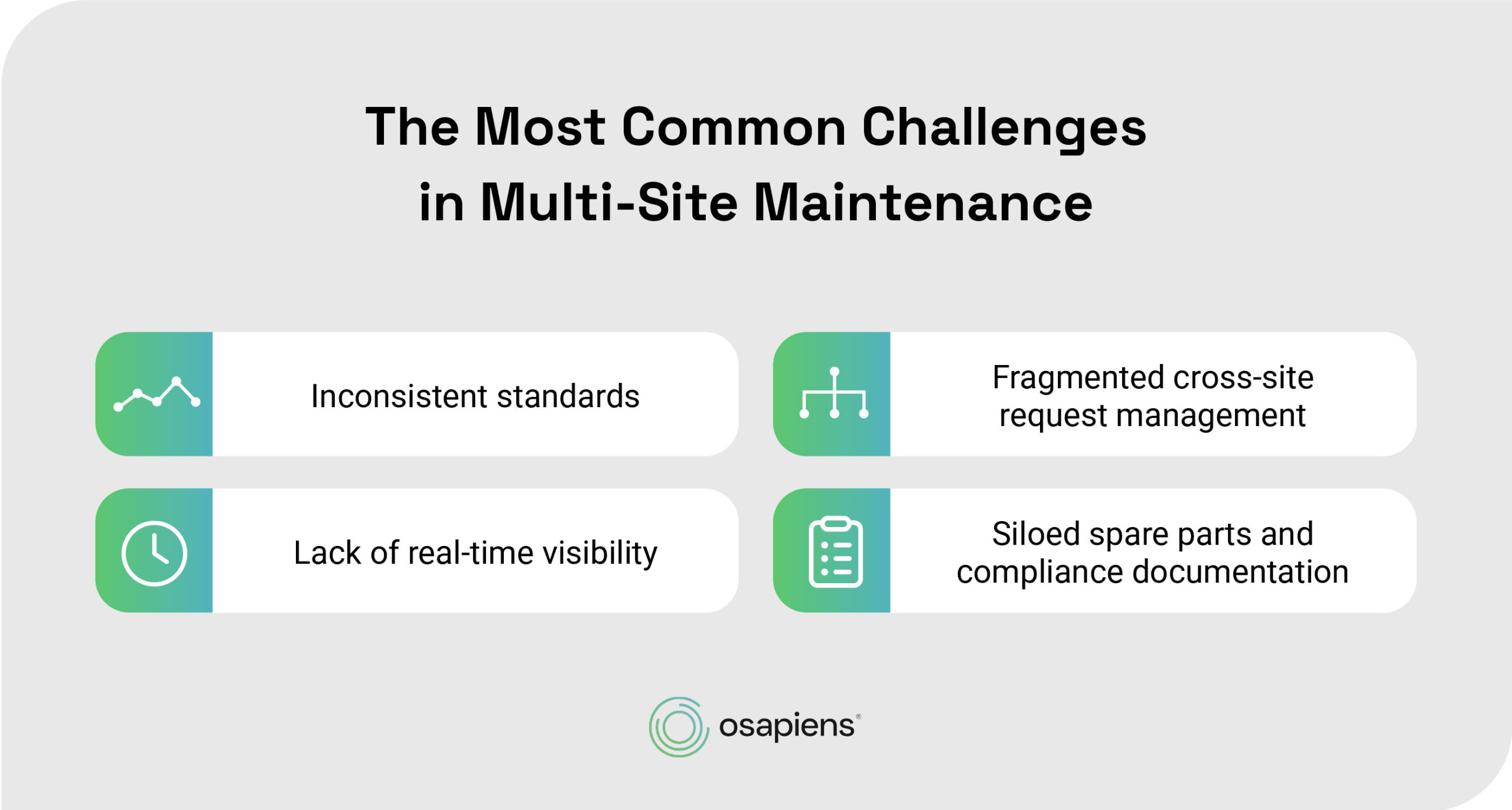
- Inconsistent standards: Every site builds its own workflows, naming conventions, and definitions of what a “completed” maintenance task actually means. In many organizations, this is compounded by Shadow-IT: IT prescribes systems and processes, but maintenance teams on the ground work around them because they don’t fit their daily reality. The result is a parallel universe of WhatsApp groups, personal spreadsheets, and informal workarounds, invisible to leadership and impossible to standardize.
- Lack of real-time visibility: It leaves corporate leadership relying on delayed reports and guesswork. No single dashboard shows asset performance, maintenance costs, or equipment failures across all sites. Decisions get made on outdated information.
- Fragmented cross-site request management: It breaks down when requests flow through different channels at every location. Without best practices for managing cross-site maintenance requests, prioritization becomes inconsistent and urgent issues get buried under routine tasks at another.
- Siloed spare parts and compliance documentation: Each site manages its own inventory and audit records independently, leading to duplicate stock, emergency repairs at premium prices, and compliance gaps that only surface during audits. Organizations can learn how to prevent spare parts chaos with a centralized approach.
Growing from 3 to 15 Sites? Here’s What Breaks Without the Right System
Imagine a company with 3 manufacturing plants. Each one runs on spreadsheets and local workarounds. It works because managers know every technician by name and every machine by sound. Then the company grows to 15 sites. Suddenly, spreadsheets can no longer keep up. Naming conventions diverge: Site A logs the asset as “Motor 1500-A,” Site B calls the identical unit “Conveyor Line Motor.” Tribal knowledge disappears as new sites are staffed with new maintenance teams who have no shared context.
Leadership loses visibility entirely. The most dangerous part? Metrics often lag reality at scale. KPIs can look stable on the surface while operational risk accumulates underneath. New equipment at new sites inflates average performance numbers, masking the fact that preventive tasks are being skipped, maintenance history is incomplete, and no one at headquarters can tell which site is actually in trouble.
Compliance and Audit Trails Across Sites
In regulated industries like manufacturing and pharma, compliance is not a feature to check off. It is a standalone operational challenge. Every site must document what maintenance was performed, when it happened, who did it, and whether it met the required standard. When that documentation lives in different systems at different sites, audit preparation turns into weeks of scrambling to piece together records. A thorough maintenance audit checklist can help establish consistent documentation standards across all locations.
The liability angle is serious. In regulated environments, the inability to prove a maintenance task was completed on time and to standard can carry significant legal and financial consequences. Standardized multi site systems solve this by making the entire organization “always audit-ready” rather than reactively assembling evidence under pressure. This is especially critical for efficient pharma maintenance where regulatory scrutiny is highest.
Here is how organizations with fragmented versus standardized maintenance compare across key performance dimensions:
| Dimension | Fragmented (Siloed Sites) | Standardized (Unified Platform) |
|---|---|---|
| Unplanned Downtime | Reactive firefighting dominates | Preventive schedules reduce failures |
| Maintenance Mix | Mostly reactive, PM deprioritized | Mostly planned, consistent across sites |
| PM Compliance | Varies by site and individual habit | Tracked centrally, consistently high |
| Mean Time to Repair | Longer – no shared asset context | Shorter – full asset history on-site |
| Audit Preparation | Weeks of manual effort | Always audit-ready |
| New Site Onboarding | Each site starts from scratch | Templates roll out immediately |
Key Components: How a CMMS Solves Multi-Site Maintenance Challenges
The osapiens HUB for Maintenance is built to address every challenge that comes with managing maintenance across multiple locations. As a centralized platform, it connects every site, every technician, and every asset in one place, giving maintenance leaders full visibility and control. Whether used as a standalone CMMS or as a certified SAP PM extension, the osapiens HUB turns fragmented, site-specific processes into a unified preventive maintenance operation that scales with your organization.
Work Orders and Cross-Site Request Management
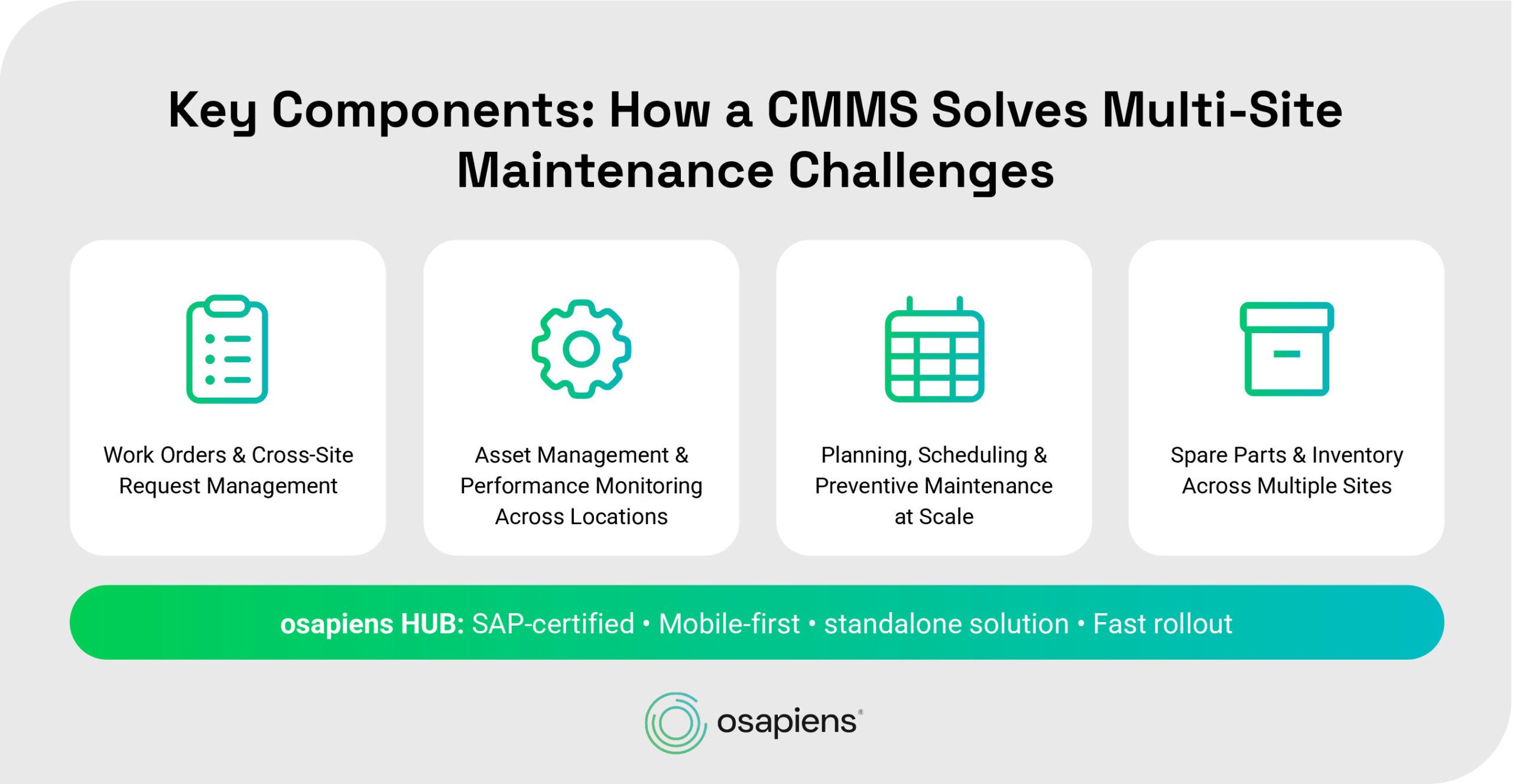
The osapiens HUB centralizes work order creation, assignment, and tracking across all sites on a single dashboard. Maintenance managers can filter work orders by site, priority, and status, making it easy to follow best practices for managing cross-site maintenance requests. Standardized work order templates ensure every location follows the same process, eliminating the inconsistencies that creep in when each site defines its own workflows.
Asset Management and Performance Monitoring Across Locations
The osapiens HUB provides a unified asset registry that works as maintenance software for managing tools and equipment across multiple sites. Every asset, regardless of location, is tracked with the same taxonomy, criticality rating, and maintenance history. This eliminates naming convention chaos across the organization. Performance monitoring lets managers compare asset health across different sites, identify recurring failures, and make data-driven decisions about resource allocation and replacements.
Planning, Scheduling, and Preventive Maintenance at Scale
Shifting from reactive to preventive maintenance across multiple locations requires more than good intentions. The osapiens HUB enables planning and scheduling based on technician skills, shifts, and availability across all sites. Master PM templates are defined centrally and pushed to every location, with updates propagating instantly. This means no site falls behind on preventive tasks because of outdated procedures. The impact is measurable: organizations using PM planning and condition-based maintenance through the osapiens HUB consistently report measurable reductions in unplanned downtime.
Spare Parts and Inventory Across Multiple Sites
When each site manages inventory independently, maintenance costs spiral. Emergency spare parts orders often come at a significant premium due to expedited procurement and logistics. The osapiens HUB solves this with location-based inventory tracking, a shared catalog, QR/barcode scanning, and low-stock alerts. It also enables cross-site transfers: if Site A urgently needs a critical part, the system shows that Site B has it in stock. This visibility alone can eliminate thousands in unnecessary procurement spend. Learn more in our blueprint for spare parts management.
How Multi-Site CMMS Software Vendors Actually Compare
Multi-site maintenance software is a crowded category. Enterprise incumbents like IBM Maximo, SAP PM / SAP S/4HANA Asset Management, IFS Ultimo, Infor EAM, and Hexagon HxGN EAM compete for the same rollouts as newer, mobile-first platforms like MaintainX, Limble, eMaint, Fiix, and UpKeep. Two things separate them in practice: how fast a first site actually goes live, and whether the interface itself works in more than one language, not just the sales site.
| Vendor | Category | UI Languages | Typical Rollout Speed |
|---|---|---|---|
| osapiens HUB for Maintenance | Mobile-first, SAP-certified | Not publicly specified — flagged above, no claim made | 1–3 weeks standalone / 4–12 weeks with SAP integration |
| IBM Maximo | Enterprise incumbent | Multilingual support confirmed for global, multi-site deployments | Major enterprise deployments typically run 6–18 months |
| SAP PM / SAP S/4HANA Asset Management | Enterprise incumbent | Not publicly documented | Enterprise-scale rollouts typically run 6–18 months |
| IFS Ultimo | Enterprise / mid-market | 12 languages confirmed (Danish, Dutch, English, Finnish, French, German, Norwegian, Polish, Portuguese, Spanish, Swedish, Turkish) | Typically 4–8 weeks |
| Infor EAM (CloudSuite) | Enterprise incumbent | Multi-language, deployed in 70+ countries | Mid-market deployments typically 6–12 months |
| Hexagon HxGN EAM | Enterprise incumbent | Not publicly documented | Mid-market deployments typically 6–12 months |
| MaintainX | Mobile-first | Not publicly documented; multi-site standardization is an Enterprise-tier feature | Single-site average around 3 weeks |
| Limble | Mobile-first | Not publicly documented; cross-site reporting sits behind the Enterprise tier | Initial configuration and go-live typically 2–4 weeks |
| eMaint | Mid-market / enterprise | 25 built-in languages | Enterprise-wide rollout in as little as 90 days |
| Fiix (Rockwell Automation) | Mobile-first / mid-market | 8 languages confirmed (Danish, English, French, German, Polish, Portuguese, Spanish, Swedish) | Live within weeks for standard deployments; multi-site standardization sits behind higher tiers |
| UpKeep | Mobile-first | Not publicly documented | Most teams live in 1–2 weeks; multi-site rollouts typically take 30–60 days |
The pattern worth noticing: enterprise incumbents (Maximo, SAP, Infor, Hexagon) offer the deepest configurability but the longest rollouts, measured in months. Mobile-first tools (MaintainX, Limble) go live faster per site but often gate multi-site standardization behind their top pricing tier. The osapiens HUB for Maintenance targets the middle: 1–3 weeks standalone, 4–12 weeks with SAP integration (see the rollout section below).
What to Look for in a CMMS for Multi-Site Operations
Not every multi-site CMMS software is built to handle multi site operations. Many platforms were designed for a single facility and bolt on multi-location features as an afterthought. That creates the exact problem you are trying to solve: disconnected systems, duplicate data, and no unified view. When evaluating a CMMS solution for managing multiple sites, enterprise maintenance leaders should focus on capabilities that address the structural challenges of scale, not just feature checklists.
- Multi-site architecture, meaning one system serving all facilities with configurable hierarchies rather than separate licenses per location.
- Role-based permissions are equally critical so site managers see only their data while corporate leadership gets full visibility across the entire organization.
- Mobile access with offline capability: Technicians working in warehouses, basements, or remote locations need mobile access with offline capability.
- Centralized reporting with drill-down dashboards: They must give you one view of KPIs across all locations.
- SAP-Integration: For organizations running SAP, a certified SAP integration keeps SAP as the financial system of record while providing a modern, technician-friendly front end.
- Local vs. global master-data ownership: The corporation should own the shared taxonomy and criticality ratings, while a site still manages its own asset list, suppliers, and spare parts, without the two conflicting.
- UI language versions: The technician-facing interface should localize for the site’s working language, not just the sales and marketing site.
The osapiens HUB for Maintenance Premium and Enterprise plans deliver all of these capabilities in a single centralized platform, purpose-built for multi site teams managing maintenance across multiple locations.
See Every Feature in Action
Get a live walkthrough of the osapiens HUB and see how it handles multi-site maintenance in practice.
Show Me the Full Platform
Consolidating KPIs Across Sites: How to Compare What Matters
How do you compare performance across 15 sites when each one tracks data differently? You can’t, and that is exactly the problem. The real value of a multi-site CMMS software is not just control. It is cross-site benchmarking. When every location reports MTTR, MTBF, PM compliance, and downtime using the same definitions, underperforming sites can no longer hide behind local excuses.
Think of it as a “league table” of reliability metrics. Suddenly, the conversation shifts from “why did we miss our target?” to “what is Site 7 doing differently that we can replicate?” That kind of operational intelligence, built on consistent maintenance data, drives continuous improvement across the entire portfolio.
osapiens HUB
| Feature | Why It Matters | osapiens HUB |
|---|---|---|
| Multi-Site Architecture |
|
✓ Built-in, included in Premium |
| Role-Based Permissions |
|
✓ Granular roles, fully configurable |
| Mobile Access |
|
✓ Mobile app, works offline too |
| Centralized Reporting & Dashboards |
|
✓ Advanced dashboards, Premium & up |
| SAP Integration |
|
✓ Certified SAP connector, Enterprise |
| Master PM Templates |
|
✓ Centrally managed, instantly synced |
| Centralized Spare Parts Catalog |
|
✓ Shared catalog, cross-site visibility |
| Master Data Ownership |
|
✓ Centralized taxonomy, site-level flexibility |
Multilingual Interfaces and Local Admin Structures
A CMMS that only works in one language, administered from one central team, breaks down fast once an organization spans Germany, the UK, and Scandinavia, or any mix of markets with different working languages.
Local admin without losing central control. As covered above, role-based permissions let a site manager see and manage only their location’s data, while corporate leadership retains full visibility across the organization. The osapiens HUB applies this same model to administration: a site can manage its own users and day-to-day settings without every change routing through a central IT ticket.
Language as an operational requirement, not a nice-to-have. For technicians on the floor, working in a second language slows down documentation and increases the risk of incomplete records, exactly the kind of gap that turns into an audit problem later. When evaluating a multi-site CMMS for a multilingual organization, confirm the technician-facing mobile interface localizes, not just the sales and marketing site.
How to Roll Out a Multi-Site CMMS Without Disrupting Operations
Not every site is at the same maturity level, and a one-size-fits-all rollout often fails. The most effective approach is phased:
- Start with a pilot site: Validate processes and configure site-specific settings
- Standardize the framework: Align asset naming conventions and workflows
- Expand step by step: Roll out to additional sites with lessons learned from the pilot
- Scale with confidence: Each new site onboards faster than the last
Realistic timelines differ sharply depending on scope. A standalone deployment, without SAP integration, typically takes 1–3 weeks from kickoff to a live first site. A structured enterprise rollout with SAP integration takes 4–12 weeks. These are two different projects, not two points on the same timeline, and conflating them is the most common estimation mistake in rollout planning. For comparison, enterprise incumbents like IBM Maximo or SAP typically run 6–18 months for a full enterprise deployment (see the vendor table above).
The osapiens HUB supports both fast SME onboarding and structured enterprise rollouts with SAP integration. This flexibility ensures that each site gets the right level of support without disrupting ongoing maintenance operations during the transition. For a step-by-step approach, see our CMMS implementation guide.
Expert tip from osapiens
The biggest mistake we see in multi-site maintenance is treating each location as a separate problem. The moment you connect them in one platform, patterns emerge, and that's where real efficiency gains begin.
Florian Bartholomäus, osapiens Expert
Multi-Site Maintenance in Practice: Lessons from Nordex and Coca-Cola
Boehringer Ingelheim selected the osapiens HUB for Maintenance to standardize plant maintenance across its global, regulated production network, integrated with SAP S/4HANA, with the first live site in Spain.
When Nordex needed to manage maintenance for over 11,400 wind turbines spread across multiple countries, spreadsheets and site-specific tools were never an option. Every turbine requires consistent maintenance documentation, scheduling, and compliance tracking, regardless of location. Nordex chose the osapiens HUB for Maintenance as its centralized platform, with seamless SAP ERP integration across all regions.
Coca-Cola North America tells a similar story at a different scale. With 35 facilities and 1,500 users, the company deployed the osapiens HUB across more than 30 locations to optimize maintenance planning and reduce costs. This is not a pilot or a proof of concept. It is a full enterprise deployment running daily maintenance operations across one of the world’s most recognized brands.
The lesson for other multi site organizations is clear: both companies chose to centralize on one platform rather than let each site operate independently, and that decision is what made consistent standards, real time insights, and cross-site efficiency possible.

Alberto Ecre, Group Lead Service Digitalization Department
★ ★ ★ ★ ★Nordex
“We were looking for a cloud platform solution that supports all of our regions. Our technicians have to visit the wind turbines every day to fix problems—we need stable solutions that make their work easier. The key was the very simple integration with our ERP system. Now we are gradually expanding: subcontractor management, tool management, and more.”
From Chaos to Control: Multi-Site Maintenance Done Right with osapiens HUB
Multi-site maintenance management is not about doing the same thing at more locations. It is about building a unified system that standardizes the framework (shared taxonomies, workflows, and templates) while giving local teams the flexibility to adapt to their asset base, local suppliers, and production schedules. Choosing the right platform for that comes down to a handful of structural questions, not a feature checklist: who owns master data, how fast the first site actually goes live, and whether local teams keep control without losing central visibility.
Nordex manages over 11,400 wind turbines worldwide on one platform. Coca-Cola North America runs 35 sites with 1,500 users through a single system. The evidence is clear: centralization works at scale. The osapiens HUB for Maintenance is built for exactly this challenge, connecting every site, every asset, and every team in one place.
Take control of maintenance across all your sites
The osapiens HUB gives maintenance leaders a single platform to standardize processes, track assets, and manage teams from one site to fifty.
Get started for free
FAQ
What is multi-site maintenance management?
Multi-site maintenance management is the coordination of work orders, inspections, asset tracking, and compliance documentation across multiple geographically distributed facilities using a centralized system. It ensures consistent maintenance standards and full visibility into operations, regardless of how many sites an organization manages.
What are the biggest challenges of managing maintenance across multiple sites?
The most common challenges include data silos between locations, inconsistent maintenance standards and naming conventions, lack of real-time visibility into asset performance, fragmented spare parts inventory leading to duplicate stock, and compliance documentation gaps that make audit preparation difficult and time-consuming.
What features should I look for in a CMMS for multi-site management?
To find the best CMMS for multiple facilities, look for a true multi-site architecture with role-based access control, centralized KPI dashboards with cross-site benchmarking, mobile access with offline capability, master PM templates that push updates to all sites, a shared spare parts catalog, and integration with existing systems like SAP.
How do I implement multi-site maintenance management?
Use a phased approach: start with a pilot site, standardize asset naming conventions and workflows, then roll out to additional locations. Keep in mind that different sites may have different maturity levels. The osapiens HUB supports both fast SME onboarding and structured enterprise rollouts. For detailed guidance, see our CMMS implementation guide.
How does the osapiens HUB support multi-site maintenance operations?
The osapiens HUB provides a single platform for all sites with centralized work orders, asset management, spare parts tracking, preventive maintenance scheduling, and cross-site KPI reporting. It includes a certified SAP integration and serves enterprise customers like Coca-Cola North America (35 sites) and Nordex (11,400+ wind turbines).
How does osapiens HUB compare to other multi-site CMMS platforms?
Enterprise incumbents like IBM Maximo or SAP offer deep configurability but typically take 6–18 months for a full rollout. Mobile-first tools go live faster per site but often gate multi-site standardization behind their top pricing tier. The osapiens HUB for Maintenance is SAP-certified for enterprise depth, with a standalone deployment in 1–3 weeks or a structured, SAP-integrated rollout in 4–12 weeks, considerably faster than classic enterprise platforms.
Start using osapiens for free
Improve your uptime, extend the life of your equipment, and simplify work order management.
Book a demo
Related content
January 1, 2026
Access Control Maintenance Checklist – Tasks, Tips & Template
January 1, 2026
Isolator System Maintenance Checklist – Tasks, Tips & Template
January 1, 2026
Commercial Roof Maintenance Checklist – Tasks, Best Practices & Digital Execution
January 1, 2026
Hydraulic Press Maintenance Checklist – Tasks, Tips & Best Practices
January 1, 2026
Asphalt Paver Maintenance Checklist – Tasks, Systems & Digital Execution
January 1, 2026
Fire Apparatus Maintenance Checklist – Tasks, Tips & Best Practices

July 9, 2026
Boehringer Ingelheim standardizes plant maintenance globally with osapiens
January 1, 2026
Fire Extinguisher Maintenance Checklist – Tasks, Tips & Best Practices
January 1, 2026
Gas Compressor Station Maintenance Checklist – Tasks, Tips & Best Practices

September 21, 2026
Best Condition Based Monitoring Software: Top 5 Comparison 2026
January 1, 2026
Automated Guided Vehicle Maintenance Checklist – Tasks, Safety & Digital Execution
January 1, 2026