

SAP

Remi Morisot, osapiens Expert | 20. May 2026 | Lesezeit 11 min.
Without clean integration, discrepancies between device management in IS-U and the equipment master data in PM lead to billing errors, missed maintenance cycles, or incorrect field assignments. The osapiens HUB for Maintenance connects the two systems in one mobile-first tool, with SAP-certified integration and no disruption to your existing backend.
Close the SAP Field Execution Gap









TRUSTED BY LEADING COMPANIES




ENTERPRISE-READY
 SAP Certification
 ISO 27001
 EU Hosting
 Entra ID & Okta
 Multi-Entity
Table of Contents
- Key Facts
- SAP IS-U vs. SAP PM: Direct Comparison for Utilities
- How IS-U and PM Work Together in Practice
- The Gap between Field Maintenance and SAP Backend
- Mobile Field Maintenance: osapiens HUB as SAP-Certified CMMS for Utilities
- Conclusion: SAP IS-U and SAP PM Cover the Back Office. Who Covers the Field?
- FAQ
Most utilities operate with two distinct SAP modules handling their core processes. SAP IS-U manages billing, meter reading, and regulatory compliance. SAP PM covers inspections, preventive maintenance, and asset repair. Both are essential, yet neither was designed for the technician who needs both at once, out in the field. With IS-U end-of-support approaching in 2027, that is exactly the problem utilities can no longer afford to work around.
Key Facts
- SAP IS-U manages the commercial side: billing, meter reading, device management, energy data management and regulatory compliance.
- SAP PM handles the physical side: inspections, preventive maintenance, repair, and the full lifecycle of assets in the field.
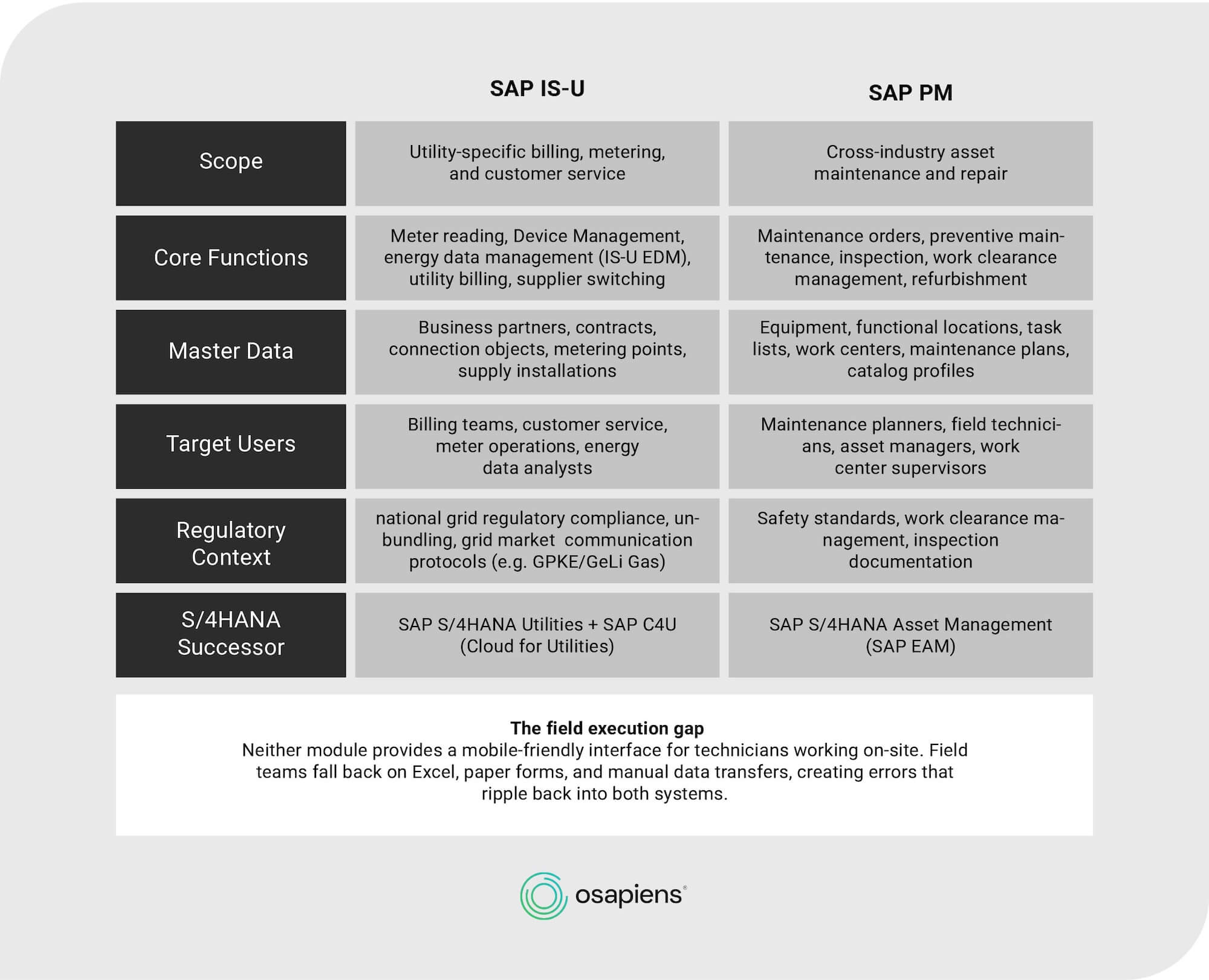
- The field execution gap: Neither SAP IS-U nor SAP PM provides a mobile-friendly interface for technicians. IS-U is a back-office billing system, and PM relies on complex SAP GUI workflows. Field teams end up falling back on Excel and paper-based workarounds.
- osapiens HUB for Maintenance: A SAP-certified mobile CMMS that bridges both IS-U and PM processes in one app. Technicians handle meter reading and maintenance tasks from a single interface, while dispatchers manage all field operations on one planning board.
SAP IS-U vs. SAP PM: Direct Comparison for Utilities
What is the difference between SAP IS-U and SAP PM?
- SAP IS-U (Industry Solutions for Utilities) is the utility-specific SAP module that handles billing, meter reading, device management, energy data management, and customer service. It manages commercial master data such as business partners, contract accounts (FI-CA), contracts, connection objects, premises, supply installations, and metering points.
- SAP PM (Plant Maintenance) is a cross-industry module for managing inspection, preventive maintenance, and repair of physical assets. It manages technical master data including functional locations, equipment master data, task lists, maintenance plans, maintenance strategies, work centers, measuring points, and bills of materials.
Utilities typically need both: IS-U for commercial customer-facing processes and PM for keeping infrastructure and equipment operational. The challenge lies not in choosing one over the other, but in understanding where each module begins, where it ends, and where they overlap.
Shared Master Data: Where IS-U and PM Overlap
Despite their different domains, SAP IS-U and SAP PM share several technical objects that form the backbone of integrated utility operations. Equipment numbers and functional locations exist in both modules, providing a common reference point between commercial and technical processes.
When a utility creates a service order in IS-U, it relies on maintenance plans, work centers, and task lists that are configured and maintained in PM. These PM-configured objects feed directly into IS-U service order billing, connecting the technical execution of field work with the commercial settlement in FI-CA. Understanding this shared data layer is essential for any utility planning its SAP integration strategy or evaluating complementary tools like a mobile CMMS.
Device Management in IS-U vs. Equipment in SAP PM
A single physical meter creates a dual-representation challenge in SAP. Both records refer to the same asset, but each module tracks different attributes.
- In IS-U, that meter is a “device” identified by its material and serial number, linked to a metering point, a supply installation, and ultimately a billing contract.
- In SAP PM, the same physical meter exists as a piece of equipment with its own maintenance history, assigned to a functional location, and eligible for maintenance plans and task lists.
Keeping these two representations synchronized is critical. Discrepancies between device management in IS-U and the equipment master data in PM lead to billing errors, missed maintenance cycles, or incorrect field assignments.
How IS-U and PM Work Together in Practice
On paper, SAP IS-U and SAP PM each handle a clearly defined part of a utility’s operations. In practice, a single customer lifecycle touches both modules repeatedly. The following scenario table walks through a typical end-to-end process at a utility company and shows exactly which module is responsible at each step.
| Process Step | Module Responsible | What Happens |
|---|---|---|
| Customer registration | SAP IS-U | A new business partner is created with contract account (FI-CA) and contract. Commercial master data is established. |
| Meter installation | IS-U + PM | The physical meter is registered as a device in IS-U (linked to a metering point and supply installation) and simultaneously as equipment in PM (with Functional Location and maintenance history). |
| Meter reading | SAP IS-U | Consumption data is captured, validated against prior readings, and stored in IS-U’s Energy Data Management (IS-U EDM) for billing preparation. |
| Billing | IS-U + FI-CA | IS-U calculates the invoice based on tariff structures and consumption data. FI-CA handles the financial posting and payment processing. |
| Meter calibration | SAP PM | A maintenance order is created in PM with a task list for the calibration procedure. The technician documents results against measuring points. |
| Grid infrastructure repair | SAP PM | A maintenance notification triggers a repair order in PM. Work centers, spare parts (via SAP MM integration), and inspection checklists are assigned to the job. |
| Supplier switch | SAP IS-U | The supplier switching process is managed entirely within IS-U, including market communication (GPKE), metering point reassignment, and contract updates for regulatory compliance. |
The table makes one thing clear: field operations sit at the intersection of both modules. A technician who installs a meter in the morning and repairs a transformer station in the afternoon needs data from IS-U and PM. Yet neither module provides a field-friendly interface for that reality.
The Gap between Field Maintenance and SAP Backend
SAP IS-U was designed as a back-office billing and customer service system. It has no mobile-optimized interface for technicians working on-site. SAP PM, while built for maintenance, relies on transaction-code-based workflows in SAP GUI that require weeks of dedicated training before a technician can use them independently. Together, they cover the full operational picture of a utility, but neither was built with the field technician in mind.
The result is predictable. Without a dedicated field execution layer, utility teams face the same recurring consequences:
- Slowed documentation: Inspection results and service reports are written on paper and entered into the system hours or days later.
- Fragmented data: Manual transfers between field and back office introduce discrepancies that affect both IS-U billing accuracy and PM maintenance records.
- Missed maintenance cycles: Without a mobile planning tool, preventive maintenance tasks get overlooked or poorly tracked across large asset portfolios.
- Rising error rates: Every manual handoff between Excel, paper forms, and SAP creates another opportunity for data entry mistakes.
- Compliance risk: Incomplete or delayed documentation makes it difficult to prove that maintenance obligations have been met.
Every workaround that field teams build around these limitations costs time, introduces risk, and adds friction to processes that should be straightforward. To close this gap, utilities increasingly look at mobile CMMS solutions like osapiens HUB for Maintenance that sit between the technician and the SAP backend.
What the 2027 SAP Deadline Means for Utility Field Teams
For most utilities, December 31, 2027 marks the end of mainstream maintenance for SAP Business Suite 7, the platform on which SAP IS-U runs. The strategic choice that follows is not just about which modules to migrate. It is the right moment to ask a broader question: does our field execution keep pace with our SAP migration?
SAP S/4HANA Asset Management offers a more modern interface, but field usability still depends on connectivity, a real constraint for technicians in substations or remote grid sites. Adding a purpose-built mobile CMMS to the migration roadmap now avoids a costly gap later.
See How Utilities Manage Meter Reading and Maintenance in One Tool
Your SAP landscape is evolving, and your field execution should keep pace. The osapiens HUB for Maintenance connects SAP IS-U and SAP PM processes in one mobile-first CMMS, so your technicians work faster and your data stays clean across systems.
Book a demo
Mobile Field Maintenance: osapiens HUB as SAP-Certified CMMS for Utilities
The previous sections revealed a clear pattern: SAP IS-U and SAP PM are powerful back-office systems, but neither delivers a field-friendly interface for the technicians who actually execute the work. The osapiens HUB for Maintenance was built to close exactly this gap. As a SAP-certified CMMS with a mobile-first design, it connects both SAP environments in one intuitive app, giving utility field teams a practical execution layer without replacing either module.
The osapiens HUB integrates directly with SAP PM for maintenance orders, equipment master data, functional locations, and task lists. It also connects with SAP IS-U processes, enabling technicians to handle meter reading jobs alongside maintenance tasks in a single mobile maintenance app. Data flows bidirectionally: every reading, checklist completion, or ticket created in the field syncs back to the relevant SAP module automatically.
What Utility Technicians Can Do in the osapiens App
Instead of switching between SAP GUI screens or falling back on paper forms, field teams use the osapiens HUB to manage their full daily workload from one interface.
Key capabilities for utility field operations include:
✓ Meter reading: Retrieve customer addresses, device numbers, and prior-year values. Read multiple meters quickly with an optimized overview for multi-tenant buildings and commercial customers.
✓ Plausibility checks: Validate readings against historical consumption data on the spot, reducing billing errors before they enter the system.
✓ Maintenance checklists: Execute inspection checklists, safety checks, and preventive maintenance tasks with structured digital workflows that fulfill documentation requirements automatically.
✓ Ticket creation: Open tickets directly from the field when issues arise during meter reading or maintenance, ensuring nothing gets lost between systems.
✓ Offline capability: Work in areas with limited connectivity, with automatic data sync once a connection is restored.
One Dispatch Board for All Field Operations
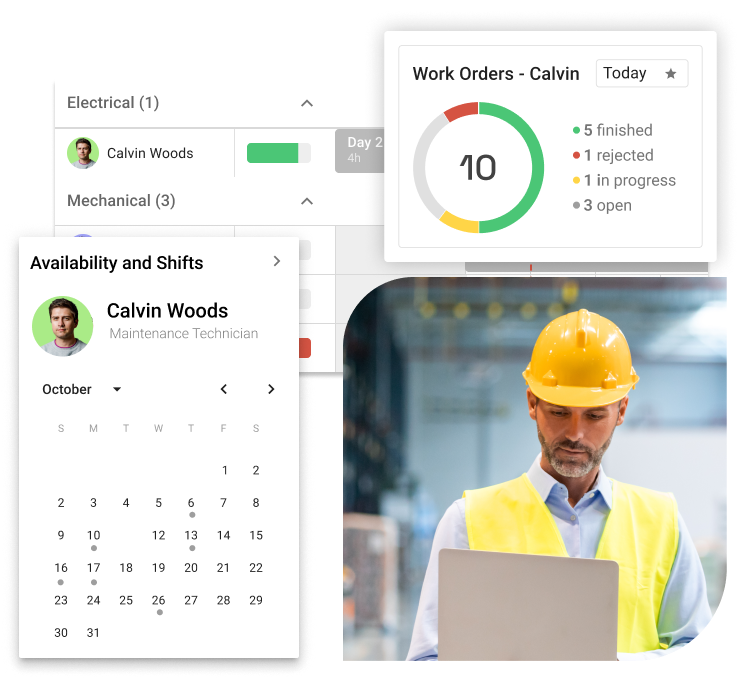
For dispatchers and workforce managers, the osapiens HUB provides a single planning board where both meter reading jobs and maintenance tasks can be assigned and tracked. This eliminates the Excel-based workarounds that many utilities still rely on, especially those that have scaled rapidly from a few hundred to several thousand assets. Dispatchers assign jobs to the right technician based on location, skill set, and availability, all within one tool instead of juggling separate systems.

Enterprise customers like Nordex already use the osapiens HUB to bridge SAP PM complexity with modern field execution. By combining SAP-certified integration with a user-friendly mobile app, the osapiens HUB for Maintenance gives utility teams the operational layer that SAP IS-U and SAP PM were never designed to provide on their own.

Alberto Ecre, Group Lead Service Digitalization Department
★ ★ ★ ★ ★Nordex
“We were looking for a cloud platform solution that supports all of our regions. Our technicians have to visit the wind turbines every day to fix problems—we need stable solutions that make their work easier. The key was the very simple integration with our ERP system. Now we are gradually expanding: subcontractor management, tool management, and more.”
Conclusion: SAP IS-U and SAP PM Cover the Back Office. Who Covers the Field?
SAP IS-U and SAP PM are not competing systems. They are complementary modules, each essential for a different part of a utility’s operations. IS-U manages the commercial side: billing, meter reading, device management, and regulatory compliance. SAP PM handles the physical reality: inspections, preventive maintenance, repairs, and asset lifecycle management. Utilities need both to function effectively. Yet the real challenge sits between these two modules. Neither IS-U nor PM provides field technicians with a mobile-friendly execution layer for their daily work. Technicians who read meters in the morning and repair grid infrastructure in the afternoon need data from both systems, but neither offers an interface designed for that reality. This field execution gap is where productivity breaks down and workarounds take over.
With mainstream maintenance for SAP Business Suite 7 – the platform on which SAP IS-U runs – ending on December 2027, utilities face a strategic window to evaluate their entire system landscape holistically. The osapiens HUB for Maintenance addresses this moment as a SAP-certified mobile CMMS that connects both IS-U and PM processes in one app. It provides the operational execution layer that both modules were never designed to deliver on their own.
FAQ
What is the difference between SAP IS-U and SAP PM?
SAP IS-U is the utility-specific module for billing, meter reading, Device Management, and energy data management. SAP PM is a cross-industry module for physical asset maintenance, covering inspections, preventive maintenance, and repair. Utilities typically need both to cover commercial and technical operations.
Can SAP PM replace SAP IS-U for a utility company?
No. SAP PM lacks utility billing, meter reading, rate management, GPKE market communication, and Bundesnetzagentur compliance features. These are core IS-U functions with no equivalent in Plant Maintenance. Both modules serve distinct, essential roles in a utility’s SAP landscape.
Is SAP EAM the same as SAP PM?
SAP EAM (Enterprise Asset Management) is the rebranded and expanded version of SAP PM under SAP S/4HANA. It retains the same core transaction codes and master data structures while adding capabilities like predictive maintenance, advanced analytics, and embedded scheduling.
How does a mobile CMMS complement SAP IS-U and PM?
A mobile CMMS like the osapiens HUB for Maintenance bridges the field execution gap. Technicians handle meter reading (an IS-U process) and maintenance tasks (a PM process) in one app. Data syncs back to SAP automatically, so field teams never need to navigate complex SAP GUI interfaces directly.
Start using osapiens for free
Improve your uptime, extend the life of your equipment, and simplify work order management.
Book a demo
ENTERPRISE CAPABILITIES
- SAP ECC & S/4HANA Certified
- Infor & MS Dynamics
- Microsoft Entra ID / Okta
- ISO 27001 & 9001
- EU Cloud · Data Sovereignty
- Development, Test, and Production Environments
- Multi-Entity & Multi-Site
- Power BI Integration
- Audit Trail & Compliance
Related content
January 1, 2026
Tankless Water Heater Maintenance Checklist – Tasks, Tips & Best Practices
January 1, 2026
Centrifuge Maintenance Checklist – Tasks, Safety & Digital Execution
January 1, 2026
Manufacturing Facility Maintenance Checklist – Essential Tasks & Digital Execution
January 1, 2026
Machine Maintenance Checklist: What to Inspect, How to Execute, and Why Digital Checklists Reduce Downtime

April 13, 2026
Service Report Template: Free Word Template for Field Service Teams
February 26, 2026
CMMS Migration Made Simple: How to Switch Maintenance Software Without Data Loss
January 1, 2026
HPLC Maintenance Checklist – Tasks, Tips & Template
January 1, 2026
Powder Coating Equipment Maintenance Checklist – Tasks, Safety & Digital Execution
March 24, 2026
Multi-Site CMMS Software: How to Choose the Right Platform and Roll It Out Across Every Site
July 27, 2026
Salesforce Field Service Alternative: Top 7 Comparison 2026
January 1, 2026
Chilled Water Pump Maintenance Checklist – Tasks, Tips & Template
January 1, 2026