

Blog

Florian Bartholomäus, osapiens Expert | 29. July 2026 | Lesezeit 12 min.
Hundreds of turbines, multiple sites and manufacturers, one technician team running it all on Excel, paper, and manual SAP entries. Every stoppage costs production time; every documentation gap risks OEM warranty coverage. osapiens HUB for Maintenance is the operational backbone to change that.
Digitalise your wind park service









TRUSTED BY LEADING COMPANIES




ENTERPRISE-READY
 SAP Certification
 ISO 27001
 EU Hosting
 Entra ID & Okta
 Multi-Entity
Table of Contents
Managing a wind fleet means coordinating dozens of moving parts: which technician goes where, what’s actually installed at each site, which spare parts are on hand, and what has to go back into SAP once a job is done. Most service teams handle this across disconnected tools: a spreadsheet for planning, a paper checklist in the field, a SAP entry typed in days later. osapiens HUB for Maintenance replaces that patchwork with a single operations layer, the connective tissue between technicians and customers on one side, and SAP data on the other.
Key Facts
-
Wind energy service data typically lives in five disconnected places, planning sheets, technician paperwork, spare parts lists, service reports, and SAP, with no single source of truth connecting them.
-
Wind energy sets specific requirements a CMMS should have: offline capability in the nacelle, certification-aware dispatch, mixed-OEM portfolios, and complete OEM warranty documentation.
-
Operations & Maintenance (O&M) costs account for 44–55% of total operating costs and rise steeply after year 10. Scalable service processes are an economic imperative, not a nice-to-have.
-
osapiens HUB for Maintenance is the operations layer between technicians and customers on one side, and SAP data on the other, covering dispatch, installed assets, spare parts, documentation, and billing in one system.
What Makes Wind Energy Maintenance So Complex
Global wind capacity reached 1,299 GW by the end of 2025, with 138 countries now generating power from wind and more than 28,000 new turbines installed in that year alone, according to GWEC’s 2026 Global Wind Report. Fleets are growing faster than service organisations can scale with conventional tools.
The core problem is rarely missing technical expertise. It is the absence of a structured operational system: many wind energy service teams still plan in Excel, document visits on paper, and transfer data manually into SAP hours or days after a visit. By then, the billing cycle is delayed, the warranty window may have passed, and no one has a complete picture of fleet status.
Wind energy is structurally different from conventional industrial maintenance in three ways:
-
Assets are geographically distributed, often in areas with no reliable mobile connectivity.
-
Portfolios span multiple OEMs with different maintenance requirements and documentation standards.
-
Regulatory and warranty obligations require timestamped, audit-proof records for every single visit.
-
The technician workforce is not scaling at the same pace as installed capacity
This is the operating reality a wind energy CMMS has to be built for.
The Operational Gap: From Trigger to Technician
A service need can start anywhere: a scheduled inspection, a customer report, or a monitoring alert. Whatever triggers it, the real question is what happens next. Who is available? Who holds a valid certification? How is the work order created, handed off to the technician in the field, and reported back to the ERP once the visit is complete?
This gap between trigger and physical service generates the most expensive inefficiencies in wind energy O&M:
-
Extended downtime while coordination happens over phone and email
-
Missing documentation that voids OEM warranty claims
-
Technicians spending a disproportionate share of their working day on administrative tasks instead of actual maintenance
Unscheduled corrective activity accounts for a significant share of variable O&M costs. A structured preventive maintenance strategy, managed digitally, is the most effective lever to shift the balance from reactive repairs to planned interventions.
What CMMS for Wind Energy Actually Covers
A CMMS for wind energy maps the complete operations layer between technician and SAP: deployment planning, installed assets, spare parts, documentation, and billing. These are the areas where the design must hold up under real wind energy conditions.
1. Deployment Planning and Dispatch
Dispatchers in wind energy must balance variables that no algorithm handles reliably:
-
Technician skills and availability
-
Proximity to the site
-
Certification status
-
Crane availability for major component work
-
For offshore sites, an active weather window
Getting this wrong means a technician arrives without the right qualification, or the visit has to be rescheduled entirely.
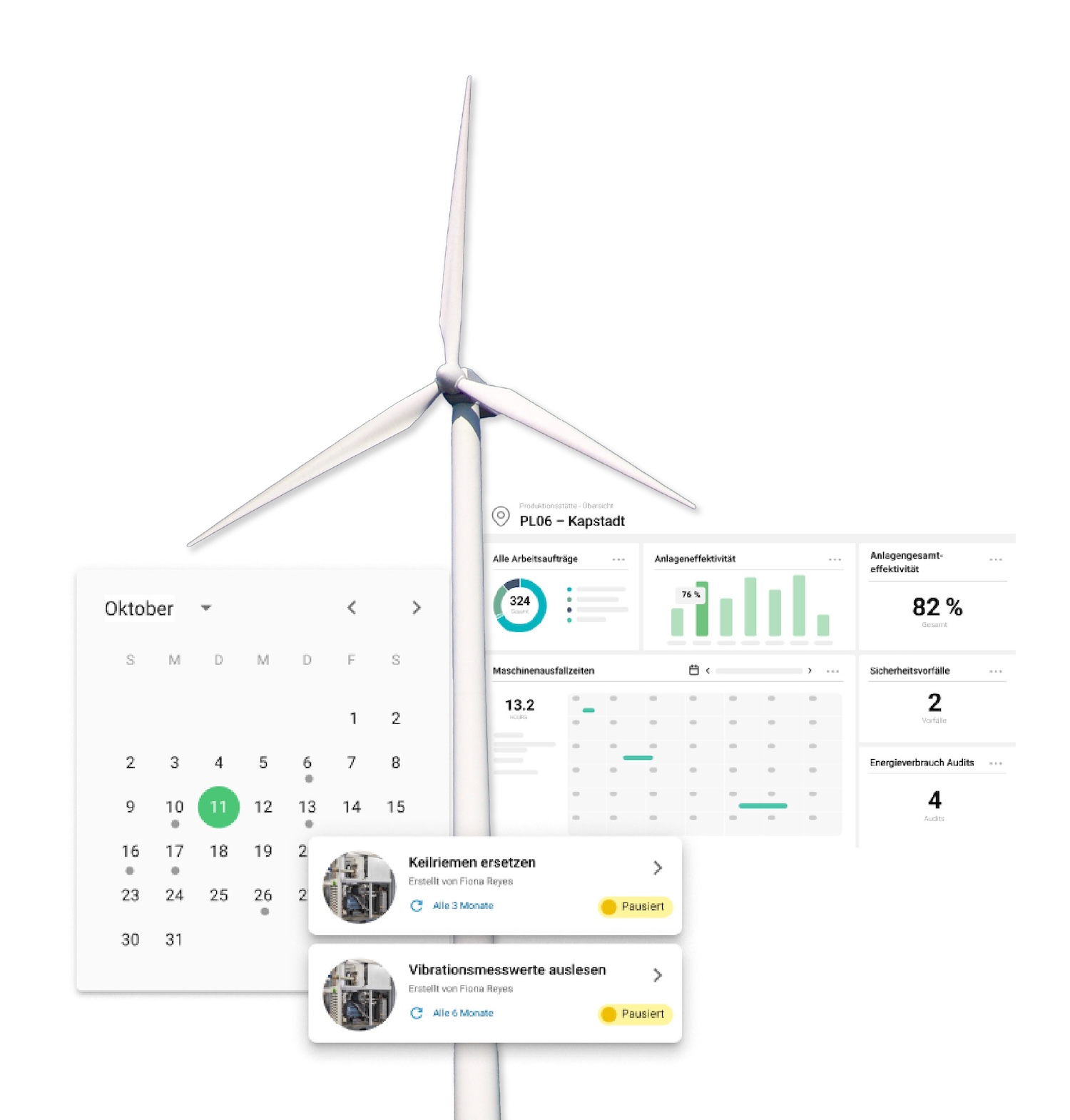
osapiens HUB for Maintenance provides an assisted planning board for resource planning. Dispatchers assign orders manually, with full visibility of technician availability, qualifications, and geographic distribution.
2. Asset Management: The Complete Maintenance History of Every Turbine
Operators and independent service providers typically manage mixed portfolios: Vestas, Siemens Gamesa, Nordex, Enercon, different vintages, varying maintenance histories. Without a structured asset view, strategic decisions about spare parts, repowering, or full-service contract evaluations are based on incomplete information.
osapiens HUB is asset-centric. Every inspection, repair, measurement, and component swap is recorded directly against the individual turbine. The result is a complete, queryable maintenance history for every asset in the fleet, regardless of OEM or site.
3. Spare Parts and Inventory
Wind turbine components, gearboxes, converters, sensors, blade parts, are expensive, slow to procure, and often specific to one OEM or turbine generation. A technician who arrives at a nacelle without the right part loses the visit, and the turbine stays down until a second trip can be scheduled.
osapiens HUB tracks inventory levels and storage locations across sites, and links every part used directly to the work order and the turbine it was installed on. Dispatchers and technicians see, before a visit is even scheduled, whether the required part is in stock and where. That visibility is what turns a two-visit repair into a one-visit repair.

4. Mobile Documentation and Warranty Compliance
Connectivity in a nacelle at 100 meters is not reliable. In many onshore locations, and virtually all offshore environments, technicians have no mobile signal at the point of work. Offline capability is an essential feature for wind energy CMMS.
Technicians using osapiens HUB work through digital checklists, record measurements, document findings with photos, and log spare parts, all without a network connection. Data is stored locally and synced automatically the moment connectivity is restored. Nothing is lost; nothing needs to be reconstructed from memory at the end of the day.
A missing or incomplete service report for a gearbox failure can be the difference between full OEM warranty coverage and a six-figure repair bill. Wind turbine OEMs require complete, timestamped maintenance records to process warranty claims. Every gap in documentation is a financial risk.
Beyond warranty, operators are subject to statutory inspection intervals that vary by market and regulator. In Germany, for example, typical requirements include:
-
Rotor blades: every 4 years (every 2 years from year 12 onward)
-
Electrical systems (DGUV V3): every 4 years
-
Cranes and lifts: annual safety inspection
-
Fire extinguishers: every 2 years
-
Full turbine inspection: generally every 4 years
Requirements differ from market to market, but the principle holds everywhere: deadlines need to be tracked systematically, not managed in a spreadsheet. A single missed deadline can put operating permits or insurance coverage at risk.
5. Bidirectional SAP Integration
Service data entered manually into SAP a day after a visit delays invoicing, creates transcription errors, and makes real-time cost analysis impossible. For companies running SAP PM, the integration quality of a CMMS determines whether the mobile layer adds value or just adds a second data entry point. A deep CMMS ERP integration is not a nice-to-have for enterprise wind operators; it is the architectural foundation that keeps field data and financial records in sync.
SAP Integration for Your Wind Energy Service Without Manual Double-Entry
osapiens HUB for Maintenance is SAP-certified. Orders, confirmations, and material withdrawals synchronise bidirectionally in real time, with no manual double-entry.
Start digitalising your wind park service now
CMMS Requirements for Wind Energy: Your Evaluation Checklist
The following requirements serve as a minimum standard when evaluating any CMMS for wind energy deployment.
| Requirement | What it means | |
|---|---|---|
| Offline capability | Full functionality without mobile connectivity, automatic sync on reconnection | |
| Multi-OEM support | Manage different turbine types with distinct maintenance requirements and checklists | |
| Statutory inspection deadline tracking | Monitoring of recurring regulatory deadlines (e.g., DGUV V3, rotor blade, crane, and full turbine inspections in Germany) | |
| Spare parts visibility | Real-time inventory levels linked to work orders and individual turbines | |
| Subcontractor management | External service providers integrated into the same digital workflow | |
| Bidirectional SAP integration | SAP-certified connector, no manual double-entry | |
| Audit-proof documentation | Timestamped records with digital signature for OEM warranty and statutory audits | |
| Scalability | From a single wind park to a global multi-region portfolio | |
| ISO 27001 certification | Data security for cloud-based storage | |
| Mobile-first design | Usable on tablets and smartphones under demanding field conditions |
Expert tip: Digital maintenance for wind energy does not need isolated solutions, but integrated platforms that consolidate information from different sources and make it actionable. Only then does maintenance transform from a reactive cost factor into a strategic competitive advantage.
How osapiens HUB Handles Wind Energy Service, End to End
osapiens HUB for Maintenance was built for exactly the operational conditions that make wind energy service difficult: distributed assets, no connectivity, complex qualifications, strict documentation obligations, and SAP as the backbone ERP.
-
Assisted dispatch planning. Full visibility of technician availability, qualifications, and geographic distribution at the point of assignment.
-
Asset-centric maintenance history. Every inspection, repair, and component swap recorded against the individual turbine, regardless of OEM or site.
-
Real-time spare parts visibility. Inventory levels and storage locations linked directly to work orders and turbines.
-
Mobile-first architecture with full offline capability and audit-proof documentation. Technicians work through complete digital workflows in the nacelle, regardless of connectivity, with every visit timestamped and signed for OEM warranty and statutory audit requirements.
-
SAP-certified bidirectional integration. No manual double-entry, immediate billing cycle, real-time cost visibility.
-
Scales from a single wind park to global multi-region portfolios. Implementation with SAP integration in 4–12 weeks.

See how osapiens HUB connects fault alerts, technician dispatch, and OEM warranty documentation in one digital process. Book a demo
From Trigger to Closed Service Report with osapiens
From trigger to closed, documented visit: four clearly bounded steps, all digitally mapped in osapiens HUB for Maintenance.
-
Capture: A scheduled inspection, customer report, or monitoring alert becomes a structured work order with priority, affected component, and turbine ID. Recurring preventive maintenance orders are generated automatically from the maintenance plan.
-
Dispatch: The dispatcher assigns the order via the planning board, checking technician qualifications, availability, and proximity. The technician receives the complete order on their mobile device, including checklists, required documentation, and spare parts list.
-
Execute: The technician works through digital checklists, records measurements and photos, and logs any spare parts used. The workflow runs fully offline if needed and syncs automatically on reconnection.
-
Report: A structured service report is generated from the completed order. The technician signs digitally on-site. SAP PM receives the confirmation automatically. The billing cycle starts immediately.
How Nordex Manages 11,400+ Wind Turbines with osapiens HUB for Maintenance
Nordex Group is one of the world’s leading wind turbine manufacturers, with service operations across multiple regions and a fleet that requires daily technician deployments at scale. The challenge: isolated solutions and manual processes that could not keep pace with a growing global portfolio, and harmonizing service procedures across regions with very different local setups.
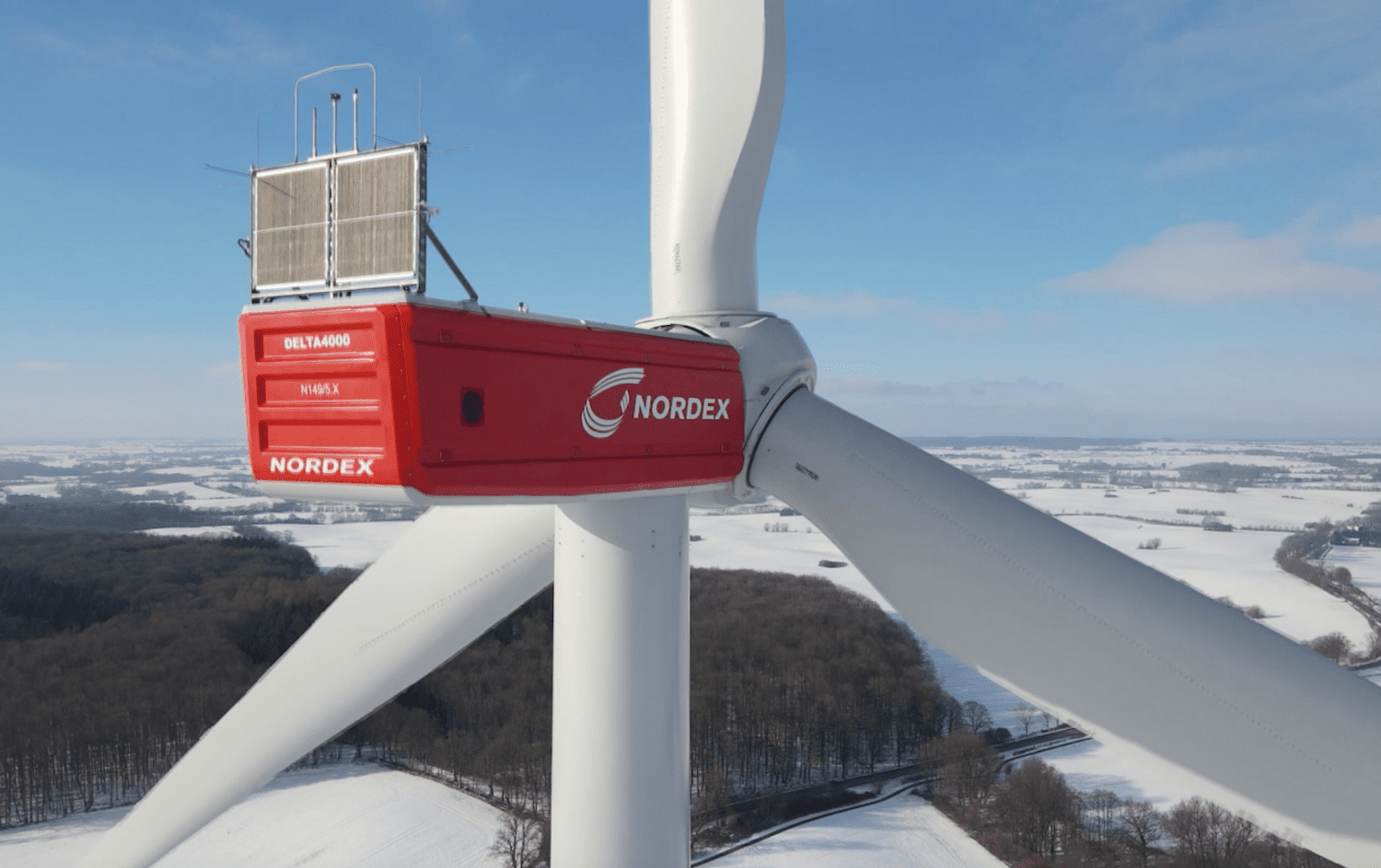
Today, Nordex manages more than 11,400 wind turbines worldwide with osapiens HUB for Maintenance. Integration with Nordex’s core ERP was the deciding factor in the platform selection, and one the team describes as straightforward to implement. From there, Nordex has expanded step by step: first subcontractor management, now tool management, with further modules planned. It’s a clear example of how a CMMS platform can grow alongside the operational requirements of a scaling service organisation, without a replacement cycle.

Alberto Ecre, Group Lead Service Digitalization Department
★ ★ ★ ★ ★Nordex
“We were looking for a cloud platform solution that supports all of our regions. Our technicians have to visit the wind turbines every day to fix problems—we need stable solutions that make their work easier. The key was the very simple integration with our ERP system. Now we are gradually expanding: subcontractor management, tool management, and more.”
Want to see what unplanned downtime and process inefficiency are costing your fleet today? Calculate your ROI
Conclusion: CMMS for Wind Energy – Less Effort, More Turbine Availability
The gap between a service trigger and a closed, documented visit is the core efficiency problem in wind energy O&M. Closing it requires more than monitoring technology. It requires an operations layer that connects technician dispatch, installed assets, spare parts, mobile documentation, and SAP feedback in a single system.
osapiens HUB for Maintenance maps this process end-to-end: from dispatcher-assisted assignment through spare parts visibility to audit-proof documentation and automatic SAP confirmation.
See osapiens HUB in Action on Your Fleet
Book a demo and see how fault capture, technician dispatch, offline documentation, and OEM warranty compliance come together in one connected workflow, built for the way wind energy service actually works.Book a free demo
FAQs
Does CMMS software work offline in a nacelle without mobile connectivity?
Yes, but only if the solution was explicitly built for offline operation. osapiens HUB stores all order data locally on the technician’s device. Checklists, measurements, and photo documentation all work without a network connection. Sync is automatic when connectivity is restored. Solutions without a robust offline mode are not suitable for wind energy deployment.
How is a CMMS different from a SCADA system or condition monitoring?
SCADA and condition monitoring detect anomalies and track turbine operating status continuously. A CMMS is the operations layer on top: it takes any trigger, a monitoring alert, a scheduled inspection, or a customer report, and manages what happens next: dispatching the right technician, tracking spare parts, documenting the visit, and reporting back to SAP. Both system types complement each other. Neither replaces the other.
Can external subcontractors be included in the digital workflow?
Professional CMMS solutions like osapiens HUB support integrating external service providers into the same digital workflow. Subcontractors access relevant orders, complete checklists digitally, and submit structured reports, without parallel paper processes. Nordex has implemented subcontractor management as the next expansion step of its osapiens HUB platform.
From what fleet size does a specialist CMMS make sense?
Already from a few dozen turbines and a small technician team, the coordination costs of manual processes exceed the investment in a digital solution, particularly when inspection deadlines, OEM warranty documentation, and SAP integration are factored in. osapiens HUB is available with a free Freemium entry point and scales to enterprise portfolios like Nordex, with 11,400+ turbines worldwide.
Maintenance Schedule Template
Use our template with asset overview, task catalog, and annual plan. Ready to use for your maintenance planning.
Download for free
ENTERPRISE CAPABILITIES
- SAP ECC & S/4HANA Certified
- Infor & MS Dynamics
- Microsoft Entra ID / Okta
- ISO 27001 & 9001
- EU Cloud · Data Sovereignty
- Development, Test, and Production Environments
- Multi-Entity & Multi-Site
- Power BI Integration
- Audit Trail & Compliance
Related content
January 1, 2026
Roof Coating Maintenance Checklist – Tasks, Best Practices & Digital Execution

May 4, 2026
CMMS for Pharmaceuticals: Meeting GxP, CSV and Audit Trail Requirements in Life Sciences
January 1, 2026
Lathe Machine Maintenance Checklist – Tasks, Safety & Digital Execution

December 4, 2025
Best UpKeep Alternatives for Enterprise CMMS in 2026
January 1, 2026
Asphalt Paver Maintenance Checklist – Tasks, Systems & Digital Execution
January 1, 2026
Plastic Injection Mold Maintenance Checklist – Tasks, Tips & Best Practices
January 1, 2026
Gas Boiler Maintenance Checklist – Tasks, Safety & Digital Execution
January 1, 2026
Building Maintenance Checklist – Essential Tasks, Best Practices & Template

November 27, 2025
Condition Based Maintenance (CBM): Definition, Types & Implementation Guide
January 1, 2026
Compaction Equipment Maintenance Checklist – Tasks, Tips & Template

May 23, 2025
Whitepaper: How to Build a Strong Business Case for a CMMS
January 1, 2026