

CMMS

Florian Bartholomäus, osapiens Expert | 17. August 2026 | Lesezeit 15 min.
The fastest way to shortlist: separate the question "does this platform know my vehicle needs a brake service in 400 miles" from the question "does this data reach SAP." The first is a fleet maintenance question every enterprise fleet has, regardless of ERP. The second only matters for the subset of enterprises running SAP PM, and even there, it is one of five things to check, not the first one.
Close the fleet maintenance data gap








TRUSTED BY LEADING COMPANIES




ENTERPRISE-READY
 SAP Certification
 ISO 27001
 EU Hosting
 Entra ID & Okta
 Multi-Entity
Table of Contents
- Key Takeaways
- Why Enterprise Fleet Maintenance Is a Vehicle Workflow Problem
- The 5 Best Enterprise Fleet Maintenance Software Platforms
- How to Choose Enterprise Fleet Maintenance Software: 5 Criteria
- Expert tip from osapiens
- Enterprise Fleet Maintenance Software, Benefits at a Glance
- osapiens HUB for Maintenance: The Enterprise Fleet CMMS Built Around the Vehicle
- FAQ
A logistics company running fifty trucks out of five regional depots. A construction firm with heavy vehicles spread across three active job sites. For both, the software question is the same: which platform actually tracks maintenance by mileage, engine hours and calendar intervals, catches a driver’s defect report before it becomes a breakdown, and gives field technicians a mobile interface they will use without being reminded? SAP connectivity matters for some of these enterprises and not others; the vehicle maintenance workflow matters for all of them.
Key Takeaways
-
Vehicle-specific maintenance depth separates real fleet CMMS platforms from GPS-first trackers: mileage, engine-hour and calendar-based service intervals, DVIR, and driver defect reporting are the baseline, not an add-on
-
Telematics and diagnostics integration (engine fault codes, OEM connectivity) is now a first-class evaluation criterion, not a nice-to-have
-
SAP integration matters specifically for SAP-governed enterprises: it is one differentiator among several, decisive for that segment, irrelevant for fleets running outside SAP
-
Implementation timelines range from days for GPS-first platforms to 4 to 12 weeks for a SAP-integrated CMMS rollout
Why Enterprise Fleet Maintenance Is a Vehicle Workflow Problem
Enterprise fleet managers are not looking for a GPS tracker alone, most already have one. What they need is a system that captures the vehicle-specific maintenance workflow end to end: service intervals tied to mileage, engine hours or calendar date, pre-trip and post-trip driver inspections (DVIR), a defect report that turns into a work order without a phone call, and a record tied to VIN, license plate, vehicle class and trailer-tractor relationships that holds up when a vehicle needs to be pulled from service and returned.
Fleet tracking software solves a routing and visibility problem: where are the vehicles, who is driving them, how much fuel are they consuming. Fleet maintenance software solves a different problem: work orders, parts, brake and oil and filter and battery service intervals, warranty tracking, and, for a subset of enterprises, SAP data synchronization. Confusing telematics visibility with maintenance execution is the single most common mistake enterprises make when selecting a platform for this use case.
At five sites with three technicians each, a spreadsheet breaks down. At twenty sites with fifty technicians, a platform that tracks vehicle location but not maintenance cost per vehicle, warranty status, or defect-to-work-order handoff creates a different kind of gap: breakdowns that a mileage-based interval would have caught, warranty claims missed because the service record lives somewhere else, and drivers who report a defect that nobody turns into a scheduled repair. For SAP-governed enterprises, that gap widens further when the maintenance data never reaches SAP PM. The solution is not a better spreadsheet or a GPS dashboard with a service reminder bolted on. It is a platform built around the vehicle’s maintenance record.
The five platforms in this comparison were evaluated on:
-
Vehicle-specific maintenance workflows: mileage, engine-hour and calendar-based intervals; DVIR and defect-to-work-order handoff; VIN, vehicle class and trailer-tractor tracking
-
Telematics and diagnostics depth: engine fault codes and DTCs, OEM/telematics platform connectivity, predictive maintenance alerts
-
Multi-site standardization: centralized templates and hierarchies across all locations
-
Mobile UX: whether drivers and technicians actually use the app without being reminded
-
SAP/ERP integration: certified connector vs. third-party middleware vs. none, relevant specifically for SAP-governed enterprises
Automatic technician dispatch is not an evaluation criterion here. Technician assignment in a mature enterprise CMMS is always manual or assisted via a planning board.
See how vehicle-specific maintenance workflows close the gap GPS trackers leave open
A mileage-based service interval that fires on time, a driver defect report that becomes a work order without a phone call, a maintenance record tied to the vehicle's VIN that survives a driver or depot change: that is the layer most fleet telematics platforms do not build. For SAP-governed enterprises, the same record can also reach SAP PM without a manual reconciliation step.
Get an enterprise demo
The 5 Best Enterprise Fleet Maintenance Software Platforms
The five platforms below were evaluated on vehicle-specific maintenance depth, telematics integration, multi-site support, mobile UX, and SAP/ERP connectivity. They are ranked by fit for enterprise fleet operations, not by market share. Two are telematics-first platforms with a maintenance layer built on top (Geotab, Samsara), one is fleet-tracking native with maintenance scheduling (Fleetio), one is a mobile-first CMMS (MaintainX), and osapiens HUB for Maintenance is the SAP-certified CMMS in the group, because the right answer depends on where telematics depth, fleet maintenance execution, and SAP connectivity sit on a given enterprise’s priority list.
| Software | Best For | Fleet Maintenance Depth | SAP Integration | Mobile UX |
|---|---|---|---|---|
| osapiens HUB for Maintenance | SAP-governed enterprise fleets, logistics and construction | Work orders, parts, DVIR-style checklists, compliance documentation | SAP-certified connector | Mobile-first |
| MaintainX | Mid-market North American fleets with moderate SAP needs | Work order management, preventive maintenance scheduling | SAP Store (custom, not certified) | Strong |
| Fleetio | SMB to mid-market, fleet-native maintenance and cost tracking | Mileage/hour-based intervals, cost-per-vehicle, vendor management | None | Good |
| Geotab | Large fleets prioritizing engine diagnostics and predictive maintenance | Fault-code-driven alerts, OEM/telematics data depth; maintenance module is a scheduling layer on telematics, not a full work-order/parts CMMS | SAP App Center partner app (telematics data into SAP Cloud Platform, not a certified PM connector) | Good |
| Samsara | Fleets wanting one platform for GPS, dash cams and light preventive maintenance | Real-time diagnostic alerts (engine, battery); maintenance is secondary to the telematics platform | None native (third-party ETL only) | Strong |
osapiens HUB for Maintenance: The SAP-Native Enterprise CMMS
Best for: Logistics companies with truck fleets, construction firms with off-site vehicles, and SAP-governed enterprises maintaining both vehicles and fixed plant equipment across multiple locations
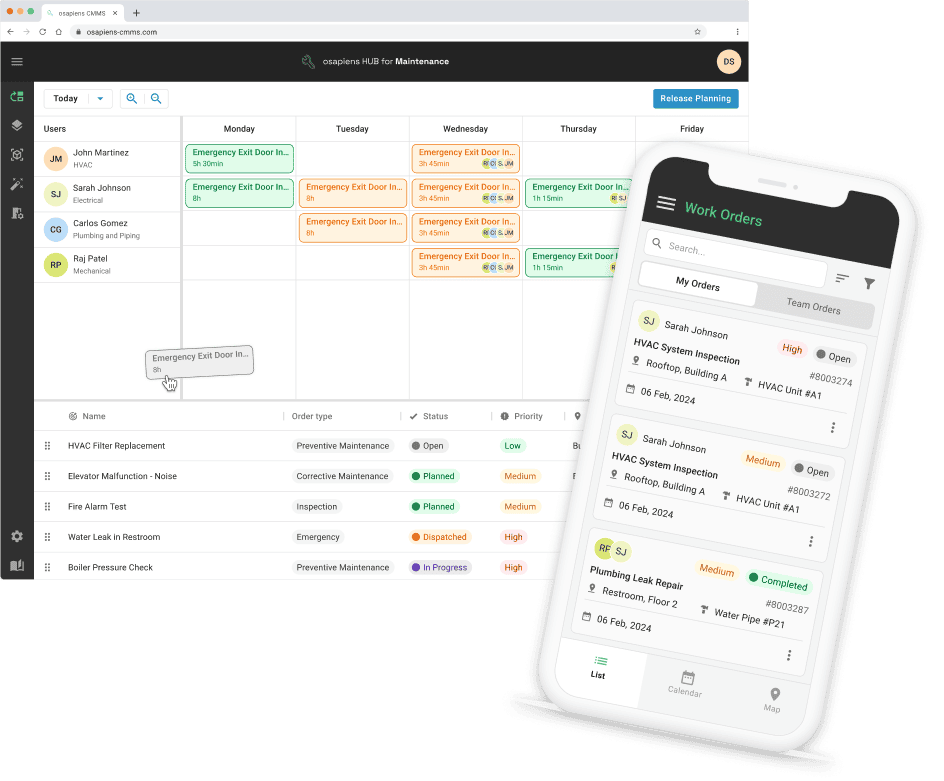
osapiens HUB for Maintenance is an AI-ready CMMS built around the vehicle’s maintenance record: work orders, parts, service intervals, and compliance documentation, with a SAP-certified connector for enterprises that also run SAP PM.
Strengths
-
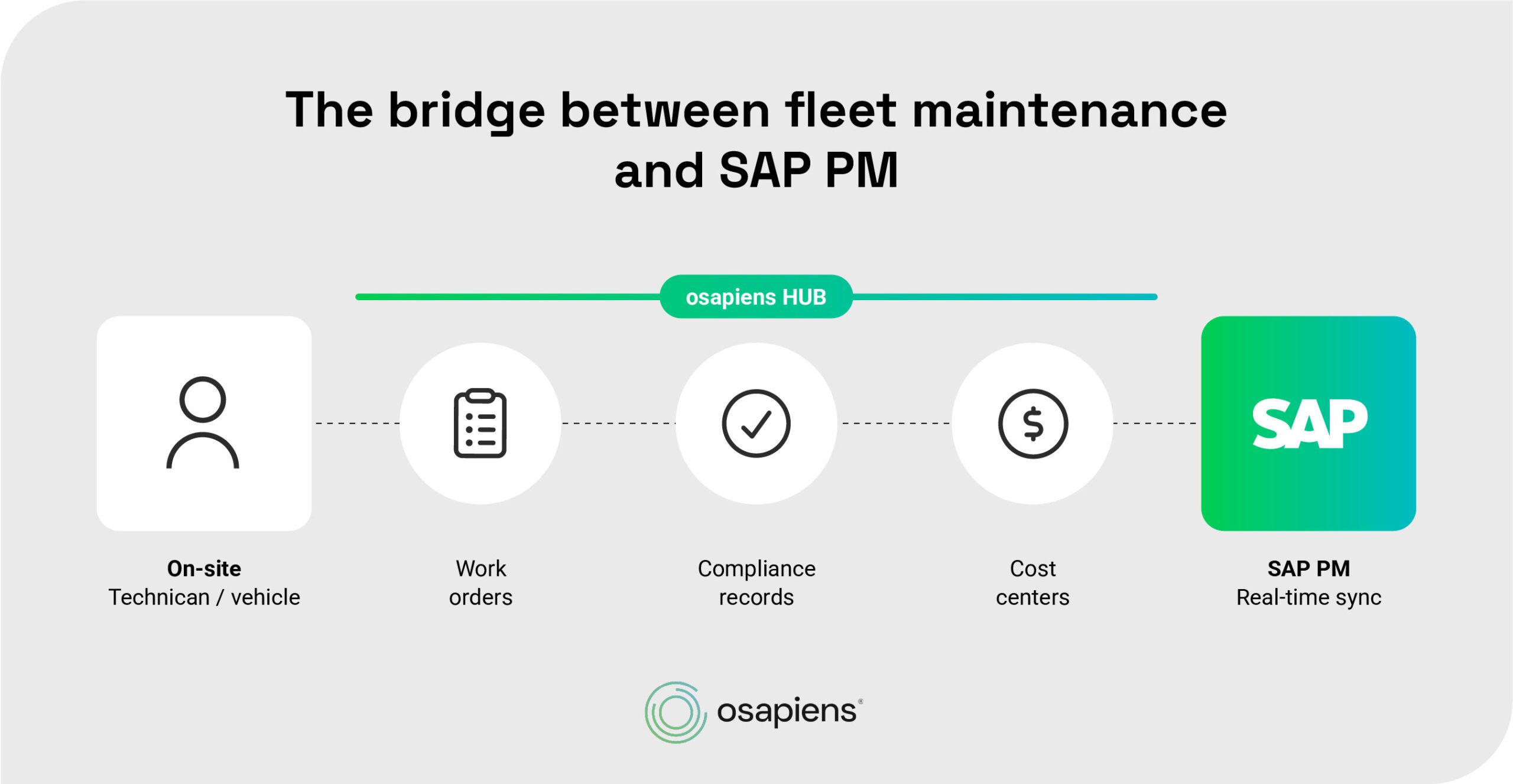
SAP-certified connector: bidirectional sync with SAP PM, MM, and FI/CO, including SAP S/4HANA; stays compatible through SAP updates without a separate integration layer or custom middleware
-
Standalone or SAP-integrated: runs fully standalone (1 to 3 weeks to implement) for enterprises outside SAP, or with the SAP-certified connector (4 to 12 weeks) for those that are
-
Multi-site standardization: centralized work order templates, parts naming standards, and asset hierarchies apply across every location from a single platform
-
Mobile-first execution: field technicians access, process, and close work orders from any device
-
Proven at enterprise scale: osapiens HUB is deployed at Nordex across globally distributed locations
-
Technician assignment: manual or assisted via the planning board; no automatic dispatch
Limitations
-
Not a GPS or telematics platform; vehicle location tracking and engine-diagnostics alerts of the kind Geotab or Samsara provide are outside the product scope
-
The SAP-certified connector is the strongest differentiator for SAP-governed enterprises specifically; for fleets outside SAP, the standalone deployment is the relevant comparison point
Bring vehicle maintenance records into one platform, with or without SAP
When a work order closes in the field and the vehicle's service history, parts used, and (for SAP-governed enterprises) SAP PM record update automatically, cost centers stay accurate and compliance documentation is audit-ready. That holds whether the enterprise runs SAP or not.
See osapiens HUB for fleet teams
MaintainX: The Mobile-First Work Order Challenger
Best for: Mid-market North American enterprises with mobile-first field teams and moderate SAP integration requirements
MaintainX is a mobile-first maintenance platform with strong work order management. A credible option for teams that prioritize UX and do not require a SAP-certified connector.
Strengths
-
Highly rated mobile UX and a fast onboarding experience
-
Available on the SAP Store since July 2023; integrates with SAP ECC 6.0 and S/4HANA
-
Multi-site management supported
-
Established enterprise customer base in North America
Limitations
-
SAP integration is custom-built by MaintainX, not SAP-certified; provided as an additional services package at extra cost
-
Vehicle-specific workflows (DVIR, mileage-based intervals, VIN/trailer-tractor tracking) are not a dedicated product focus; the platform is built for general asset maintenance first
Fleetio: The Fleet-Native Cost and Compliance Tracker
Best for: SMB to mid-market fleet operators who want maintenance scheduling built specifically around the vehicle, without ERP connectivity
Fleetio is purpose-built for fleet maintenance: mileage and engine-hour-based service intervals, vendor and warranty tracking, and cost-per-vehicle reporting, with vehicle tracking and telematics integrations layered on top.
Strengths
-
Mileage, engine-hour and calendar-based preventive maintenance scheduling built specifically for vehicles
-
Strong vehicle cost tracking, warranty tracking, and cost-per-vehicle visibility
-
Good mobile app for driver inspections and technician work orders
-
Fast to implement; strong SMB and mid-market user base
Limitations
-
No SAP integration; not a published product roadmap feature
-
Multi-site management is limited compared to enterprise CMMS platforms
-
Not built for mixed asset bases that include both vehicles and fixed plant equipment
Geotab: The Engine Diagnostics and Telematics Leader
Best for: Large enterprise fleets that want predictive maintenance driven by engine diagnostics and OEM telematics data, with SAP visibility rather than a certified CMMS connector
Geotab is a telematics platform with a maintenance layer built on top of its diagnostics data: engine fault codes, trouble codes, and predictive maintenance alerts derived from the vehicle’s own telemetry.
Strengths
-
Deep engine diagnostics: fault codes and trouble codes feed proactive maintenance alerts before a breakdown
-
Broad OEM and third-party hardware compatibility through its SDK and Marketplace
-
A partner app on the SAP App Center pushes telematics data into SAP Cloud Platform, useful for fleet analytics and visibility inside a SAP landscape
-
Established enterprise telematics scale, with ELD compliance built in
Limitations
-
The SAP connection is a data-visibility integration into SAP Cloud Platform, not a certified bidirectional connector to SAP PM; work orders do not sync back the way a certified CMMS connector does
-
Maintenance is a scheduling and alerting layer on top of the telematics platform, not a full work-order, parts, and compliance-documentation CMMS
-
User reviews flag the maintenance module specifically as harder to use than the core tracking product
Samsara: The All-in-One IoT Fleet Platform
Best for: Fleets that want one platform for GPS tracking, dash cams, driver safety, and lightweight preventive maintenance alerts
Samsara combines real-time vehicle tracking, video-based driver safety, and diagnostic alerts (engine faults, battery health) in a single easy-to-deploy platform, with preventive maintenance as one part of a broader IoT offering.
Strengths
-
Real-time diagnostic alerts for engine faults, battery levels, and equipment condition
-
Strong, well-reviewed mobile app for drivers and fleet managers
-
Fast deployment and hassle-free hardware installation
-
Serves a wide range of fleet types, including construction and school transportation
Limitations
-
No native or certified SAP connector; enterprises connect Samsara data to SAP through third-party ETL tools such as Fivetran, which requires its own integration project
-
Maintenance is secondary to the telematics platform: work order depth, parts management, and vehicle-specific compliance documentation are lighter than a dedicated fleet CMMS
-
No published multi-site standardization features comparable to a CMMS built for enterprise rollout
How to Choose Enterprise Fleet Maintenance Software: 5 Criteria
The comparison table above gives you a fast read across the five platforms. These five criteria explain why the distinctions in that table matter at enterprise scale.
1. Vehicle-Specific Maintenance Workflows and Compliance
This is the baseline test for any fleet maintenance platform. Does it schedule service by mileage, engine hours, and calendar date, not just a generic recurring reminder? Does it support DVIR-style pre-trip and post-trip driver inspections, and does a driver’s defect report turn into a work order without a phone call? Can the record track VIN, license plate, vehicle class, and trailer-tractor relationships, and does it support taking a vehicle out of service and returning it once repaired? A platform that cannot connect a driver’s defect report to a scheduled work order leaves the exact gap that turns a minor issue into a roadside breakdown. Warranty tracking and maintenance cost per vehicle round out this criterion: without them, a fleet manager cannot see which vehicles are draining the budget or which repairs should still be covered.
2. Telematics and Diagnostics Integration
Engine fault codes and diagnostic trouble codes (DTCs), fed from the vehicle or from an OEM/telematics platform, are what turns maintenance from reactive to predictive. The platforms that build this well catch a failing part from its fault code before the vehicle stops running, rather than after. This is also where GPS-first platforms like Geotab and Samsara are genuinely strong: their core product is built on exactly this kind of vehicle telemetry, even where their work-order and parts management is lighter than a dedicated CMMS.
3. Multi-Site Visibility and Standardization
Enterprise fleets operate across multiple depots, job sites, or service regions with different technicians and different parts suppliers at each location. Multi-site maintenance management at enterprise scale requires centralized work order templates, parts naming standards, and asset hierarchies, not conventions that vary site by site. A platform that cannot standardize across sites produces fragmented data that makes centralized reporting and compliance documentation unreliable.
4. Mobile UX for Drivers and Technicians
A driver completing a pre-trip inspection or a technician closing a work order at a depot needs an app that works in seconds, not minutes, ideally with offline capability. The practical test is not whether a mobile app exists, but whether drivers and technicians actually use it without being reminded. If it requires training time or more than a few taps to log a defect or confirm a repair, the data gap reappears in the form of paper checklists and phone calls.
5. SAP/ERP Integration Depth
For SAP-governed enterprises specifically, the depth of the SAP connection is a real differentiator, though it is not the deciding factor for every fleet case. A SAP-certified connector synchronizes work orders, assets, maintenance plans and cost objects bidirectionally and stays compatible through SAP updates. A partner integration that pushes telematics data into SAP Cloud Platform for visibility, as Geotab offers, is a different and lighter thing than a certified PM connector. Third-party ETL connectors, as used to bring Samsara data into SAP, require an ongoing integration project on top. For fleets that do not run SAP, this criterion carries far less weight than criteria 1 through 4.
Expert tip from osapiens
The fastest way to shortlist: separate the question "does this platform know my vehicle needs a brake service in 400 miles" from the question "does this data reach SAP." The first is a fleet maintenance question every enterprise fleet has, regardless of ERP. The second only matters for the subset of enterprises running SAP PM, and even there, it is one of five things to check, not the first one.
Florian Bartholomäus, osapiens Expert
Enterprise Fleet Maintenance Software, Benefits at a Glance
-
Mileage, engine-hour, and calendar-based service intervals catch failures before they become breakdowns, instead of relying on a fixed reactive schedule
-
A driver’s defect report turns into a scheduled work order automatically, closing the gap between what the driver sees and what gets repaired
-
Engine fault codes and diagnostic data turn maintenance from reactive to predictive, extending vehicle life and reducing unplanned downtime
-
Multi-site standardization reduces parts inventory waste and keeps naming conventions consistent across depots
-
For SAP-governed enterprises, a certified connector removes the manual reconciliation step between field work orders and SAP PM
osapiens HUB for Maintenance: The Enterprise Fleet CMMS Built Around the Vehicle
Enterprise fleet maintenance is a vehicle workflow problem before it is anything else: service intervals by mileage or engine hours, a driver’s defect report that becomes a work order, a maintenance record tied to VIN and vehicle class that holds up at audit time. For SAP-governed enterprises, that record also needs to reach SAP PM without a manual reconciliation step.
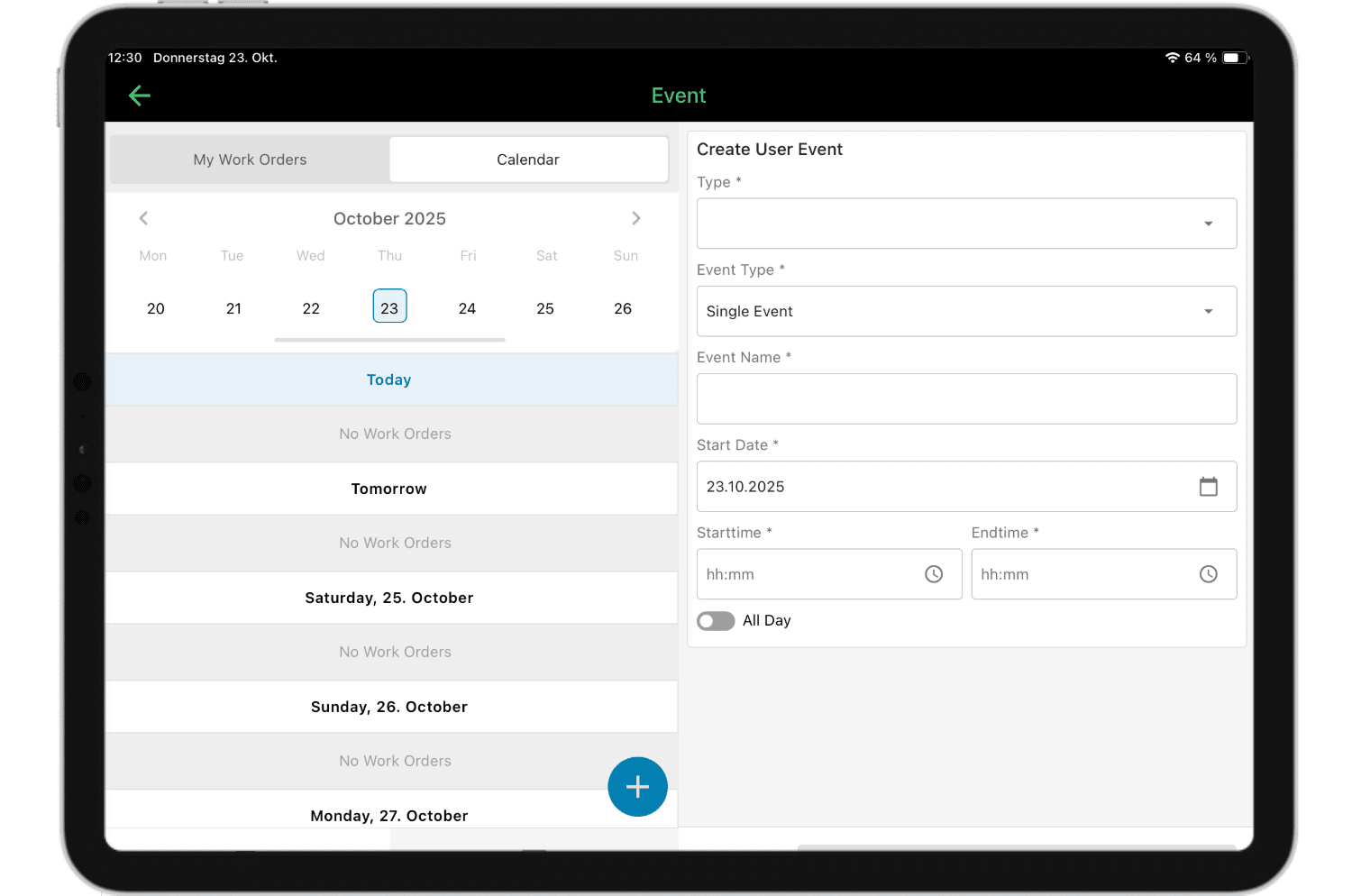
osapiens HUB for Maintenance covers both: a CMMS built around the vehicle’s maintenance record, with a SAP-certified connector for the enterprises that need it. It implements standalone in 1 to 3 weeks, or with SAP integration in 4 to 12 weeks. For SAP-governed enterprises maintaining logistics truck fleets, construction site vehicles, or any fleet operating outside plant boundaries, osapiens HUB for Maintenance is the enterprise fleet maintenance software built around how the vehicle actually gets maintained.
Give every vehicle a maintenance record that holds up, in the field and in SAP
When a driver's defect report becomes a work order automatically, and that work order closes with the vehicle's full service history intact, cost centers stay accurate and compliance documentation is audit-ready. For SAP-governed enterprises, the same record reaches SAP PM without a reconciliation step.
Get an enterprise demo for your fleet
FAQ
What is the difference between fleet management software and fleet maintenance software for enterprise?
Fleet management software focuses on vehicle tracking, GPS, routing, fuel management, and driver monitoring, the core of platforms like Geotab and Samsara. Fleet maintenance software, specifically a CMMS, focuses on work orders, mileage or engine-hour-based service intervals, DVIR and defect reporting, parts management, and compliance documentation. Many enterprises need both: a telematics platform for visibility and a CMMS for maintenance execution.
Do telematics platforms like Geotab or Samsara replace a fleet maintenance CMMS?
Not fully. Geotab and Samsara both generate strong diagnostic data (engine fault codes, battery health, predictive alerts) that feeds maintenance decisions, and both include a maintenance module. But neither is built as a full work-order, parts, and compliance-documentation CMMS the way osapiens HUB, MaintainX, or Fleetio are. Many enterprises run a telematics platform for vehicle data and a dedicated CMMS for maintenance execution, sometimes connected to each other.
Does enterprise fleet maintenance software integrate with SAP PM?
It depends on the platform. Of the five platforms in this comparison, osapiens HUB for Maintenance is the only one with a SAP-certified connector that synchronizes work orders, assets, and cost objects bidirectionally. MaintainX offers SAP integration via the SAP Store, but it is custom-built, not pre-certified. Geotab has a partner app that pushes telematics data into SAP Cloud Platform for visibility, which is a different kind of integration than a certified PM connector. Fleetio and Samsara have no native SAP integration.
How does a fleet CMMS handle a driver’s defect report?
In a platform built around vehicle-specific workflows, a driver logs a defect during a pre-trip or post-trip inspection (DVIR), and that report converts into a work order without a manual handoff, often flagging the vehicle for review before it goes back into service. The record stays tied to the vehicle’s VIN, so the repair history is visible the next time that vehicle comes up for service. Platforms without this handoff rely on drivers calling or emailing a dispatcher, which is where defects get lost.
How can construction companies manage fleet maintenance across multiple job sites with one system?
The requirement is a CMMS that supports centralized work order templates, mileage or engine-hour-based service schedules, and vehicle-specific records (VIN, vehicle class, trailer-tractor relationships) across locations simultaneously. Vehicles operating off-site at active construction projects need maintenance records created in the field and synced to the central system in real time, with SAP connectivity for enterprises that run SAP PM.
Is a dedicated fleet maintenance tool or a CMMS better for a logistics company running SAP?
For a logistics company running SAP and maintaining both vehicle fleets and other fixed assets, a CMMS with fleet-specific maintenance workflows is the stronger choice: it handles mileage and engine-hour-based intervals, DVIR and defect reporting, and a mixed asset base, and it can integrate natively with SAP PM so maintenance data reaches the ERP without a separate sync step. A telematics platform like Geotab or Samsara is optimized for vehicle diagnostics and GPS visibility; it reaches its ceiling when work-order depth, parts management, and SAP connectivity become requirements.
Start using osapiens for free
Improve your uptime, extend the life of your equipment, and simplify work order management.
Book a demo
ENTERPRISE CAPABILITIES
- SAP ECC & S/4HANA Certified
- Infor & MS Dynamics
- Microsoft Entra ID / Okta
- ISO 27001 & 9001
- EU Cloud · Data Sovereignty
- Development, Test, and Production Environments
- Multi-Entity & Multi-Site
- Power BI Integration
- Audit Trail & Compliance
Related content
January 1, 2026
Bench Grinder Maintenance Checklist – Tasks, Safety & Digital Execution
July 21, 2025
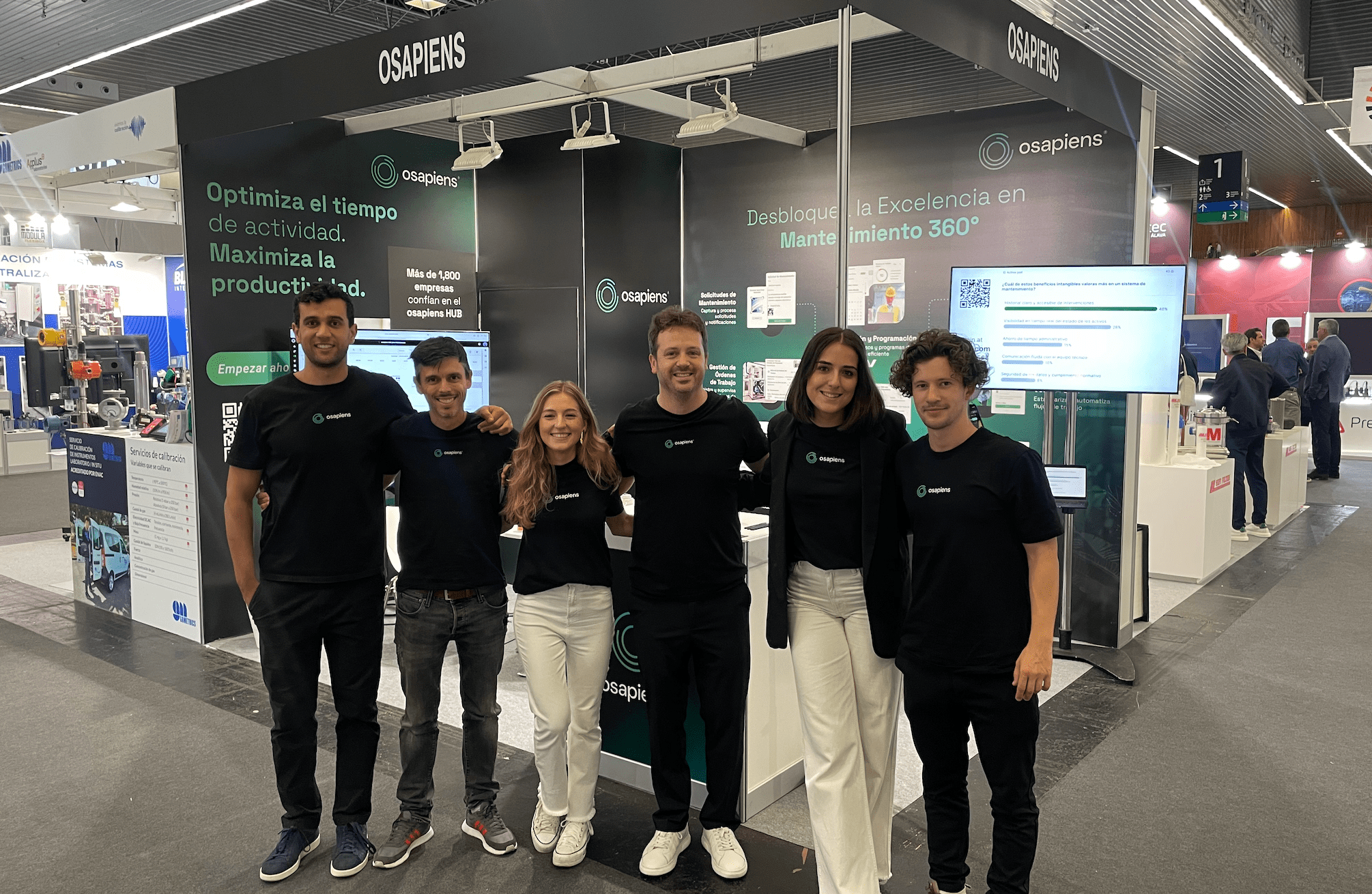
Maintenance Bilbao 2025: Key Insights on Maintenance Management
January 1, 2026
Lyophilizer Maintenance Checklist – Tasks, Tips & Template
October 15, 2025
How osapiens’ SAP CMMS integration enables easy mobile maintenance
January 1, 2026
Backflow Preventer Maintenance Checklist – Tasks, Compliance & Digital Execution
January 1, 2026
Solar Inverter Maintenance Checklist – Tasks, Tips & Template
January 1, 2026
Laboratory Equipment Maintenance Checklist – Tasks, Best Practices & Digital Solution
January 1, 2026
Control Panel Maintenance Checklist – Tasks, Tips & Template
January 1, 2026
Tablet Press Maintenance Checklist – Tasks, Tips & Template
January 1, 2026
Electrical Preventive Maintenance Checklist – Tasks, Safety & Digital Execution
January 1, 2026
Conveyor Belt Preventive Maintenance Checklist – Tasks, Tips & Digital Execution
January 1, 2026