

Blog

Florian Bartholomäus, osapiens Expert | 8. October 2026 | Lesezeit 11 min.
A pasteurizer fails overnight, the maintenance log lives on a paper form nobody can find, and three days later an IFS or BRC auditor asks for the last calibration record. Every hour of downtime costs a batch, and every undocumented repair is a potential audit finding. osapiens HUB for Maintenance brings preventive maintenance and a mobile, tamper-proof audit trail together on one platform built for food and beverage production.
Digitize Your Audit-Ready Maintenance







TRUSTED BY LEADING COMPANIES




ENTERPRISE-READY
 SAP Certification
 ISO 27001
 EU Hosting
 Entra ID & Okta
 Multi-Entity
Table of Contents
- Key Takeaways
- The Rising Cost of Downtime in Food and Beverage
- HACCP and Critical Control Points: What Your CMMS Must Document
- What a CMMS for Food and Beverage Needs to Cover
- How osapiens HUB for Maintenance Supports Food and Beverage Compliance
- Conclusion: Audit-Ready CMMS Software for Food and Beverage with osapiens HUB
- FAQ
Food and beverage manufacturers running maintenance on Excel or paper are managing two risks at once: unplanned downtime and food safety compliance gaps. Choosing CMMS software for food and beverage production means finding a platform that documents HACCP-linked maintenance, hygiene checklists, and calibration records well enough to survive an unannounced audit. Scheduling work orders is the part every CMMS can do. This article covers the rising cost of downtime, the compliance requirements auditors actually check, and what a food and beverage plant should look for in a platform.
Key Takeaways
-
Downtime keeps getting more expensive: FMCG is the only manufacturing sector where downtime hours have risen since 2019, and per-plant downtime costs have roughly doubled.
-
CCP calibration is a maintenance obligation: temperature probes, pH sensors, and metal detectors need documented calibration, and a missed due date is already a compliance gap.
-
Maintenance evidence beats maintenance activity: IFS, BRC, and FSSC 22000 auditors look for time-stamped records with traceable changes; a note saying a job happened proves little on its own.
-
osapiens HUB for Maintenance turns compliance into a maintenance byproduct: digital checklists, a locked audit trail, and CCP calibration management make HACCP and dust-safety evidence automatic, not extra work.
The Rising Cost of Downtime in Food and Beverage
Food and beverage is moving against the trend. Since 2019, almost every manufacturing sector has cut its unplanned downtime hours. Fast-moving consumer goods (FMCG), the category that includes food and beverage, is the only one where downtime hours went up. The cost of a single hour has stayed broadly stable at around 36,000 USD, but the extra hours add up: annual downtime costs for a large FMCG plant have roughly doubled to just over 10 million USD, according to Siemens’ The True Cost of Downtime 2024 report.
The industry’s cost structure explains part of this. A single stop can trigger three cost chains at once:
-
Product loss: temperature-critical processes are interrupted, and raw materials can spoil in place.
-
Sanitation before restart: after maintenance on food-contact equipment, the line needs cleaning and release before production can resume.
-
Delivery delays: missed shipments can lead to contractual penalties.
Across industries, ABB’s “Value of Reliability” study puts the cost of unplanned downtime at 116,000 EUR per hour worldwide and 147,000 EUR per hour in Germany. 69% of industrial companies worldwide experience unplanned downtime at least once a month.
The leading causes are well known, as a manufacturing study shows:
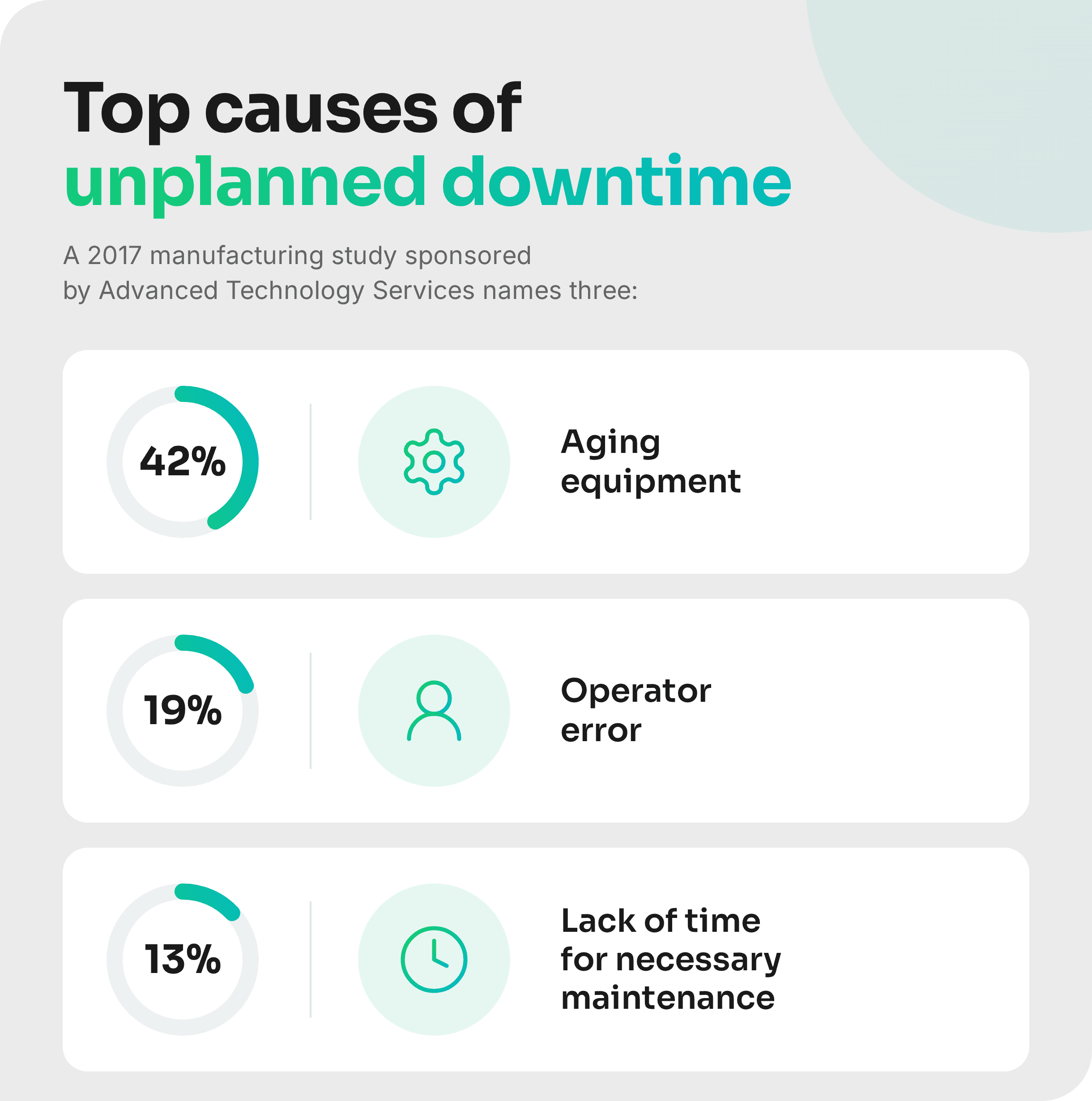
Structured preventive maintenance addresses aging equipment and missing maintenance time directly. Digital checklists and work instructions reduce the room for operator error. A CMMS brings both together in one system.
HACCP and Critical Control Points: What Your CMMS Must Document
HACCP, short for Hazard Analysis and Critical Control Points, is the internationally recognized framework for food safety. Its principles are set out by the Codex Alimentarius Commission of the FAO and WHO. Codex guidance is voluntary, but many markets make it binding:
-
EU: Regulation (EC) No 852/2004 requires HACCP-based procedures at every stage after primary production, along with documents and records that show these procedures work in practice, scaled to the nature and size of the business.
-
United States: the FDA’s Preventive Controls for Human Food rule requires a written food safety plan and documented corrective actions. The FDA’s HACCP Principles and Application Guidelines follow the same seven principles.
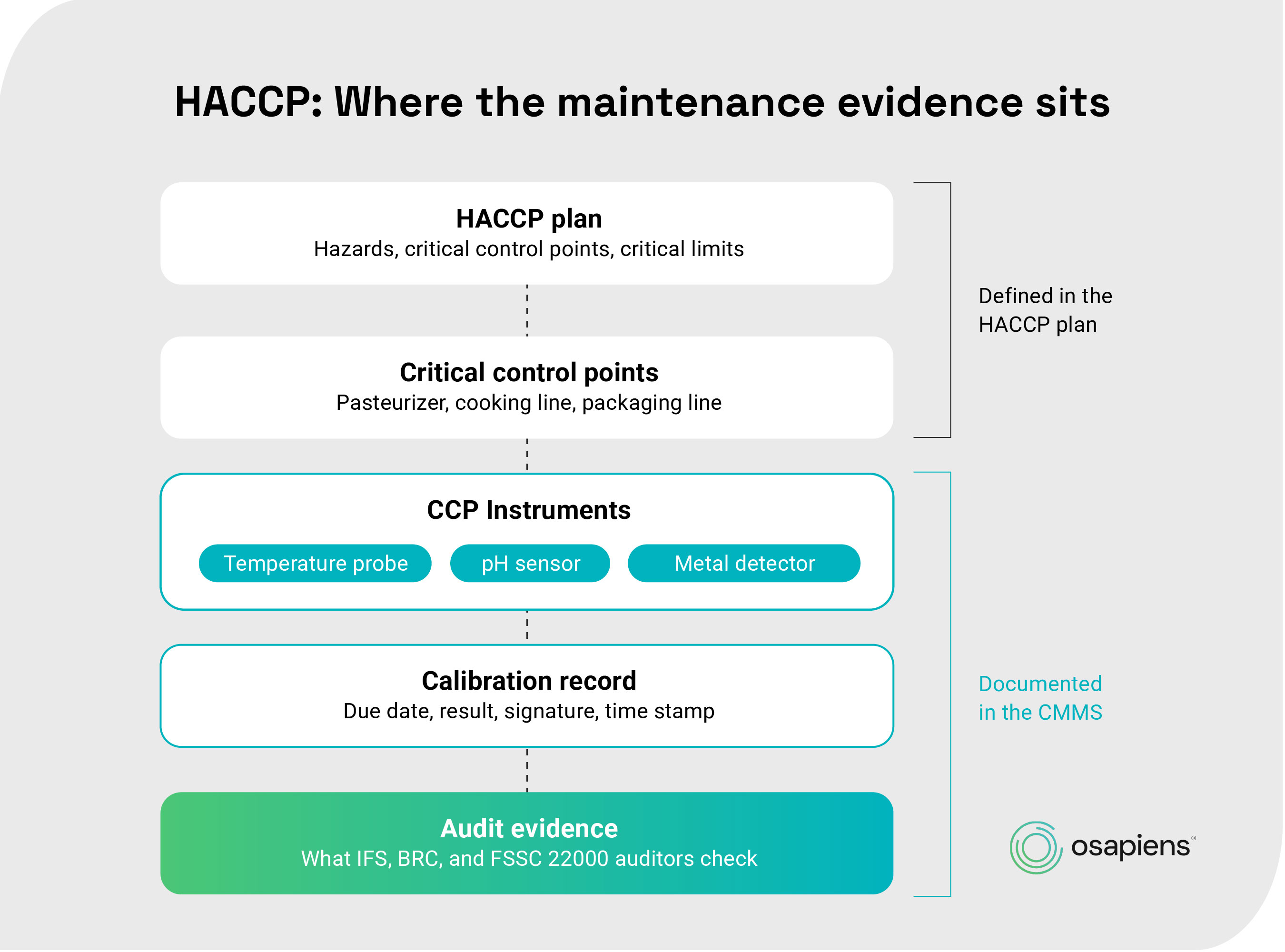
For maintenance, this means a complete history per asset and documented corrective action whenever a check fails. HACCP also puts a direct obligation on the instruments that monitor critical control points. Typical examples are:
-
Pasteurizer: temperature probes
-
Cooking line: pressure and pH sensors
-
Packaging line: metal detectors
Each instrument needs a documented calibration schedule. A missed calibration should be flagged immediately, before it turns into an audit finding.
A CMMS does not replace a HACCP plan. It is the evidence layer underneath one: the system that turns a HACCP principle into a maintenance record an auditor can check.
Sanitation and CIP: Coordinating Hygiene and Maintenance Windows
Clean-in-place (CIP) cycles and maintenance work often need the same equipment. When hygiene and maintenance are planned separately, the line often stops twice: once for cleaning and once for the repair. Planned together, both fit into one window.
Maintenance on production-adjacent equipment also comes with hygiene steps before and after the job:
-
Foreign-object control: tools and parts are accounted for, and the area is checked before production restarts.
-
Allergen changeover checks: equipment is cleaned and verified before the next product runs.
-
Hygiene release: a responsible person confirms the line is ready for production.
IFS and BRCGS auditors check these steps as part of their hygiene and maintenance requirements. In the EU, allergen management has also been part of Regulation 852/2004 since the 2021/382 amendment.
Bring Hygiene and Maintenance Into One Workflow
CIP cycles, allergen changeovers, and calibration due dates do not have to live in three different systems. See what it looks like when hygiene sign-off and maintenance work share one digital checklist.
Digitize Your Food Safety Checklists
IFS Food, BRC/BRCGS, and FSSC 22000: Passing Global Certification Audits
IFS Food, BRCGS, and FSSC 22000 are third-party certification schemes. They audit whether a plant’s HACCP-based food safety program works in daily practice, and maintenance documentation is one of the main pieces of evidence.
In practice, an auditor expects:
-
a complete preventive maintenance history for every production-relevant asset
-
a clear link between calibration records and the CCPs they protect
-
signed-off sanitation checklists
-
corrective-action records with traceable changes
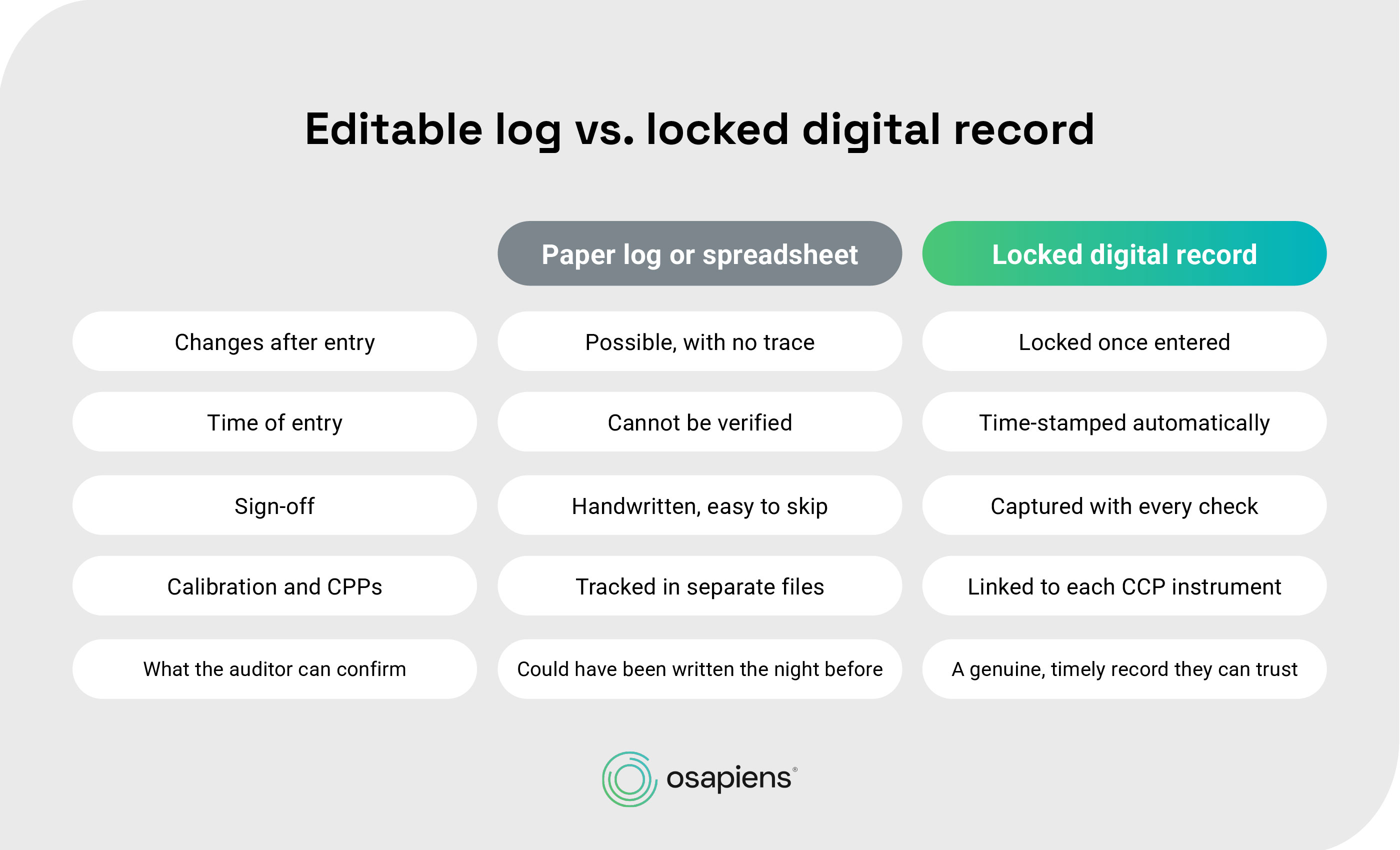
Paper logs and shared spreadsheets make this hard to prove. Both can be changed after the fact without a visible trace, so an auditor cannot easily tell a timely record from one written the night before the audit. At its core, this is a data-integrity problem, and it is the gap a locked, time-stamped maintenance record closes.
ATEX and Combustible Dust: The Maintenance Risk Most CMMS Content Ignores
Many food plants handle powdered raw materials such as flour, sugar, starch, milk powder, cocoa, and grain. With the right combination of concentration, confinement, and an ignition source, these can form an explosive dust cloud. Hygiene and calibration get most of the attention in food maintenance, and dust safety often gets less.
In the EU, two ATEX directives apply:
-
Directive 1999/92/EC (workplace): the operator assesses explosion risks and classifies areas, such as a silo interior or the area around a flour conveyor, into zones.
-
Directive 2014/34/EU (equipment): sets the requirements for equipment and protective systems used in those zones. The zone determines which equipment category is required.
The stakes are well documented. In 2008, a sugar dust explosion at the Imperial Sugar refinery in Port Wentworth, Georgia, killed 14 workers. Between 1980 and 2005, the U.S. Chemical Safety and Hazard Investigation Board identified 281 combustible dust incidents that killed 119 workers and injured 718 (OSHA, Combustible Dust).
For the maintenance team, this means:
-
checking for dust accumulation
-
monitoring temperatures on bearings and other hot spots
-
inspecting conveyors and elevators in classified zones on a regular schedule
Each check is documented together with the zone’s classification. No single legal interval applies to every plant: the operator sets inspection frequency through its own risk assessment.
What a CMMS for Food and Beverage Needs to Cover
Paper checklists and Excel trackers fail in two ways at once: a missed inspection means a machine can break down without warning, and a missing signature means an auditor cannot confirm the inspection ever happened. A general-purpose CMMS solves the first problem by scheduling tasks. Food plants also need the documentation depth described in the previous sections. The table below summarizes these requirements and why they count in an audit.
| Focus area | What the CMMS must cover | Why it matters |
|---|---|---|
| HACCP/CCP calibration | Calibration plans per CCP instrument, with clear due dates | A missed calibration is already a compliance gap |
| Audit documentation | Time-stamped records with traceable changes | IFS, BRCGS, and FSSC 22000 auditors check record integrity |
| Combustible dust | Asset records with zone information and housekeeping checklists | Inspections in classified zones must be documented |
| SAP integration | Standalone use or a certified SAP integration | Avoids a parallel paper process next to SAP |
| Mobile/offline execution | A mobile app that works without Wi-Fi | Technicians document at the asset, including in cold storage |
The next section shows how osapiens HUB for Maintenance covers these requirements in daily maintenance work.
Close the Gap Between Maintenance and Audit-Ready Proof
A completed work order and an audit-ready record are not the same thing. See what a maintenance history looks like when every calibration, sign-off, and corrective action is captured automatically.
Book a free demo
How osapiens HUB for Maintenance Supports Food and Beverage Compliance
osapiens HUB for Maintenance brings together everything a food and beverage plant needs to turn everyday maintenance work into audit-ready evidence:
-
Mobile, offline-capable documentation: technicians log calibration checks, sanitation sign-off, and repairs directly at the asset, including in cold storage, production halls, or other areas where WLAN coverage is unreliable. The interface is built to stay operable with gloves in hygiene zones.
-
Tamper-proof audit trail: every check, signature, and corrective action is time-stamped and locked once entered, giving IFS, BRC, and FSSC 22000 auditors a record they can trust without manual reconciliation.
-
CCP-linked calibration management: calibration due dates for temperature probes, pressure and pH sensors, and metal detectors escalate automatically instead of relying on someone remembering to check a spreadsheet.
-
SAP-certified integration: work orders and completed documentation flow bidirectionally between osapiens HUB for Maintenance and SAP PM or SAP EAM, with no custom development to maintain after every SAP update.
-
Mandatory digital checklists: hygiene, foreign-object, and allergen sign-off must be completed before a technician can close a work order, so an incomplete or skipped step cannot quietly slip past the record.
-
External service provider documentation: plants that use specialized maintenance contractors must document those jobs with the same completeness as internal work, so external providers are integrated into the same workflow and audit trail.
-
Spare parts linked to the maintenance plan: critical parts for food machinery, such as food-grade seals, valves, and conveyor belts, stay tied to the maintenance plan, which prevents premium-priced emergency orders.
Many plants that already run SAP assume SAP PM covers maintenance as well. In practice, technicians in those plants often keep documenting on paper: SAP transactions such as IW21 and IW38 are built for desktop terminals, and a technician in a hygiene zone, wearing gloves and working under time pressure, has no practical way to use them at the asset. The result is a parallel paper process and an incomplete asset history in SAP. The mobile layer of osapiens HUB for Maintenance closes exactly that gap, while SAP remains the system of record.
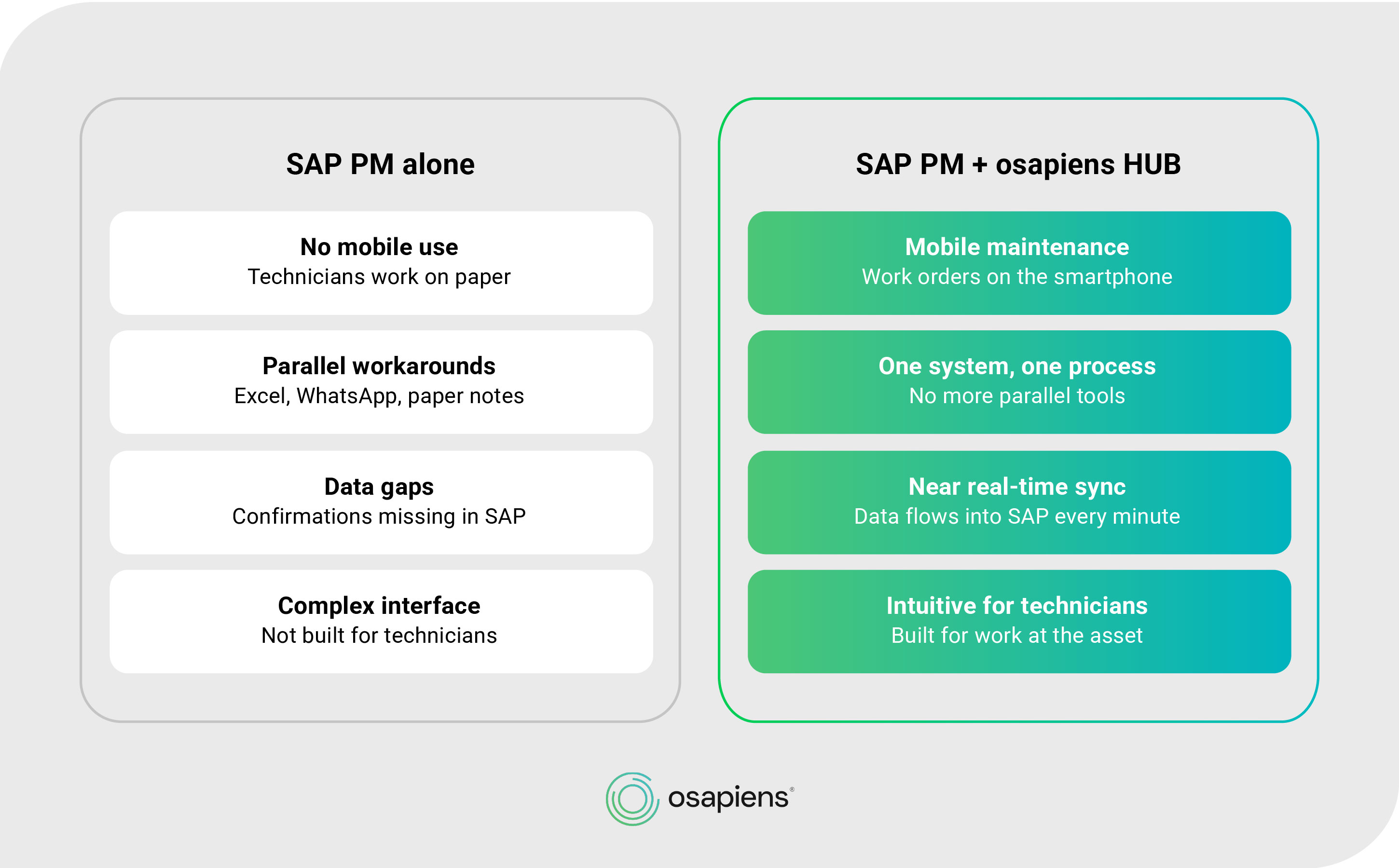
osapiens HUB for Maintenance works fully standalone, with typical implementation in 1 to 3 weeks, or with bidirectional SAP integration, typically implemented in 4 to 12 weeks, considerably faster than a classic enterprise rollout and without a dedicated IT project team.
Multi-site food and beverage producers already run maintenance this way: Coca-Cola North America runs osapiens HUB for Maintenance across 35 plants with 1,500 users, and Puratos has standardized maintenance across 65 production sites on the same SAP-integrated platform.
Conclusion: Audit-Ready CMMS Software for Food and Beverage with osapiens HUB
The right CMMS software for food and beverage manufacturing turns HACCP, IFS, BRC, and ATEX requirements into a byproduct of everyday maintenance work, with no separate compliance project bolted on afterward. osapiens HUB for Maintenance brings Smart Forms, time-stamped records, and calibration plans directly into the technician’s daily workflow, so the next unannounced audit finds evidence instead of paperwork. Producers like Coca-Cola North America and Puratos already run maintenance this way across more than 100 plants. See what that looks like for your own production lines.
FAQ
How does a CMMS support HACCP compliance for food and beverage manufacturers?
A CMMS does not replace a HACCP plan. It produces the evidence a HACCP plan depends on: calibration records for the instruments monitoring your critical control points, time-stamped maintenance history, and documented corrective action when a check fails. Auditors check the maintenance record against the HACCP plan, and a CMMS keeps that record complete and consistent.
Is ATEX compliance relevant for food and beverage plants that handle flour, sugar, or grain?
Yes. Flour, sugar, starch, and grain dust can form explosive atmospheres under the right conditions. In the EU, Directive 1999/92/EC requires the operator to assess these risks and classify affected areas, such as a silo interior or the area around a flour conveyor, into zones. Directive 2014/34/EU sets the requirements for equipment used in those zones. Plants outside the EU should check the equivalent local rules, but the combustible dust risk applies wherever these materials are handled.
Can a CMMS help food and beverage plants prepare for IFS, BRC, or FSSC 22000 audits?
Yes. These certification schemes audit HACCP-based food safety programs, and maintenance documentation (calibration records, sanitation sign-off, corrective-action history) is one of the areas they check most closely. A CMMS with time-stamped records and traceable changes makes it easy to prove that each entry was made at the right time, which is much harder with paper logs or shared spreadsheets.
Does a food and beverage CMMS need to run on top of SAP?
No. osapiens HUB for Maintenance works fully standalone, including in plants with no SAP system. Plants that already run SAP can connect it through a SAP-certified integration, with work orders and documentation flowing in both directions.
How long does it take to implement a CMMS in a food or beverage production plant?
It depends on whether the plant integrates with SAP. A standalone deployment of osapiens HUB for Maintenance typically takes 1 to 3 weeks. A deployment with bidirectional SAP integration typically takes 4 to 12 weeks, and the one-time SAP configuration costs considerably less than a complex consulting project.
Start using osapiens for free
Improve your uptime, extend the life of your equipment, and simplify work order management.
Book a demo
ENTERPRISE CAPABILITIES
- SAP ECC & S/4HANA Certified
- Infor & MS Dynamics
- Microsoft Entra ID / Okta
- ISO 27001 & 9001
- EU Cloud · Data Sovereignty
- Development, Test, and Production Environments
- Multi-Entity & Multi-Site
- Power BI Integration
- Audit Trail & Compliance
Related content
January 1, 2026
Hydraulic Press Maintenance Checklist – Tasks, Tips & Best Practices
January 1, 2026
Milling Machine Maintenance Checklist – Tasks, Best Practices & Digital Execution
August 19, 2025
Version 3.17: The Next-Gen Cockpit for Your Maintenance
January 1, 2026
Chiller Maintenance Checklist – Tasks, Best Practices & Digital Execution
January 1, 2026
Commercial Building Maintenance Checklist – Tasks, Systems & Digital Execution
January 1, 2026
Industrial Mixer Maintenance Checklist – Tasks, Tips & Template
January 1, 2026
Construction Equipment Maintenance Checklist – Tasks, Tips & Template

January 15, 2026
IBM Maximo Alternatives: The Best EAM & CMMS Platforms Compared
January 1, 2026
Wind Turbine Maintenance Checklist – Tasks, Components & Digital Execution
January 1, 2026
Electrical Substation Maintenance Checklist – Tasks, Safety & Digital Execution
January 1, 2026
Laboratory Equipment Maintenance Checklist – Tasks, Best Practices & Digital Solution
January 1, 2026