

CMMS

Florian Bartholomäus, osapiens Expert | 11. June 2026 | Lesezeit 12 min.
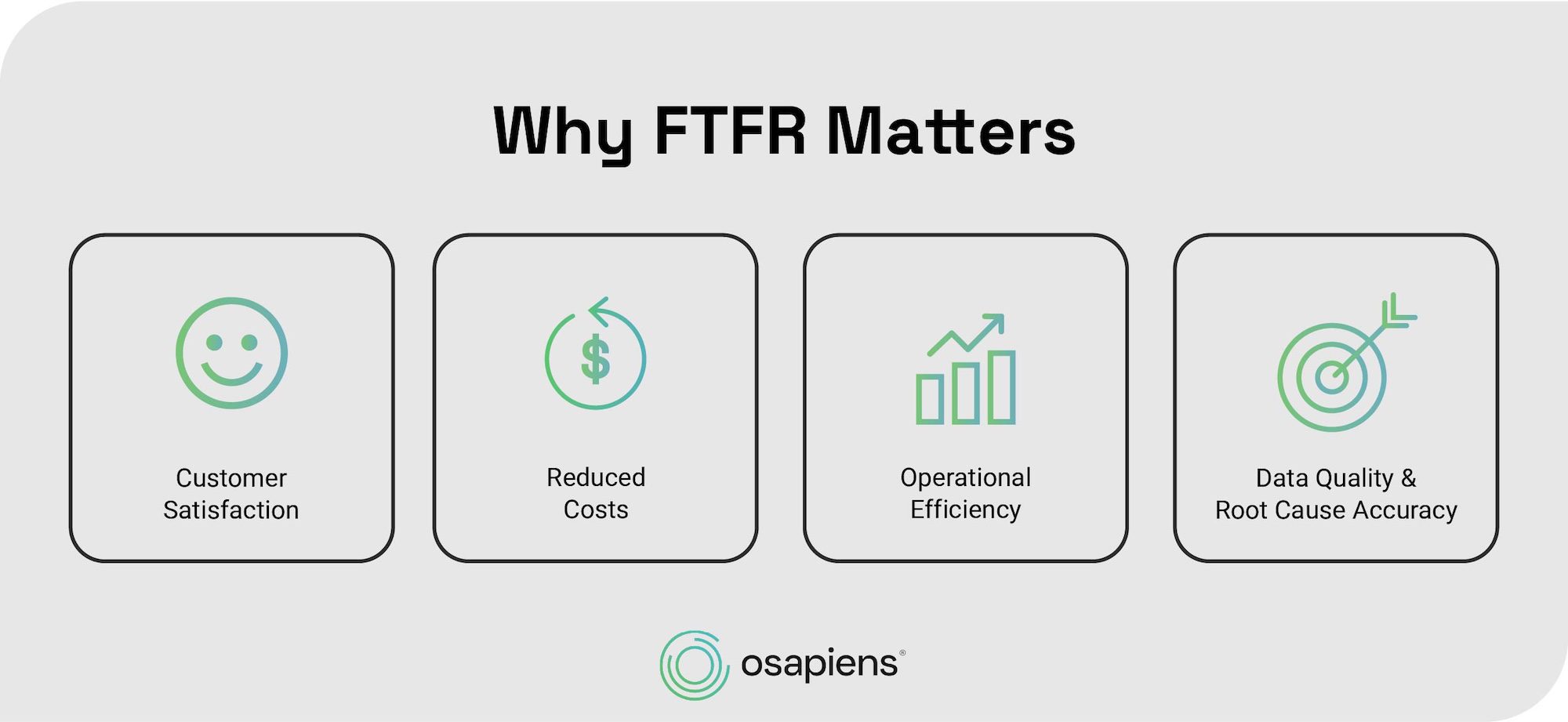
When analyzing repeat visit data, segment failures by root cause category, specifically parts unavailability, skill mismatch, and incomplete job information, rather than reviewing aggregate FTFR alone. This segmentation reveals which process lever to prioritize and prevents generic improvement efforts that address symptoms instead of causes. The osapiens HUB for Maintenance captures this failure-mode data automatically within the work order lifecycle, making structured root cause analysis a byproduct of daily operations.
Improve first time fix rates










TRUSTED BY LEADING COMPANIES




ENTERPRISE-READY
 SAP Certification
 ISO 27001
 EU Hosting
 Entra ID & Okta
 Multi-Entity
A technician arrives at a production line, diagnoses the fault, and then walks back to the storeroom because the required coupling is out of stock. Forty minutes later, the repair finally begins. That scenario plays out in plants every day, and it is not a technician problem. It is a planning problem. First time fix rate (FTFR) is the metric that makes this kind of systemic failure visible, and the osapiens HUB for Maintenance is built specifically to eliminate its root causes.
Key Facts
- Industry average FTFR is around 75–80%: Meaning one in four or five jobs requires a repeat visit, with each additional dispatch costing an estimated 200€–300€ in direct costs alone.
- Parts unavailability causes 51% of repeat visits: According to Aberdeen Group research, the majority of failed first fixes trace back to missing or incorrect parts at the job site, not technician skill gaps.
- Most organizations cannot measure what they cannot see: A joint osapiens and Fraunhofer IML study found that only 40% of organizations use dashboards to track maintenance KPIs, making FTFR invisible in the majority of operations.
- The osapiens HUB for Maintenance addresses all three root causes simultaneously: Integrated spare parts visibility, skill-based job assignment, and guided digital work orders with mandatory completion steps ensure technicians arrive prepared and close jobs correctly the first time.
What Is First Time Fix Rate and Why Does It Matter?
First time fix rate measures the percentage of maintenance jobs resolved completely on the initial visit, without a return trip, a secondary parts order, or a reopened work order. For maintenance managers, it is one of the clearest signals of how well the operation is actually set up before a technician leaves the depot.
What makes FTFR a particularly valuable KPI is that it reflects the entire pre-dispatch process at once: fault diagnosis, parts staging, technician qualification, and information access. A low rate rarely points to one problem. It points to a system that is not connected.
Best-in-class organizations achieve FTFR rates between 88% and 98%, while the industry average sits closer to 75–80%. Lower-performing operations fall below 63%. At 75%, one in four jobs fails on the first attempt. Each failure generates an average of 1.6 additional visits before the issue is closed. For a plant running 400 work orders per month, that translates to roughly 100 repeat dispatches and over 20.000€ in direct additional costs.
FTFR Benchmarks by Performance Tier
| Performance Tier | Typical FTFR Range | Operational Implication |
|---|---|---|
| Best-in-class | 88–98% | Structured processes, integrated parts and data |
| Industry average | 75–80% | Significant repeat visit cost and technician capacity loss |
| Low-performing | Below 63% | Systemic planning failures, adverse impact on asset uptime and SLA compliance |
Low FTFR Is a Systems Problem, Not a People Problem
The instinct when FTFR drops is to look at technician performance. The data points elsewhere. Aberdeen Group research identifies three leading causes of repeat visits:
- Insufficient or incorrect parts on site: responsible for 51% of failed first fixes
- Technician lacking the right skills or experience for the specific job: 25% of cases
- Insufficient time allocated to complete the work: 13% of cases
Parts availability alone accounts for more than half of all failures. That is a procurement and inventory visibility problem, not a skills problem.
This systemic framing matters because it changes where improvement efforts should be directed.
“In many companies, skilled technicians are celebrated for fixing tough problems under pressure. This dedication is admirable but reflects a culture that rewards firefighting over prevention.”
Dr. Thomas Heller, Head of Department Facilities and Service Management at Fraunhofer IML
The “Maintenance in Transition” study from osapiens and Fraunhofer IML, conducted across 407 maintenance decision-makers in the UK and Europe, found that 59% of organizations still execute maintenance tasks using spreadsheets and 41% rely on paper-based checklists.
When technicians are dispatched without access to asset history, real-time parts availability, or structured work instructions, repeat visits are structurally inevitable.
FTFR is not a performance gap. It is a tooling gap.
7 Strategies to Improve First Time Fix Rate
Each of the following strategies addresses one or more of the root causes identified above. The most effective approach is to implement them as a connected system, not as isolated process changes.
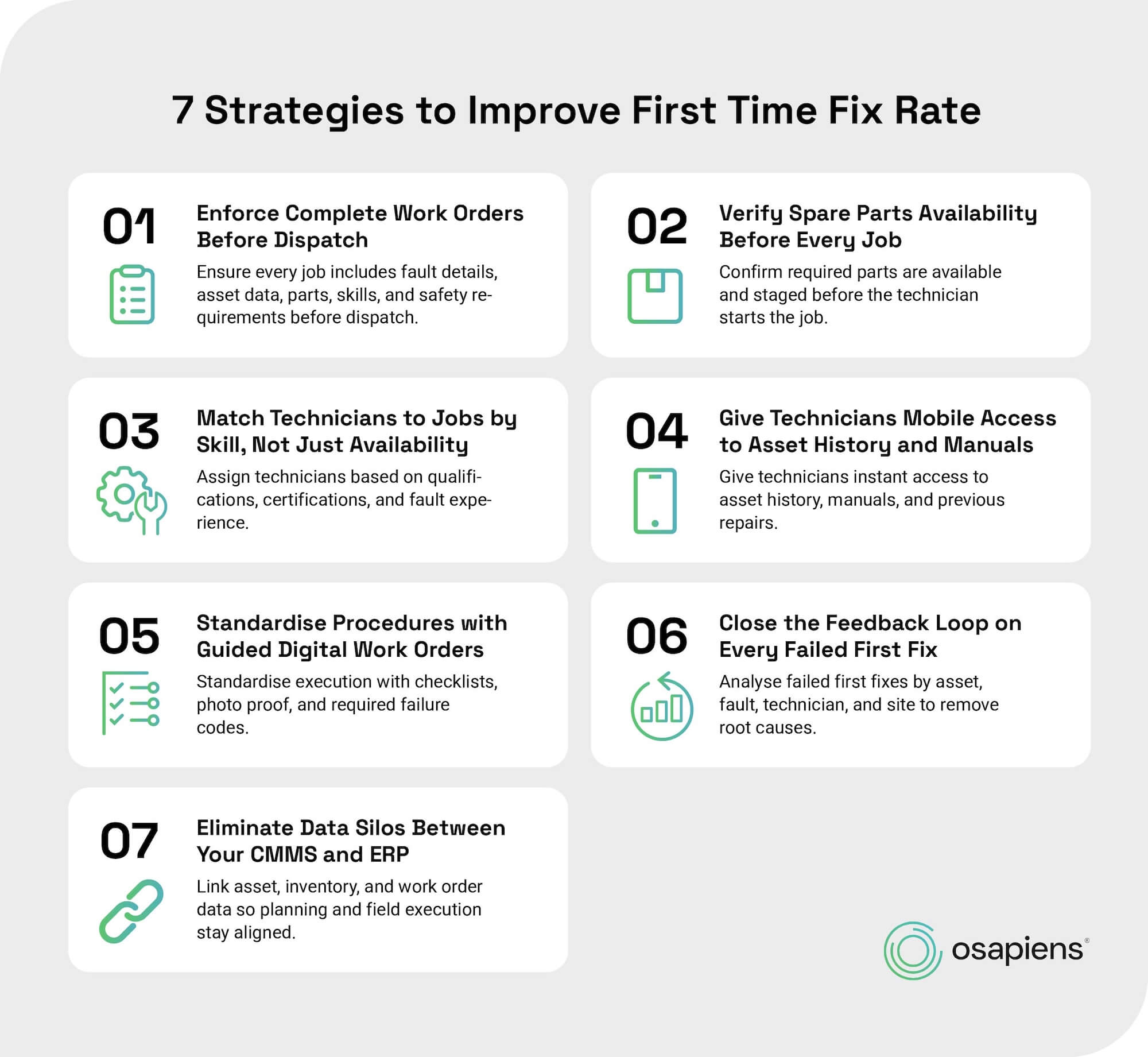
1. Enforce Complete Work Orders Before Dispatch
Every work order sent to a technician should include a clear fault description, the asset ID and location, required parts with stock confirmation, required skill level, and any applicable safety permits. Work orders missing these fields should be returned for completion before a technician is dispatched. Incomplete job information is a primary driver of on-site improvisation, which leads directly to missed steps and return visits.
The osapiens HUB enforces this discipline through mandatory field configuration at the work order level. Planners cannot release a work order for dispatch until all required fields are completed, which removes the most common source of incomplete job preparation before it reaches the technician.
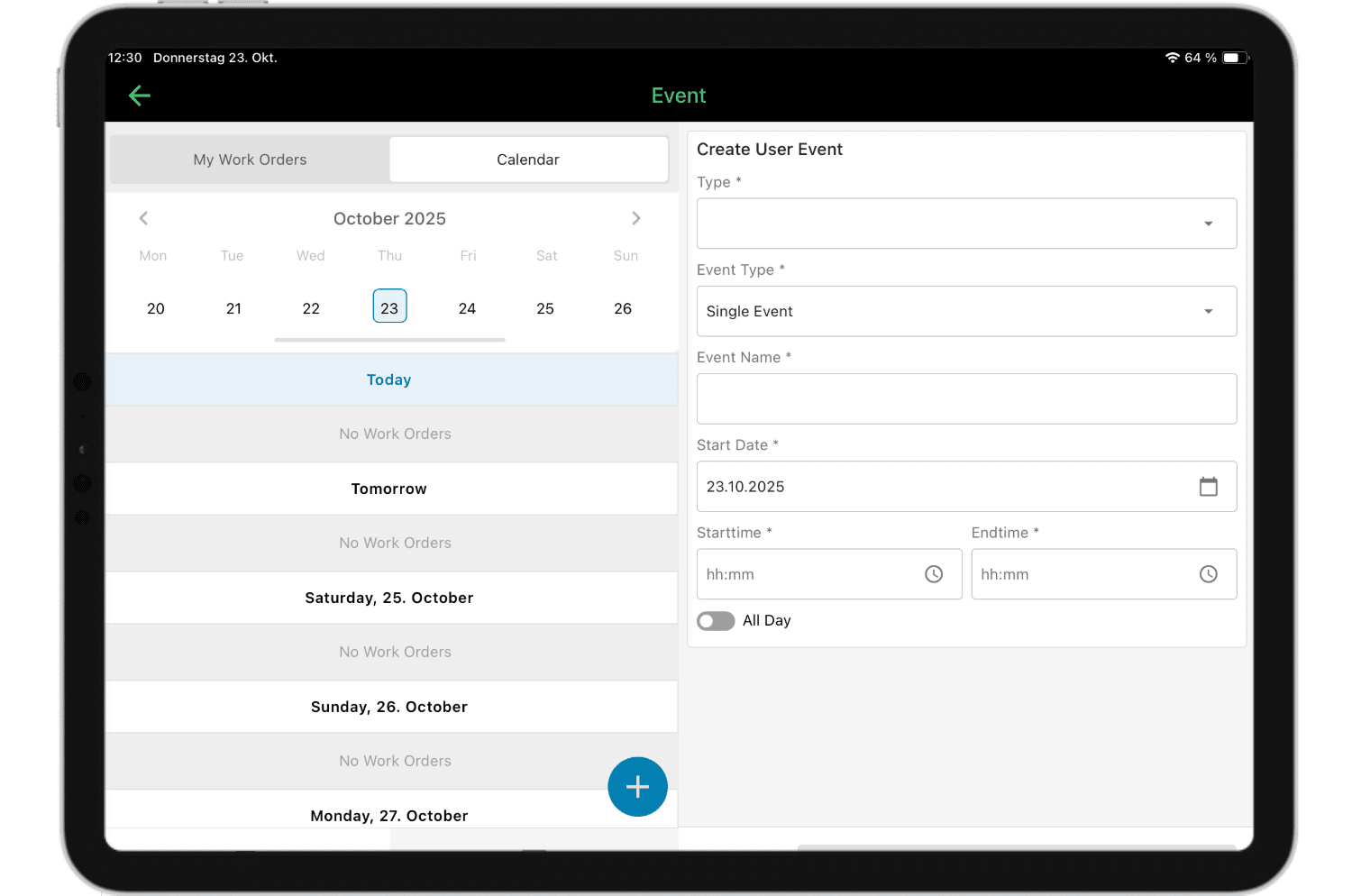
If you want to see how a complete work order should be structured before going digital, our free Excel work order template covers exactly these fields, including order number, asset ID, technician assignment, scope of work, and a PPE and safety checklist. A practical reference for teams formalizing their process today. Download it now.
2. Verify Spare Parts Availability Before Every Job
Parts unavailability at the job site is the single largest cause of failed first fixes. Before a technician leaves for a job, the system should confirm that every required part is in stock and, where applicable, physically staged.
In the osapiens HUB, required parts are linked directly to the work order. Planners see current stock levels at the point of job preparation, not after dispatch. This prevents the classic scenario where a technician diagnoses the fault correctly but cannot complete the repair because a part turns out to be out of stock, and a second visit is already inevitable.

3. Match Technicians to Jobs by Skill, Not Just Availability
Sending the nearest available technician to a complex fault they are not qualified to resolve guarantees a repeat visit.
The osapiens HUB allows planners to store skill profiles and certifications at the technician level. When assigning a work order manually, dispatchers can match the job requirements against the technician’s qualification profile before confirming the assignment. The result is fewer mismatches at dispatch and fewer repeat visits caused by the wrong person arriving at the right asset.
4. Give Technicians Mobile Access to Asset History and Manuals
A technician arriving at an asset without its service history is starting from scratch. Access to previous fault codes, repair records, installed components, and OEM documentation on a mobile device changes the diagnostic starting point entirely. Mobile-first CMMS with offline functionality ensures this access holds even in areas with poor connectivity, which is a practical reality in many plant environments and at distributed field sites.
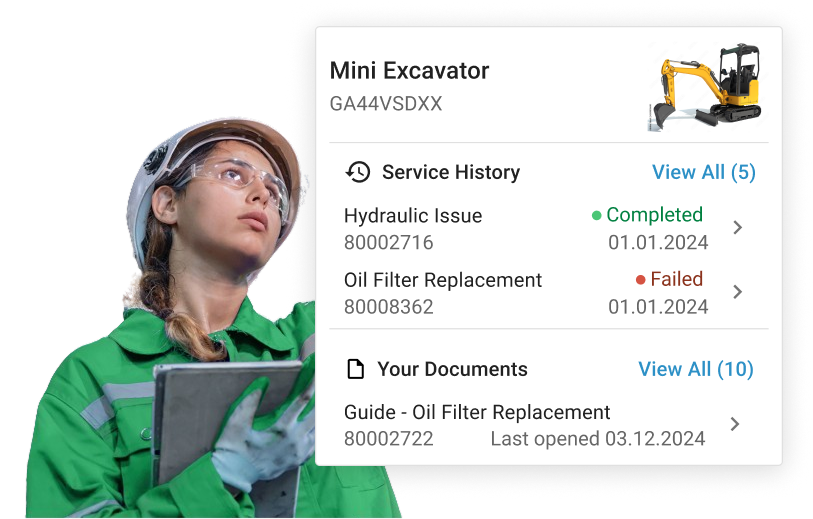
Nordex Group, which manages more than 11.400 wind turbines globally using the osapiens HUB for Maintenance, identified mobile access and ERP integration as the two operational priorities that make daily technician dispatch viable at that scale.

Alberto Ecre, Group Lead Service Digitalization Department
★ ★ ★ ★ ★Nordex
“We were looking for a cloud platform solution that supports all of our regions. Our technicians have to visit the wind turbines every day to fix problems—we need stable solutions that make their work easier. The key was the very simple integration with our ERP system. Now we are gradually expanding: subcontractor management, tool management, and more.”
5. Standardise Procedures with Guided Digital Work Orders
Guided digital work orders with mandatory checklist steps, required photo uploads, and enforced failure code entry do two things simultaneously. They prevent technicians from skipping steps under time pressure, and they ensure that a completed job is genuinely complete rather than administratively closed. This proof of repair principle is what separates a high FTFR from an inflated one.

Preventive maintenance workflows built around structured digital procedures also reduce the variance between technicians, which matters particularly in multi-site operations where consistency is difficult to maintain manually.
6. Close the Feedback Loop on Every Failed First Fix
Most maintenance teams know their FTFR is lower than it should be. Fewer know exactly why. Without structured data capture at the work order level, repeat visit patterns stay invisible, and improvement efforts remain reactive rather than targeted.
The osapiens HUB surfaces FTFR alongside companion KPIs such as Mean Time to Repair, Repeat Visit Rate, and Parts Fill Rate in configurable dashboards. Segmenting repeat visit data by asset type, fault category, technician, and site reveals the patterns that generic averages conceal. A specific machine may account for a disproportionate share of repeat visits. A particular fault type may consistently expose a parts stocking gap. This makes FTFR improvement an operational discipline rather than a quarterly reporting exercise.
7. Eliminate Data Silos Between Your CMMS and ERP
For organizations running SAP PM or S/4HANA, one of the most common and least visible causes of low FTFR is the gap between back-office planning data and field execution. When asset master data, parts inventory, and work order status are locked in SAP while technicians work from printed sheets or disconnected mobile apps, the information technicians need to succeed the first time simply does not reach them.
SAP-certified CMMS integration with bidirectional data sync closes this gap. Work orders created in SAP flow directly to the technician’s mobile device, and parts consumption, completion status, and fault codes flow back to SAP in real time, without manual re-entry. This is the integration architecture that enterprise customers including Coca-Cola North America, with 35 plants and 1.500 users, rely on through the osapiens HUB for Maintenance.
First Time Fix Rate by Industry: Where the Stakes Differ
The financial and operational consequences of a failed first fix vary significantly by sector, and the right improvement priorities reflect those differences.
Manufacturing
In manufacturing, FTFR has a direct relationship with Overall Equipment Effectiveness (OEE). A single repeat visit on a bottleneck production line can cascade into hours of lost throughput. The priority is parts integration and guided work orders that prevent improvised repairs that pass a visual check but fail under load within hours.
The osapiens HUB connects parts availability, asset history, and work order execution in one platform, giving production maintenance teams the foundation to resolve faults completely the first time.
Pharmaceutical and Life Sciences
In pharmaceutical and life sciences production, the compliance dimension adds a second layer of urgency. Maintenance in GMP-regulated environments must follow validated procedures exactly, and every repair must be traceable. A repeat visit does not just cost time; it creates an audit trail complication that can trigger a deviation investigation. Structured digital work orders with mandatory completion evidence are both a FTFR lever and a compliance requirement.
The osapiens HUB supports GxP-compliant documentation with enforced checklists, required photo uploads, and full work order traceability.
Utilities
In utilities and distributed asset environments, travel cost is the multiplier. A repeat visit to a remote wind turbine or a substation involves not just a second labor hour but a second full-day dispatch. this scale, the priority shifts from individual job preparation to portfolio-level visibility: understanding which asset types, locations, or fault categories drive the highest repeat visit rates.
The osapiens HUB gives utilities operators configurable dashboards to track FTFR by site and asset class, identify recurring fault patterns, and adjust parts stocking and technician qualification accordingly.
Improving Your FTFR with the osapiens HUB
The osapiens HUB for Maintenance is built around the three root causes that Aberdeen Group identified as driving the majority of repeat visits: parts unavailability, skill mismatches, and information gaps at the point of execution. Each is addressed through specific platform capabilities that work together rather than as isolated features.
- Integrated spare parts and inventory management links stock levels directly to work orders, so dispatchers confirm parts availability before a technician leaves
- Guided work orders with mandatory checklist steps, photo requirements, and failure code fields prevent jobs from being closed without evidence of completion
- Skill-based job assignment surfaces technician qualifications alongside work order requirements, so planners match the right person to each fault type
- Mobile-first interface with offline functionality ensures technicians have access to asset history, OEM documentation, and real-time work order data regardless of connectivity conditions
For organizations running SAP PM or SAP S/4HANA, the osapiens HUB for Maintenance provides a SAP-certified bidirectional integration that synchronizes work orders, parts consumption, asset data, and completion status between SAP and the field in real time. This eliminates the information silo that causes technicians in SAP-centric environments to arrive on-site without the data they need.
FAQ
What is a good first time fix rate for industrial maintenance?
Best-in-class organizations achieve FTFR rates between 88% and 98%, while the industry average sits around 75–80%. A FTFR below 70% is associated with measurable adverse effects on asset uptime, SLA compliance, and customer retention, according to Aberdeen Group research. The right target depends on industry context, asset criticality, and current baseline, but any operation below 80% has significant room for structured improvement.
How do we start tracking FTFR if we have no current measurement in place?
Begin at the work order level by adding a “resolved on first visit” flag to every closed work order, either manually or through a CMMS field. Once you have 4–6 weeks of data, segment it by asset type, fault category, and technician to identify where repeat visits are concentrated. The osapiens HUB for Maintenance captures this data automatically as part of the work order lifecycle, making FTFR reporting a byproduct of normal operations rather than a separate tracking exercise.
Can FTFR be improved without replacing our existing SAP environment?
Yes. The osapiens HUB for Maintenance operates as a mobile execution and planning layer on top of SAP PM or S/4HANA, using a SAP-certified bidirectional connector. Asset master data, work orders, and parts inventory remain in SAP, while technicians interact through an intuitive mobile interface. This approach avoids SAP replacement and typically delivers faster time to value than a full EAM migration, with implementation timelines of 1–3 months including SAP integration.
Why does improving FTFR matter more than just reducing MTTR?
Mean Time to Repair (MTTR) and FTFR measure different things. A team can achieve a low MTTR by closing jobs quickly while still returning repeatedly to the same asset. FTFR measures whether the repair was genuinely complete the first time. A short repair that fails within hours is operationally worse than a longer repair that holds for years. Tracking both KPIs together provides a complete picture of execution quality and is the approach recommended for any maintenance operation targeting sustainable uptime improvement.
Start using osapiens for free
Improve your uptime, extend the life of your equipment, and simplify work order management.
Book a demo
ENTERPRISE CAPABILITIES
- SAP ECC & S/4HANA Certified
- Infor & MS Dynamics
- Microsoft Entra ID / Okta
- ISO 27001 & 9001
- EU Cloud · Data Sovereignty
- Development, Test, and Production Environments
- Multi-Entity & Multi-Site
- Power BI Integration
- Audit Trail & Compliance
Related content
July 22, 2025
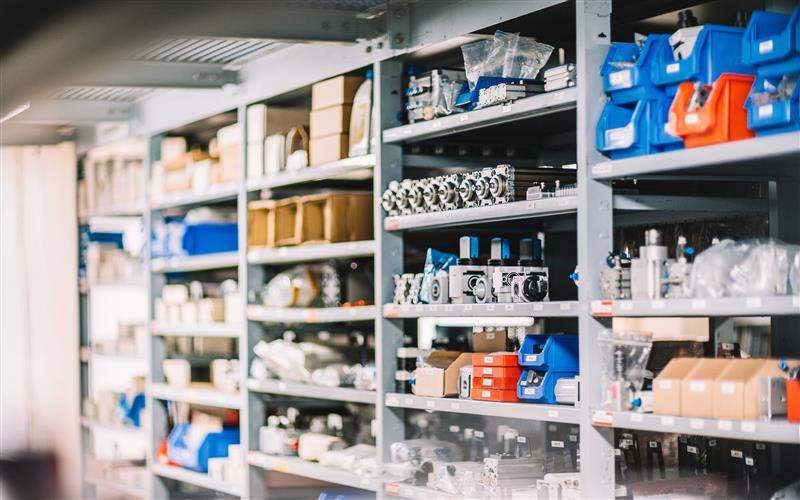
osapiens HUB for Maintenance: Blueprint for Spare Parts Management
January 1, 2026
Lyophilizer Maintenance Checklist – Tasks, Tips & Template

April 7, 2026
Enterprise CMMS Software: Top 5 CMMS Solutions 2026
March 24, 2026
Multi-Site CMMS Software: How to Choose the Right Platform and Roll It Out Across Every Site

June 25, 2025
What is a CMMS? A Guide to Modern Maintenance Software
January 1, 2026
Surface Grinding Machine Maintenance Checklist – Tasks, Tips & Template
January 1, 2026
Press Machine Maintenance Checklist – Tasks, Tips & Template

January 12, 2026
SAP S/4HANA Migration: Complete Guide for a Successful ERP Transition in 2026
January 1, 2026
Material Handling Equipment Maintenance Checklist: Tasks, Intervals & Digital Execution
January 1, 2026
Boiler Maintenance Checklist – Tasks, Tips & Template
January 1, 2026
Welding Machine Maintenance Checklist – What to Inspect, When & How
April 17, 2025