

Maintenance Checklist

Florian Bartholomäus, osapiens Expert | 1. January 2026 | Lesezeit 9 min.
Most pneumatic failures start small—a minor air leak today becomes a pressure drop crisis by week's end. Catching issues early through systematic inspection prevents the cascading failures that shut down production lines.
Create your checklist for free











TRUSTED BY LEADING COMPANIES




ENTERPRISE-READY
 SAP Certification
 ISO 27001
 EU Hosting
 Entra ID & Okta
 Multi-Entity
Table of Contents
- Pneumatic System Maintenance: Key Facts
- Why You Need a Pneumatic System Maintenance Checklist
- What to Include in Your Pneumatic System Maintenance Checklist
- Common Pneumatic System Problems Your Maintenance Checklist Prevents
- From Paper Checklist to Digital: How the osapiens HUB Automates Your Pneumatic System Maintenance Checklist
- FAQ
Pneumatic systems power critical operations across manufacturing, utilities, and facility management—yet they remain among the most under-maintained industrial assets. Without structured preventive maintenance, small problems like air leaks, moisture accumulation, and seal wear cascade into production-stopping failures. A systematic pneumatic system maintenance checklist transforms reactive repairs into proactive care, reducing unplanned downtime and extending equipment lifespan through consistent, documented inspection and servicing.
Pneumatic System Maintenance: Key Facts
- Structured maintenance reduces failures: Organizations implementing systematic pneumatic maintenance checklists experience fewer emergency breakdowns and improved equipment reliability through early detection of degradation.
- Air leaks waste significant energy: Studies show that between 20–30% of compressed air in poorly maintained systems is lost to leaks, increasing operating costs and reducing actuator performance.
- Documentation ensures compliance: Complete maintenance records prove due diligence during audits and provide traceability required by safety regulations and quality management standards.
- Digital execution improves consistency: Mobile-first CMMS platforms like osapiens HUB for Maintenance eliminate paper-based friction, enforce complete data capture, and create audit-ready documentation automatically.
Why You Need a Pneumatic System Maintenance Checklist
Pneumatic equipment operates reliably when properly maintained—but degrades predictably when maintenance becomes inconsistent or reactive. A structured checklist ensures critical tasks occur systematically rather than depending on technician memory or experience.
- Consistency across teams: Standardized checklists ensure every technician performs the same inspections and adjustments, eliminating variability that leads to missed problems or incomplete work.
- Risk reduction through early detection: Systematic inspection catches degradation before catastrophic failure—a seal showing early wear gets replaced during planned maintenance rather than failing mid-production.
- Documentation and traceability: Recorded inspections create evidence of maintenance activities, supporting regulatory compliance and providing historical data for maintenance audits and failure investigations.
- Technician guidance and training: Detailed checklists support less experienced team members by documenting required steps, acceptance criteria, and safety procedures for each maintenance task.
- Standardization across sites: Multi-site organizations use checklists to ensure consistent maintenance quality regardless of location, shift, or individual technician assigned to the work.
- Compliance support: Structured checklists help meet regulatory requirements and internal audit standards by documenting that maintenance was performed according to specifications and safety guidelines.
What to Include in Your Pneumatic System Maintenance Checklist
An effective pneumatic system maintenance checklist organizes tasks by component and system rather than arbitrary time intervals. This component-focused structure ensures every critical subsystem receives appropriate attention based on its function and failure modes.
Actual maintenance intervals depend on usage intensity, environmental conditions, and manufacturer recommendations. Equipment operating in high-humidity environments or harsh conditions requires more frequent inspection than systems in controlled facilities. The checklist below provides a framework; customize frequencies based on your operational context and historical failure data.
| Component / System | Inspection & Maintenance Tasks | Purpose |
|---|---|---|
| Air Compressor | Check oil level and quality, inspect air intake filters, verify operating temperature, drain condensate from receiver tank, test pressure relief valves | Ensures reliable compressed air supply, prevents contamination, maintains safety systems |
| Air Treatment (Filters & Dryers) | Inspect filter bowls for moisture accumulation, replace filter elements when saturated, verify dryer operation and dew point, clean or replace desiccant media | Removes moisture and contaminants that cause corrosion and component wear |
| Pressure Regulators | Verify pressure settings against specifications, check for air leaks at vent holes, inspect diaphragm condition, test pressure adjustment response | Maintains correct operating pressure, prevents over-pressurization damage |
| Pneumatic Cylinders & Actuators | Inspect rod seals for leakage, verify full stroke completion, check mounting alignment, lubricate pivot points and rod surfaces, test cushion adjustment | Ensures smooth actuation, prevents seal failure and internal leakage |
| Valves & Control Components | Test valve shifting and response, inspect for air leaks at exhaust ports, verify solenoid operation, clean valve bodies of debris | Maintains precise control, prevents sticking and erratic operation |
| Distribution Lines & Connections | Perform leak detection using soap solution or ultrasonic equipment, inspect hoses for cracks and wear, tighten loose fittings, verify proper routing and support | Eliminates energy waste from leaks, prevents pressure loss affecting downstream equipment |
| Lubrication Systems | Check oil mist lubricator reservoir levels, verify lubricant viscosity and type, adjust oil feed rate, inspect for proper oil distribution | Protects seals and moving parts from friction and premature wear |
| Safety & Instrumentation | Test emergency shutoff mechanisms, verify pressure gauge accuracy, inspect safety relief valves, check pressure switch operation | Ensures personnel safety and prevents equipment damage from over-pressure conditions |
Turn Your Pneumatic System Maintenance Checklist into Digital Work Orders
Create structured checklists for every component—from compressors to cylinders to air treatment systems. Execute them on mobile devices, sync with SAP PM, and maintain complete audit trails automatically.Start with Your Pneumatic System Maintenance Checklist
Common Pneumatic System Problems Your Maintenance Checklist Prevents
Structured maintenance checklists address the predictable failure patterns that create unplanned downtime and safety risks in pneumatic systems. Understanding these failure modes clarifies why specific inspection tasks matter.
- Air leaks and pressure loss: Leaks at fittings, worn seals, and loose connections waste compressed air and reduce system pressure. Regular leak detection and seal inspection catch these issues before they compromise actuator performance or force compressors to run continuously.
- Moisture contamination and corrosion: Water vapor condenses in distribution lines and storage tanks, causing rust formation and microbial growth. Daily condensate drainage and filter bowl inspection prevent moisture accumulation that degrades components and contaminates downstream equipment.
- Seal failure and internal leakage: Inadequate lubrication, contamination, and age-related degradation cause seals to fail, creating internal air bypass that reduces actuator force. Systematic lubrication and seal inspection extend seal life and prevent sudden failures during production.
- Cylinder sticking and sluggish actuation: Debris accumulation, corrosion, and inadequate lubrication cause cylinders to bind or move slowly. Regular cleaning, proper lubrication, and inspection of cylinder bores maintain smooth operation and prevent complete immobilization.
- Filter clogging and restricted airflow: Particulates and moisture saturate filter elements, creating pressure drops that affect system performance. Scheduled filter replacement based on visual inspection and pressure differential measurements maintains proper airflow and protects downstream components.
- Regulator failure and pressure fluctuations: Worn diaphragms and failed seals in pressure regulators cause inconsistent pressure or complete loss of pressure control. Inspection of regulator vent holes for continuous air leaks enables early detection and scheduled replacement before catastrophic failure.
From Paper Checklist to Digital: How the osapiens HUB Automates Your Pneumatic System Maintenance Checklist
Paper checklists, Excel spreadsheets, and manual documentation create friction that undermines maintenance consistency. Technicians working in the field must record observations by hand, then transcribe notes into office systems—creating delays, transcription errors, and incomplete records that compromise audit readiness.
Media breaks between field work and documentation systems mean supervisors lack real-time visibility into work progress. A technician discovering a problem during inspection cannot immediately access historical records, order replacement parts, or notify supervisors—forcing improvised repairs or deferred maintenance that accumulates uncontrolled.
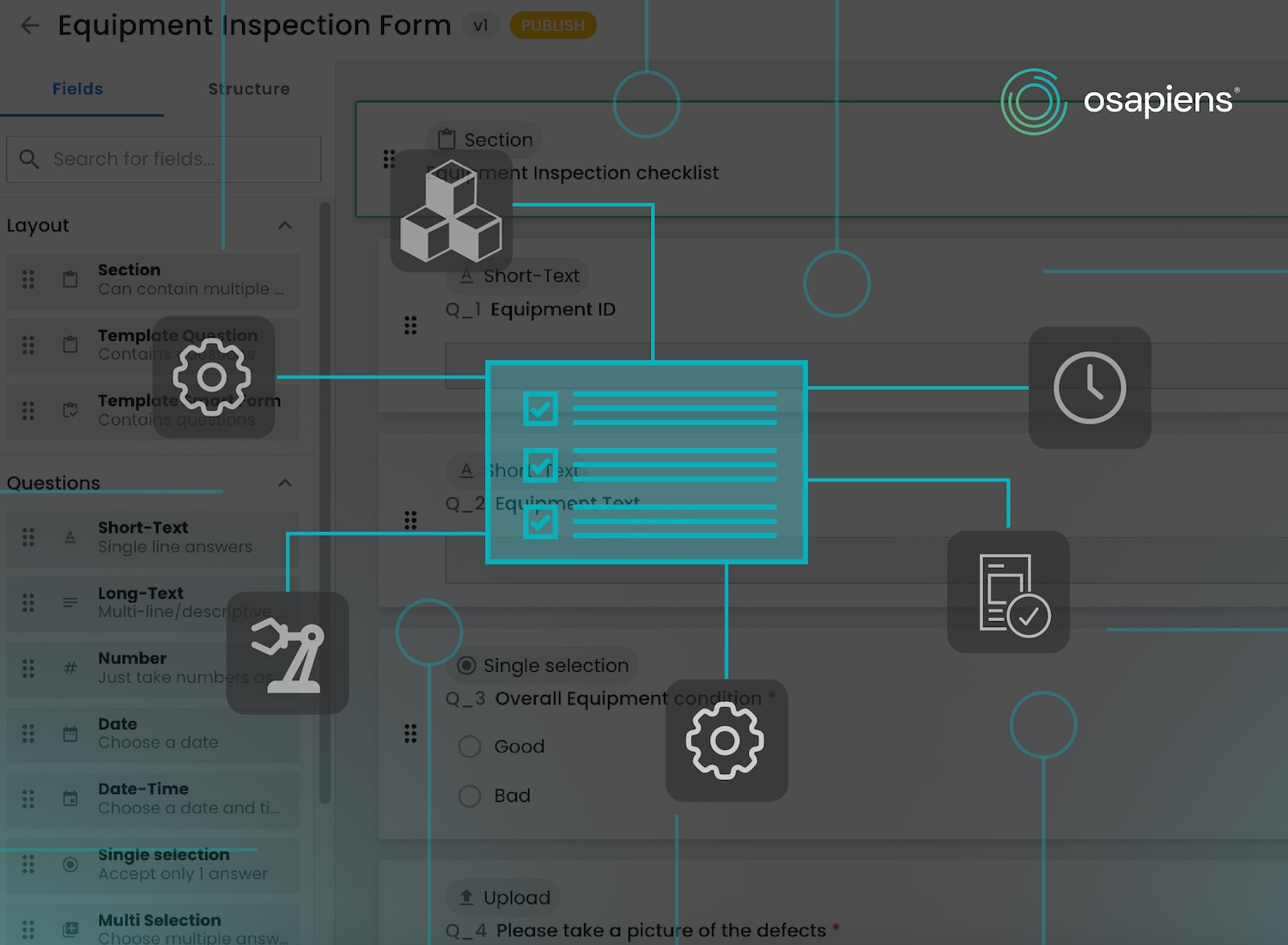
The osapiens HUB for Maintenance transforms pneumatic system maintenance through mobile-first execution and real-time data capture. Technicians access digital checklists directly on smartphones or tablets, complete inspections in the field, and capture photos documenting equipment condition—all synchronized immediately to centralized systems.
Key capabilities supporting pneumatic maintenance:
- Mobile checklist execution: Technicians complete structured inspection procedures on mobile devices, with mandatory fields ensuring complete data capture and embedded reference images showing correct techniques.
- Photo documentation and timestamps: Visual evidence of seal condition, leak locations, and component wear attaches directly to work orders, providing objective records for supervisors and engineers without requiring physical presence.
- SAP PM integration: Bi-directional synchronization with SAP Plant Maintenance ensures enterprise systems remain updated while technicians work in user-friendly mobile interfaces designed for field execution rather than office data entry.
- Automated work order generation: Preventive maintenance schedules automatically create inspection work orders based on calendar intervals, operating hours, or condition thresholds—eliminating manual scheduling and ensuring consistent maintenance timing.
- Audit-ready documentation: Complete maintenance history, timestamped activities, and technician signatures create compliance evidence required for regulatory audits and quality management certifications like ISO 9001.
| Aspect | Paper or Excel Checklist | Digital Checklist with osapiens HUB |
|---|---|---|
| Field Accessibility | Technicians carry printed checklists that get damaged, lost, or left in offices | Mobile access on smartphones/tablets with offline capability for areas without connectivity |
| Data Completeness | Incomplete notes, illegible handwriting, missing observations due to rushed work | Mandatory fields enforce complete data capture; conditional logic guides technicians through required steps |
| Real-Time Visibility | Supervisors learn about problems hours or days later when paperwork reaches offices | Immediate notification when issues are identified; supervisors monitor work progress in real-time |
| Historical Context | Technicians cannot access previous inspection results or maintenance history during field work | Complete asset history and past work orders accessible on mobile devices at point of work |
| Documentation Quality | Manual transcription introduces errors; photos taken separately must be manually linked to records | Photos, timestamps, and observations attach directly to work orders; no transcription required |
| Audit Readiness | Scattered paper records in filing cabinets; difficult to locate specific maintenance documentation | Centralized digital records with instant search and filtering; complete audit trails automatically maintained |
Stop Losing Uptime to Pneumatic System Failures
Digitize your maintenance checklists, automate preventive work order creation, and give every technician a mobile tool that works—even offline. SAP PM integration included.Try osapiens HUB for Free
FAQ
What should be included in a pneumatic system maintenance checklist?
A comprehensive pneumatic system maintenance checklist includes air compressor inspection (oil levels, filters, condensate drainage), air treatment verification (filter replacement, dryer operation), leak detection throughout distribution lines and connections, cylinder and actuator inspection (seal condition, stroke completion, lubrication), valve testing (shifting response, exhaust port leaks), pressure regulator verification, and safety system testing (relief valves, emergency shutoffs). Customize task frequency based on equipment usage, environmental conditions, and manufacturer specifications rather than following rigid time intervals.
How often should I complete my pneumatic system maintenance checklist?
Maintenance frequency depends on usage intensity, environmental conditions, and equipment criticality. Common practice includes daily condensate drainage and visual leak checks, weekly filter bowl inspection and lubrication level verification, monthly comprehensive leak surveys and seal inspection, and quarterly or semi-annual filter element replacement and component overhaul. High-humidity environments, dusty facilities, or extended-hour operations require more frequent inspection than controlled environments with moderate usage. Base intervals on actual operating conditions and historical failure patterns rather than arbitrary schedules.
Can I customize this pneumatic system maintenance checklist template?
Customization is essential for effective maintenance. Adapt the checklist framework to your specific equipment types (rotary screw vs. reciprocating compressors), operating environment (humidity levels, temperature extremes, dust exposure), usage patterns (continuous vs. intermittent operation), and manufacturer recommendations. Digital CMMS platforms like osapiens HUB enable flexible checklist templates with equipment-specific procedures, conditional logic based on inspection findings, and adjustable frequencies that reflect actual operational needs rather than generic industry standards.
How does a digital CMMS improve maintenance checklist management?
A digital CMMS transforms checklist execution through mobile accessibility that eliminates paper-based friction, automated scheduling that generates work orders based on time or usage triggers, real-time data capture with photos and timestamps, enforced completeness through mandatory fields, and centralized documentation creating audit-ready records. Platforms with SAP PM integration maintain enterprise system synchronization while providing technician-friendly mobile interfaces. Organizations using digital checklists report improved maintenance consistency, reduced documentation time, and better visibility into equipment condition across multiple sites and shifts.
Start using osapiens for free
Improve your uptime, extend the life of your equipment, and simplify work order management.
Book a demo
ENTERPRISE CAPABILITIES
- SAP ECC & S/4HANA Certified
- Infor & MS Dynamics
- Microsoft Entra ID / Okta
- ISO 27001 & 9001
- EU Cloud · Data Sovereignty
- Development, Test, and Production Environments
- Multi-Entity & Multi-Site
- Power BI Integration
- Audit Trail & Compliance
Related content
January 1, 2026
Genset Maintenance Checklist – Tasks, Tips & Best Practices
January 1, 2026
Electric Generator Maintenance Checklist – Tasks, Tips & Best Practices
January 1, 2026
Wheel Loader Maintenance Checklist – Tasks, Tips & Template
January 1, 2026
Circuit Breaker Maintenance Checklist – Tasks, Tips & Template
January 1, 2026
Fire Suppression System Maintenance Checklist – Tasks, Compliance & Digital Execution
January 1, 2026
Die Casting Machine Maintenance Checklist – Tasks, Best Practices & Digital Execution
January 1, 2026
Chilled Water Pump Maintenance Checklist – Tasks, Tips & Template
January 1, 2026
Lorry Maintenance Checklist – Tasks, Tips & Template
January 1, 2026
Granulation Equipment Maintenance Checklist – Tasks, Tips & Best Practices
January 1, 2026
Wire EDM Machine Maintenance Checklist – Tasks, Tips & Digital Execution
January 1, 2026
Diesel Generator Set Maintenance Checklist – Tasks, Best Practices & Digital Execution
January 1, 2026